Lake Toba Supervolcano
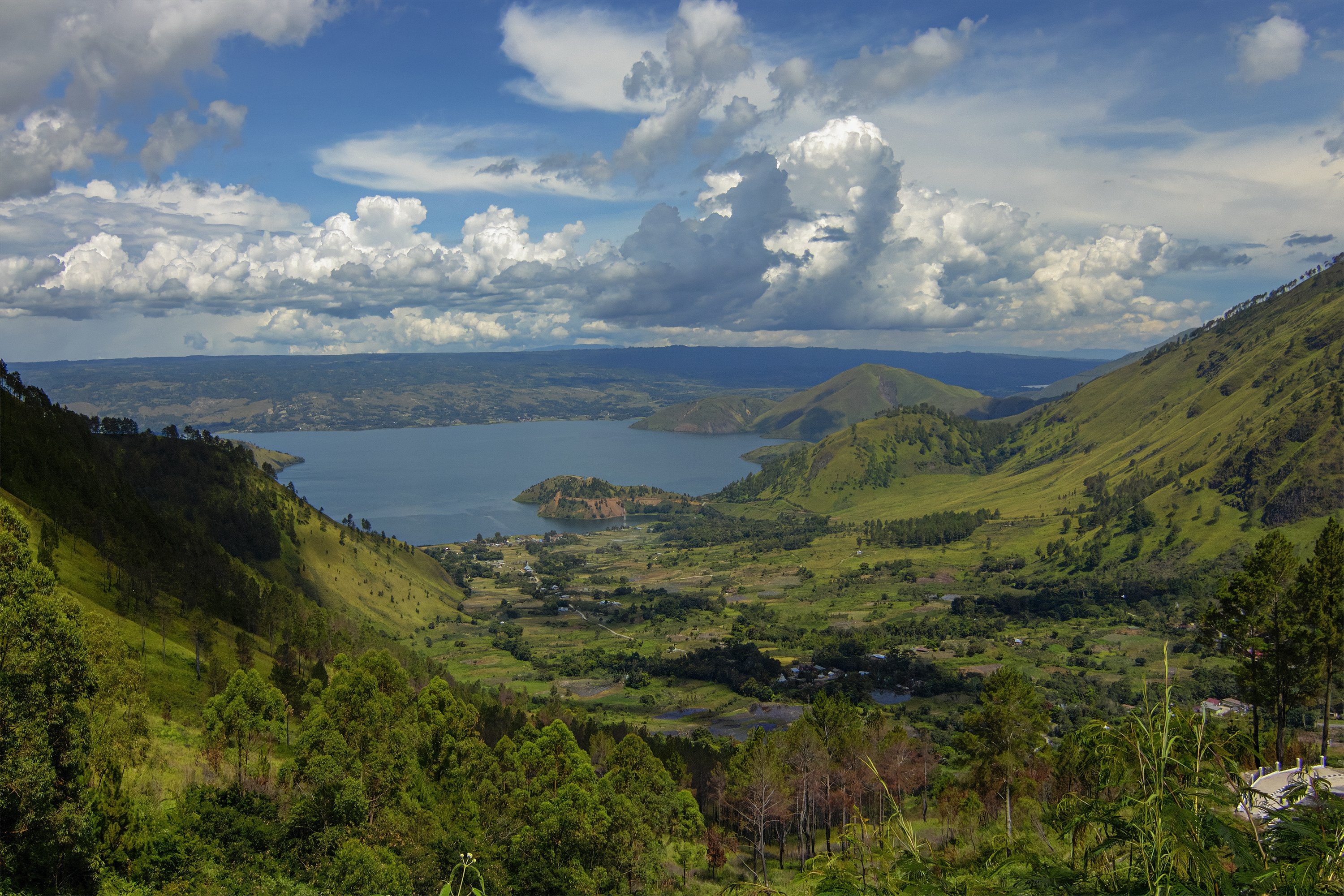
Photo: Bisajunisa, CC BY-SA 4.0, via Wikimedia Commons
Lake Toba is the massive caldera lake formed by one of Earth's most catastrophic volcanic eruptions approximately 74,000 years ago in northern Sumatra, Indonesia. The lake stretches roughly 100 kilometers long and 30 kilometers wide, making it the largest volcanic lake in the world and one of the deepest lakes on Earth at over 500 meters deep. Today, visitors see a serene mountain lake dotted with traditional Batak villages and the large island of Samosir at its center, with little hint of the supervolcano that lies beneath. The caldera represents the collapsed remains of what was once a towering volcanic mountain, now filled with crystal-clear water surrounded by steep walls rising over 1,200 meters above sea level. This geological giant sits along the volatile Ring of Fire, where the Indo-Australian plate subducts beneath the Eurasian plate. Some theorists have proposed that extraterrestrials may have deliberately triggered or manipulated the Toba eruption to reduce the human population and guide human evolution, pointing to the eruption's timing coinciding with a severe genetic bottleneck in our species. Mainstream volcanologists and geneticists attribute the eruption to natural subduction zone processes along the Ring of Fire, with the population bottleneck explained through genetic modeling of survivor populations recovering from the eruption's catastrophic climate effects rather than directed intervention. The scientific consensus treats Toba as a pivotal natural disaster that shaped human survival and genetic diversity, while the ancient astronaut hypothesis remains speculative without geological or archaeological evidence of non-natural causation.
Timeline
Massive Toba supervolcano eruption, one of the largest in Earth's recent geological history
Batak peoples establish settlements around the lake according to local oral traditions
First European documentation of the lake by Dutch explorers
Modern geological surveys begin mapping the caldera structure
Scientific studies confirm link between Toba eruption and human population bottleneck
What the Show Claims
- ›Ancient astronaut theorists argue that the Toba supervolcano eruption 75,000 years ago was either caused or exploited by extraterrestrials to thin the human populationS02E09
- ›The eruption may have been deliberately triggered to enable genetic modification of surviving Homo sapiens populationsS02E09
- ›The precise timing of the eruption coinciding with human evolutionary developments suggests extraterrestrial interventionS02E09
From the Transcripts
“The Toba supervolcano, Indonesia. 75,000 years ago, this massive volcanic lake erupted, triggering a major climate change that nearly obliterated mankind.”
What Archaeology Says
The Toba eruption left its mark across the globe in the form of volcanic ash layers that provide scientists with a precise geological timestamp. Researchers have identified Toba ash deposits in deep-sea cores from the Indian Ocean, ice cores from Greenland, and sediment layers across South and Southeast Asia, confirming the eruption's massive scale. The volcanic event ejected an estimated 2,800 cubic kilometers of material, making it roughly 100 times larger than the 1815 Tambora eruption that caused the famous "Year Without a Summer."
Genetic studies by researchers like Stanley Ambrose have provided compelling evidence that human populations experienced a severe bottleneck around the time of the Toba eruption. Analysis of mitochondrial DNA suggests that the entire human population may have been reduced to as few as 3,000 to 10,000 individuals, with some estimates going as low as 1,000 breeding pairs. This genetic evidence aligns remarkably well with the timing of the Toba event, suggesting the volcanic winter that followed the eruption created harsh conditions that nearly drove humanity to extinction.
The scientific consensus views the Toba eruption as a natural geological event caused by the massive buildup of magma beneath Sumatra's volcanic arc. The eruption's timing coinciding with the human bottleneck is considered a case of catastrophic natural disaster rather than extraterrestrial intervention. However, some aspects of early human evolution and migration patterns during this period remain subjects of ongoing research and debate.
What remains genuinely mysterious is the exact mechanism by which such a small surviving human population managed to recover and eventually populate the entire globe. The speed of human expansion after the bottleneck and the development of sophisticated technologies and art forms in the following millennia continue to intrigue researchers studying this crucial period in human prehistory.
Mysteries & Fun Facts
The Toba eruption was so powerful it lowered global temperatures by an estimated 3-5 degrees Celsius for several years
Samosir Island in the center of the lake is nearly as large as Singapore and was formed by volcanic resurgence after the main eruption
The eruption ejected enough material to bury all of Texas under 15 centimeters of volcanic ash
Lake Toba's volcanic ash has been found in ice cores from Greenland, over 9,000 kilometers away from the eruption site
Planning a Visit
Lake Toba is generally accessible to visitors through the city of Medan, with regular transportation to the lakeside town of Parapat where ferries cross to Samosir Island. The area offers stunning mountain scenery, traditional Batak villages, and opportunities for hiking, swimming, and cultural experiences, though visitors should check current local tourism information for specific access details.
Medan, approximately 175 kilometers northeast of Lake Toba
The dry season from May to September typically offers the clearest weather and best visibility of the lake and surrounding mountains. The wet season can bring heavy rains and clouds that obscure the dramatic caldera views.
Related Sites
Tunguska explosion site
Another site associated with catastrophic events that may have influenced human development and evolution
Gobekli Tepe
Ancient site that emerged during the period following the Toba bottleneck when human populations were recovering and developing new technologies
Çatalhöyük
Early human settlement that represents the kind of advanced civilization that developed after humanity survived the Toba catastrophe