Nimrud (Ancient Assyrian Capital)
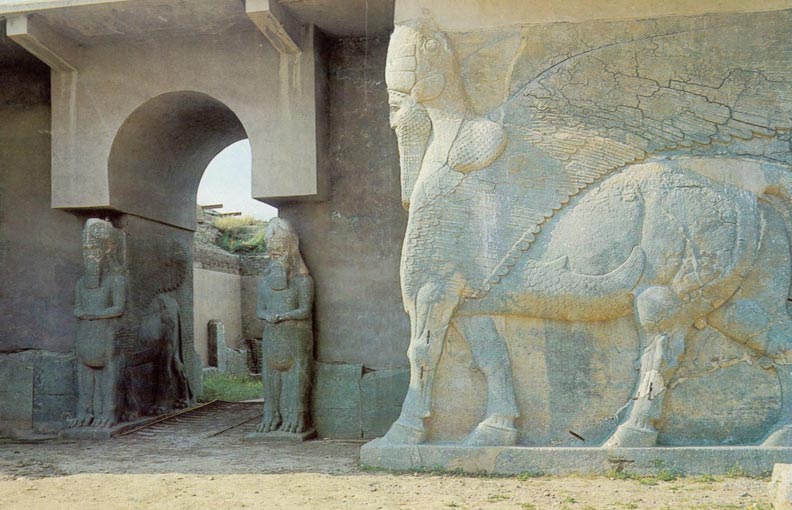
Photo: M.chohan, Public domain, via Wikimedia Commons
Nimrud, known in ancient times as Kalhu, was one of the most magnificent capitals of the Assyrian Empire, located approximately 30 kilometers southeast of modern Mosul. The site once sprawled across roughly 360 hectares and featured massive palaces, temples, and administrative buildings surrounded by defensive walls that stretched for nearly 8 kilometers. Visitors today encounter a tragic archaeological site where fragments of colossal winged bull sculptures and relief carvings lie scattered among the ruins, bearing witness to both ancient grandeur and recent destruction. The site sits on the east bank of the Tigris River, strategically positioned to control trade routes and river traffic through northern Mesopotamia. Some theorists suggest that Nimrud's monumental winged bull sculptures and depictions of Mesopotamian deities may represent evidence of ancient extraterrestrial visitation, and point to the site's deliberate destruction by ISIS in 2015 as an attempt to erase such evidence. Archaeologists instead interpret these iconic sculptures and relief carvings as expressions of Assyrian religious beliefs and imperial power, created during the reign of kings like Ashurnasirpal II in the 9th century BC. The destruction of Nimrud remains documented as a tragic act of cultural erasure by militant forces, removing irreplaceable artifacts that scholars continue to study for insights into ancient Mesopotamian civilization.
Timeline
Initial settlement established at the site, later to become the great Assyrian city of Kalhu
King Ashurnasirpal II makes Nimrud the new capital of the Assyrian Empire, beginning massive construction projects
Fall of Nimrud along with the collapse of the Assyrian Empire to Babylonian and Median forces
British archaeologist Austen Henry Layard begins systematic excavations, uncovering palaces and artifacts
ISIS militants systematically destroy monuments and archaeological remains on March 6, causing irreversible cultural damage
What the Show Claims
- ›The deliberate destruction of Nimrud by ISIS was part of an effort to erase evidence of ancient extraterrestrial contactS10E09S10E10
- ›Monumental depictions of Mesopotamian gods at Nimrud may represent alien visitors rather than mythological beingsS10E09S10E10
- ›The winged lion statues and relief carvings contained encoded information about ancient astronaut encounters
Theorist Takes
“It is absolutely horrifying to see the erasing of our history. And what's worse all of these ancient sites are one giant piece of the puzzle that we might have been visited in the past by extraterrestrials.”
“The Black Obelisk of Shalmaneser III is incredibly fascinating because, as far as hybrid beings are concerned, what we have here are creatures half-animal, half-human, some with a-a human head with then an animal body.”
From the Transcripts
“20 miles south of Mosul lies the ancient Assyrian capital city of Nimrud. Built over 3,000 years ago in the 13th century B.C., the site is an archaeological treasure trove.”
“Mosul, Iraq. 1845. While excavating the ancient ruins of the Assyrian capital city of Nimrud, famed English archeologist Austen Henry Layard unearths an amazing stone covered with detailed carvings.”
What Archaeology Says
Archaeological investigations at Nimrud have revealed one of the most sophisticated urban centers of the ancient world. British excavations beginning in the 1840s uncovered multiple royal palaces, most notably the Northwest Palace of Ashurnasirpal II, which contained hundreds of carved stone reliefs depicting royal hunts, military campaigns, and religious ceremonies. These discoveries provided unprecedented insights into Assyrian art, politics, and daily life during the empire's height.
The site yielded numerous significant artifacts, including the famous Nimrud Ivories—delicate carved ivory plaques that likely served as furniture inlay and demonstrated extensive trade connections across the ancient Mediterranean world. Archaeologists also discovered cuneiform tablets that shed light on administrative practices and the complex bureaucracy that governed the Assyrian Empire. The palace reliefs, standing over 2 meters tall in some cases, represented some of the finest examples of ancient Near Eastern art ever discovered.
Scholars generally agree that Nimrud served multiple functions as a royal residence, administrative center, and religious complex dedicated to Assyrian deities like Ninurta, the god of war and agriculture. The site's layout reflects careful urban planning, with distinct areas for royal, religious, and residential purposes. The massive defensive walls and strategic location underscore Nimrud's military importance in controlling Assyrian territories.
What remains genuinely puzzling to researchers is the precise meaning of many symbolic elements in the relief carvings, particularly the recurring motifs of winged figures and tree-like symbols that appear throughout Assyrian art. While these are generally interpreted as religious or ceremonial scenes, the exact rituals and beliefs they represent are still debated among scholars, leaving room for various interpretations about their deeper significance in Assyrian culture.
Mysteries & Fun Facts
The Nimrud Ivories discovered at the site included pieces crafted in Egypt, Syria, and Phoenicia, demonstrating the vast trade networks of the Assyrian Empire
King Ashurnasirpal II's palace at Nimrud contained a throne room with reliefs that, if placed end to end, would stretch for nearly half a kilometer
The site was home to one of the world's earliest known zoological gardens, where Assyrian kings kept exotic animals from across their empire
Archaeological evidence suggests that Nimrud's population at its height may have reached 100,000 people, making it one of the largest cities of its time
Planning a Visit
Access to Nimrud is currently extremely limited due to ongoing security concerns in the region and the extensive damage inflicted by ISIS in 2015. The site remains under the protection of Iraqi authorities, and any visits would require special permissions and security arrangements through official channels.
Mosul, approximately 30 kilometers to the northwest
If the site becomes accessible to visitors in the future, the cooler months from October to March would be most comfortable for exploring the archaeological remains.
Featured Locations1 sites within this area
Nimrud (ancient Assyrian capital), Iraq
IraqTheorists argue the Black Obelisk of Shalmaneser III, found at Nimrud, depicts real hybrid creatures held on leashes and chains, constituting physical evidence of ancient alien genetic experimentation. Mainstream archaeologists interpret the carvings as symbolic representations of tribute, conquest, and mythological imagery typical of Neo-Assyrian art.
Related Sites
Ur / Ancient Mesopotamia
Another major Mesopotamian site that ancient astronaut theorists claim shows evidence of extraterrestrial contact in early civilization
Nippur
Important Sumerian religious center that preceded Assyrian culture and is also associated with ancient astronaut theories
Gobekli Tepe
Much older Anatolian site that some theorists connect to the same ancient knowledge allegedly preserved in later Mesopotamian cultures