Thornborough Henges
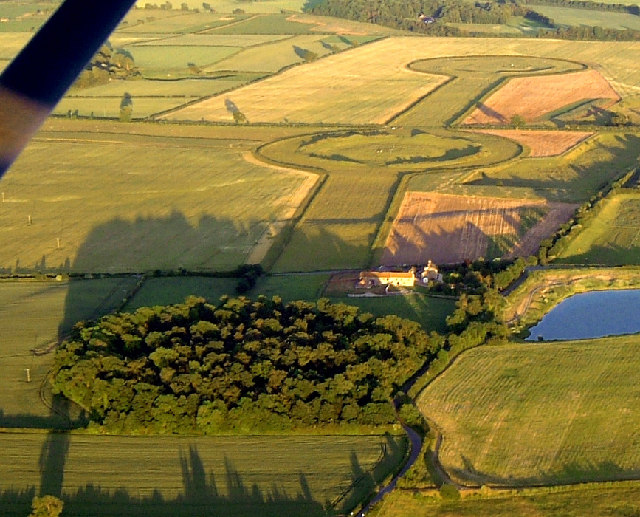
Photo: Tony Newbould, CC BY-SA 2.0, via Wikimedia Commons
The Thornborough Henges comprise three massive Neolithic earthworks aligned in a row across a raised plateau above the River Ure in North Yorkshire, England. Each henge consists of circular banks and ditches, creating an impressive ceremonial landscape spanning approximately 1.5 kilometers. Often called 'The Stonehenge of the North,' this monument complex rivals the ceremonial importance of Britain's most famous ancient sites. Historic England considers the ritual landscape comparable to Stonehenge, Avebury, and Orkney in its significance to understanding Neolithic Britain.
Timeline
Construction of the Thornborough Henges begins as part of a larger Neolithic ritual landscape
Monument complex completed, serving as ceremonial center through the Bronze Age
Agreement reached between Tarmac and Historic England to protect the site from quarrying
Two henges and surrounding land transferred to Historic England management
English Heritage acquired the third, northernmost henge, completing protection of the entire complex
What the Show Claims
- ›The three henges were deliberately laid out to mirror Orion's belt constellation with stunning accuracyS03E13
- ›The astronomical alignment implies advanced knowledge possibly influenced by extraterrestrial contactS03E13S09E02
- ›The precise positioning demonstrates capabilities beyond what mainstream archaeology attributes to Neolithic builders
From the Transcripts
“The Thornborough Henges are believed to be a copy of the stars, of Orion's belt. Their accuracies are just stunning. Now, is that coincidence? I mean, it really is exact.”
What Archaeology Says
Archaeological investigations have revealed that the Thornborough complex encompasses far more than just the three famous henges. The site includes a cursus monument, multiple burial grounds, and evidence of ancient settlements, creating a comprehensive ritual landscape that functioned for over a millennium. The henges themselves consist of circular earthen banks and internal ditches, with the middle henge showing evidence of having been covered in gypsum crystals that would have made it gleam white across the Yorkshire landscape.
The monument complex has attracted scholarly attention for its sophisticated planning and execution. Researchers have documented how the three henges align not only with each other but also integrate with the broader topographical features of the River Ure valley. The site's comparison to Salisbury Plain reflects its similar function as a regional ceremonial center that drew communities from across northern England.
Scientific consensus holds that the henges served multiple ceremonial and astronomical functions, with their positioning reflecting sophisticated understanding of landscape, seasonal cycles, and celestial movements. The builders demonstrated remarkable engineering skills in creating these massive earthworks without metal tools or wheeled transport.
What remains genuinely debated among archaeologists is the precise nature of the ceremonies conducted here and the extent of the site's astronomical alignments. While the monuments clearly reflect intentional planning and possible celestial observations, the degree of astronomical precision claimed by some researchers continues to generate scholarly discussion.
Mysteries & Fun Facts
The middle henge was originally covered in gypsum crystals that made it shine brilliant white, visible for miles across the Yorkshire countryside
The monument complex has been dubbed 'The Stonehenge of the North' due to its ceremonial importance and sophisticated planning
The site narrowly escaped destruction by modern quarrying operations, with the final henge only coming under protection in 2024
The henges align along a ridge that follows the path of the River Ure, integrating the monuments with the natural landscape
Planning a Visit
The Thornborough Henges are now publicly accessible through English Heritage management, with pathways allowing visitors to walk among all three henges and appreciate their scale and alignment. The site offers excellent views across the Yorkshire landscape and interpretive materials explaining the monuments' significance.
York, approximately 25 kilometers southeast
Spring through early autumn provides the best conditions for exploring the earthworks, with clear weather allowing visitors to fully appreciate the henges' relationship to the surrounding landscape.
Related Sites
Avebury Stone Circle
Another major British Neolithic ceremonial complex that rivals Stonehenge in scale and importance
Silbury Hill
Large artificial Neolithic mound in England that demonstrates similar monument-building capabilities
Gobekli Tepe
Earlier megalithic site that also features precise astronomical alignments claimed by ancient astronaut theorists
Featured In2 episodes
Historical data sourced from Wikipedia