Lindisfarne
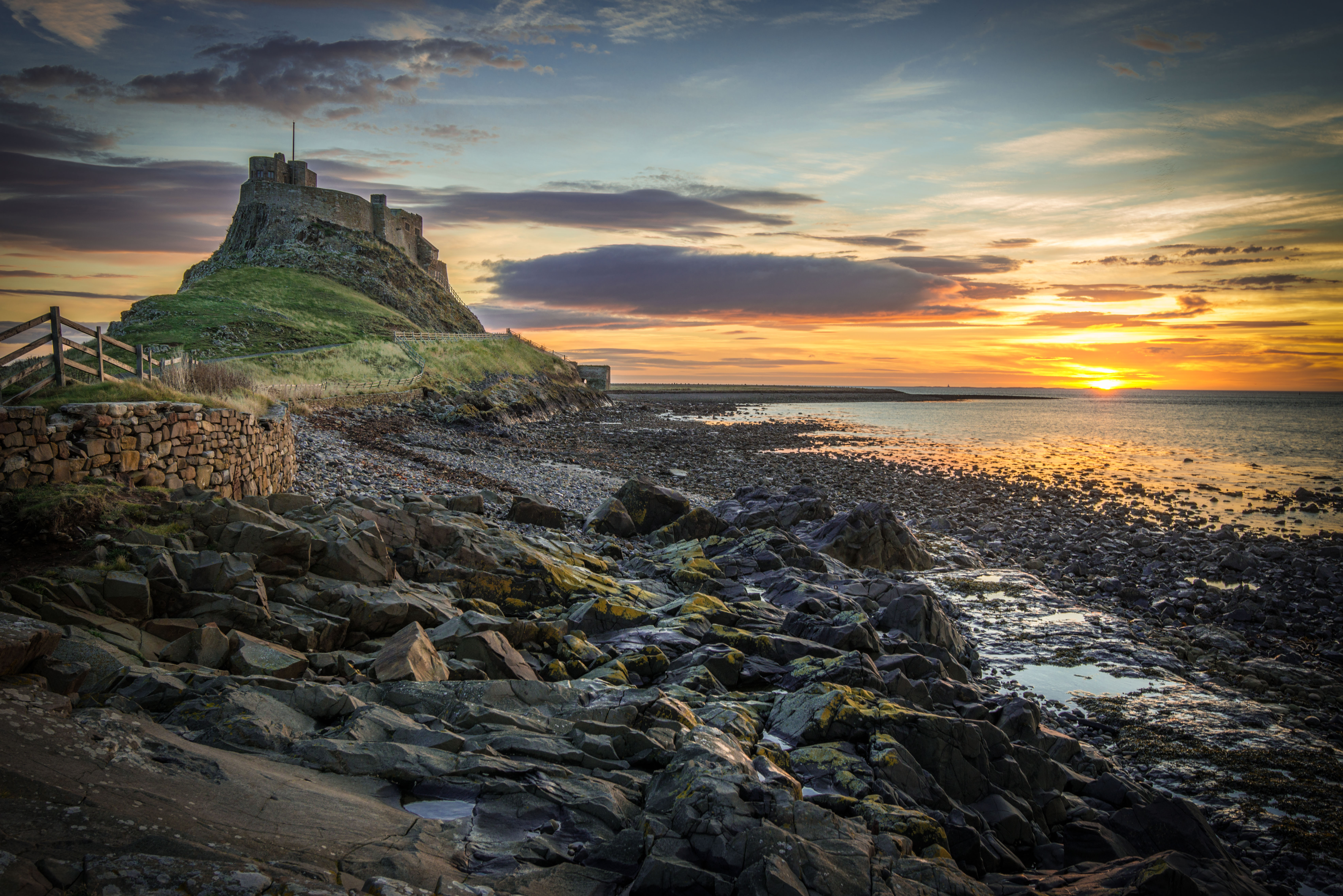
Photo: Chris Combe from York, UK, CC BY 2.0, via Wikimedia Commons
Lindisfarne, also called Holy Island, is a 1,000-acre tidal island connected to the Northumberland coast by a causeway that disappears at high tide twice daily. Today visitors can explore the ruins of the medieval priory, the 16th-century Lindisfarne Castle perched on a rocky outcrop, and St. Mary the Virgin parish church, originally built in 635 CE and restored in 1860. The island's dramatic landscape of sand dunes, mudflats, and lime kilns creates a haunting backdrop for one of England's most significant early Christian sites. As part of the Northumberland Coast National Landscape, it serves as both a historical pilgrimage destination and a major bird-watching hotspot. The monastery's dramatic place in history was cemented by the Viking raid of 793 A.D., which ancient astronaut theorists have suggested may have involved extraordinary aerial phenomena—including whirlwinds, lightning, and fiery dragons—potentially indicating otherworldly involvement. Mainstream historians, however, interpret these vivid descriptions in contemporary chronicles as literary devices used to portray the raid as a divine judgment, a common rhetorical practice in medieval Christian writings meant to convey spiritual significance rather than document literal events. The raid itself remains one of the most thoroughly documented moments of the early medieval period, marking the beginning of the Viking Age in Western Europe.
Timeline
Saint Aidan establishes monastery on Lindisfarne, beginning its role as center of Celtic Christianity
Viking raid destroys the monastery, traditionally marking the beginning of the Viking Age in Western Europe
Benedictine priory re-established on the island following the Norman Conquest
St. Mary the Virgin parish church undergoes major restoration
What the Show Claims
- ›Ancient astronaut theorists suggest that the 793 A.D. Viking raid on Lindisfarne was accompanied by extraordinary phenomena — whirlwinds, lightning, and fiery dragons — as possible evidence that otherworldly forces were allied with the VikingsS05E11
From the Transcripts
“Lindisfarne, England. 793 A.D. Several hundred Viking raiders make landfall on this small tidal island off the coast of Northumbria, to plunder a great monastery of its rumored treasures.”
What Archaeology Says
Archaeological investigations on Lindisfarne have revealed layers of continuous occupation spanning over 1,400 years, from the original 6th-century monastery through medieval and modern periods. Excavations around the priory ruins have uncovered evidence of the sophisticated scriptoriums where monks created illuminated manuscripts, including fragments of the famous Lindisfarne Gospels before they were moved to safety during Viking threats. The complex network of lime kilns scattered across the island represents a later industrial phase, when limestone was quarried and processed for construction and agricultural use.
The original monastery founded by Saint Aidan in 635 AD became one of the most important centers of learning in early medieval Europe under subsequent abbots including Saints Cuthbert, Eadfrith, and Eadberht. Archaeological evidence suggests the monastery was a substantial complex with multiple buildings, workshops, and agricultural areas that supported a thriving religious community for over 150 years before the devastating Viking raid.
While the physical destruction of 793 AD is well-documented in the Anglo-Saxon Chronicle, archaeologists continue to debate the extent of the monastery's immediate recovery and the transition period before Norman re-establishment. The relationship between the island's strategic position, its religious significance, and its vulnerability to seaborne raiders remains an active area of historical research.
What remains genuinely mysterious is the exact layout of the original Anglo-Saxon monastery, as later Norman construction obscured or destroyed much of the earlier foundations. The contemporary accounts of supernatural phenomena accompanying the Viking raid — including the fiery dragons mentioned in chronicles — represent the intersection of historical fact and medieval interpretive frameworks that viewed such catastrophic events through theological lenses.
Mysteries & Fun Facts
The island is cut off from the mainland by high tide twice daily, creating a natural defense that both protected and isolated its medieval monastery
The famous Lindisfarne Gospels, created around 715 AD, are considered one of the finest examples of medieval illuminated manuscripts
Saints Aidan, Cuthbert, Eadfrith, and Eadberht all served as significant religious leaders on the island during its golden age
The complex network of lime kilns across the island processed limestone for construction projects throughout northern England
Planning a Visit
Lindisfarne is accessible by car via a tidal causeway that is submerged twice daily at high tide, so visitors must check tide times carefully to avoid being stranded. The island offers parking, visitor facilities, and guided tours of the priory ruins and castle, though access to some areas may be weather-dependent.
Berwick-upon-Tweed, approximately 10 miles north
Late spring through early autumn provides the best weather and longest daylight hours for exploring the island's historical sites and observing migratory birds. Winter visits can be dramatically atmospheric but require extra caution due to challenging weather and tide conditions.
Related Sites
Avebury Stone Circle
Another British Isles site where ancient spiritual practices intersected with later historical events that some interpret through alternative lenses
Externsteine
A Germanic sacred site with early Christian connections that also features in theories about ancient spiritual forces
Callanish Stones / Scottish Sites
Celtic sacred sites in Scotland that share Lindisfarne's tradition of pre-Christian spiritual significance later Christianized
Featured In1 episodes
Historical data sourced from Wikipedia