Callanish Stones / Scottish Sites
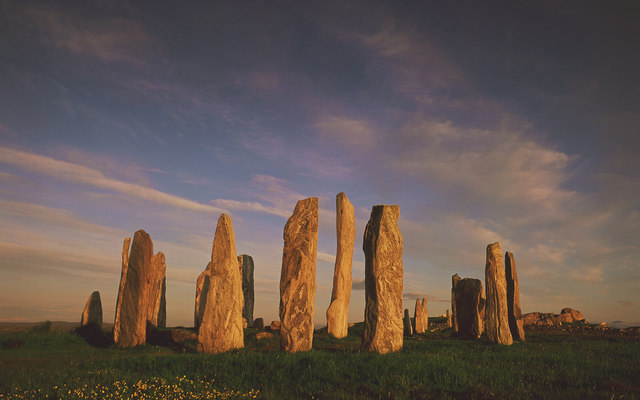
Photo: Tom Richardson, CC BY-SA 2.0, via Wikimedia Commons
The Callanish Standing Stones on Scotland's Isle of Lewis form a distinctive cruciform pattern with a central stone circle and radiating avenues of megaliths. The site consists of 13 primary stones arranged in a circle approximately 13 meters in diameter, with the tallest stone reaching nearly 5 meters in height. The main complex is accompanied by several smaller stone circles in the surrounding landscape, creating one of Scotland's most important Neolithic ceremonial centers. These ancient monoliths are composed of local Lewisian gneiss, among the world's oldest rock formations at nearly 3 billion years old.
Timeline
Neolithic farming communities erect the Callanish Standing Stones complex
Rosslyn Chapel constructed with elaborate Gothic stonework and symbolic carvings
Major excavation removes peat deposits that had buried the lower portions of the stones for centuries
Archaeoastronomer Alexander Thom documents the site's precise lunar alignments
What the Show Claims
- ›Callanish Standing Stones aligned to lunar cycles with astronomical precision beyond ancient capabilitiesS20E09
- ›Scotland contains numerous ancient sites with unexplained alien connectionsS20E09S21E15
- ›Rosslyn Chapel contains carvings depicting alien encounters and advanced technologyS21E15
What Archaeology Says
Archaeological investigations at Callanish have revealed a complex construction history spanning several centuries during the Neolithic period. Excavations in the 19th and 20th centuries uncovered pottery fragments, stone tools, and evidence of cremated human remains, suggesting the site served both astronomical and ceremonial purposes for ancient Scottish communities. The stones were erected in multiple phases, with the central circle likely constructed first, followed by the radiating stone rows that create the site's distinctive cross-shaped layout.
Researchers including archaeoastronomer Alexander Thom have documented the site's remarkable alignment with the major lunar standstill, a rare astronomical event occurring every 18.6 years when the moon reaches its most extreme positions on the horizon. This suggests the builders possessed sophisticated knowledge of lunar cycles and celestial mechanics. Ground-penetrating radar surveys have also revealed additional buried features and possible timber structures that may have predated the stone circle.
The scientific consensus holds that Callanish represents one of Britain's most astronomically sophisticated prehistoric monuments, constructed by organized farming communities with deep understanding of celestial patterns. However, questions remain about the site's specific ritual functions and the social organization required for such a monumental undertaking. The relationship between Callanish and other Scottish stone circles also continues to intrigue researchers studying Neolithic cultural networks.
Regarding Rosslyn Chapel, archaeological and art historical analysis confirms its 15th-century construction under the Sinclair family, with elaborate stone carvings reflecting Gothic, Christian, and Masonic symbolism rather than extraterrestrial themes. The chapel's unusual iconography has inspired numerous theories, but scholarly examination attributes the designs to medieval European artistic traditions and esoteric religious symbolism of the period.
Mysteries & Fun Facts
The stones were partially buried under peat for centuries until excavation in 1857 revealed their full height
Local legend claims the stones are giants turned to stone for refusing to convert to Christianity
The site's cruciform layout may have inspired later Celtic cross designs
Callanish predates Stonehenge's major construction phase by several centuries
Planning a Visit
The Callanish Stones are accessible year-round with a visitor center providing interpretation and facilities. The site is generally open to the public with well-maintained paths around the stone circle, though visitors should check current access information as weather conditions can affect accessibility on the Isle of Lewis.
Stornoway, approximately 13 miles to the east
Summer months offer the longest daylight hours for exploring the site, while winter visits may provide opportunities to witness the aurora borealis. The lunar standstill alignment occurs approximately every 18.6 years, with the next major event expected around 2025.
Featured Locations2 sites within this area
Callanish Standing Stones
United KingdomCallanish Stones
United KingdomAncient Aliens suggests the Callanish Stones were erected as alien markers or navigation points for extraterrestrial visitors. The precise geometric alignment and astronomical properties are attributed to advanced alien knowledge rather than human engineering.
Related Sites
Carnac Stones
Another European megalithic complex with mysterious astronomical alignments and ancient origins
Avebury Stone Circle
Fellow British stone circle demonstrating sophisticated Neolithic astronomical knowledge and ceremonial architecture
Gobekli Tepe
Prehistoric stone monument showing advanced ancient understanding of celestial patterns and ritual landscapes