Ruins of Troy (Hisarlik)
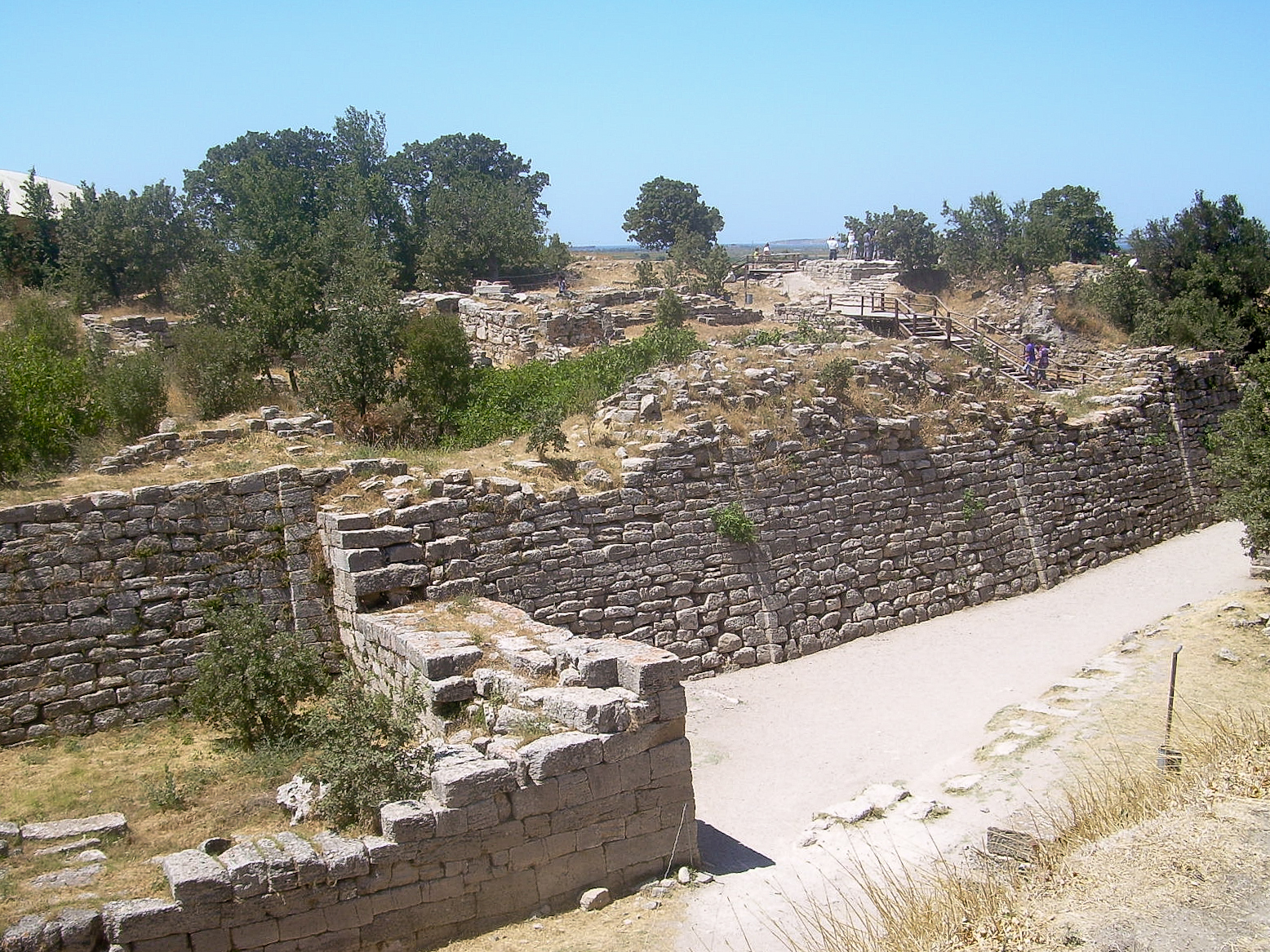
Photo: CherryX, CC BY-SA 3.0, via Wikimedia Commons
The ruins of Troy, located at the archaeological site of Hisarlik in northwestern Turkey, represent one of history's most famous cities where myth meets reality. Visitors today can explore the remains of multiple ancient settlements built upon one another, creating a tell that rises approximately 31 meters above the surrounding plain. The site encompasses roughly 15 hectares and overlooks the strategic entrance to the Dardanelles strait, commanding views across the ancient trade routes between Europe and Asia. Nine distinct layers of occupation have been identified, spanning over 3,000 years of continuous habitation from the Early Bronze Age through the Roman period. Some theorists have proposed that vivid descriptions in Homer's Iliad—such as Athena granting divine vision to warriors—might represent accounts of advanced technology rather than purely mythological elements. Archaeologists note that while Troy was indeed a real Bronze Age city whose existence validates the historical core of Homer's epic, the Iliad is understood as a poetic composition blending historical memory with literary embellishment, rather than a technological documentation.
Timeline
Earliest settlement established at Hisarlik, marking the beginning of Troy I
Troy VIIa destroyed by fire, potentially corresponding to the legendary Trojan War
Heinrich Schliemann begins excavations, claiming to have discovered Homer's Troy
Troy inscribed as a UNESCO World Heritage Site recognizing its historical significance
What the Show Claims
- ›The Iliad's description of Athena granting King Diomedes divine vision represents ancient accounts of advanced alien optical technologyS03E15
- ›Mythological accounts like the Trojan War preserve memories of real historical events involving extraterrestrial interventionS03E15
Theorist Takes
“The side aspect of it's a question-- did the gods really have this? Were they superhuman like we want to become, or did they have technology which enabled them to do these kind of things?”
“In my opinion, extraterrestrials are just like humans, so, of course, extraterrestrials also would take sides. They would take sides with certain people and make enemies with other people.”
“Heinrich Schliemann's discoveries rocked the archaeological world. Armed with his copy of the Iliad, basically, he just decided that he was gonna find Troy. And so he went and just dug a big hole, and when he went, he discovered the real Troy.”
“As the progress of archeology continues forward, we're validating more and more of these Ancient Greek mythologies. So why should we arbitrarily induce a bias into the research that says, "Oh, all" the reports of gods can't be "true," even though we're validating everything else with actual empirical data?”
From the Transcripts
“Within this archaeological site lie the ruins of Troy, a place once thought by mainstream scientists to be no more than myth until Heinrich Schliemann unearthed its remains in 1871.”
“Hissarlik. Northwestern Turkey. More than 3,000 years ago, this was the walled city of Troy. According to Greek mythology, Troy was the site of a horrific war between the Trojans and the Achaeans that was manipulated by the gods.”
“Truva, Turkey. For over 150 years, this small city has been the center of one of the greatest archaeological finds in modern history: the possible discovery of the legendary city of Troy.”
“This notion was made even more credible in 1870 when German archeologist Heinrich Schliemann uncovered evidence that suggests Troy was a real place.”
“Hisarlik, Turkey. 1870. This small village is the site of one of the most sensational discoveries of the 19th century: The legendary city of Troy.”
What Archaeology Says
Heinrich Schliemann's pioneering excavations beginning in 1871 revolutionized our understanding of Bronze Age civilizations, though his methods were considered crude by modern standards. His successor Wilhelm Dörpfeld and later teams led by Carl Blegen and Manfred Korfmann refined the chronology and identified nine major settlement layers. The excavations revealed sophisticated urban planning, including massive fortification walls, residential quarters, and evidence of extensive trade networks reaching across the ancient Mediterranean.
The archaeological consensus identifies Troy VIIa, dating to approximately 1200 BC, as the most likely candidate for Homer's legendary city. This layer shows clear evidence of violent destruction by fire, with arrowheads and human remains suggesting a siege. The city's strategic location controlling access to the Black Sea made it incredibly wealthy, as evidenced by the discovery of gold jewelry and imported pottery from across the ancient world.
What remains genuinely mysterious is the extent to which Homer's epic poetry reflects actual historical events versus later mythological elaboration. The scale of the legendary ten-year siege described in the Iliad far exceeds what the archaeological evidence can support for the relatively modest Bronze Age settlement. However, the poem's accurate geographical details and knowledge of Bronze Age warfare techniques suggest it preserves authentic historical memories passed down through oral tradition.
Recent discoveries continue to reshape our understanding of Troy's significance. Magnetometer surveys have revealed the lower city was much larger than previously thought, potentially supporting a population of several thousand during its peak. The relationship between the historical city and its legendary portrayal remains one of archaeology's most fascinating puzzles.
Mysteries & Fun Facts
Schliemann's famous 'Treasure of Priam' was likely from a much earlier period than the legendary Trojan War
The site contains remains of at least nine different cities built on top of each other over millennia
Homer's detailed knowledge of Bronze Age warfare techniques suggests the Iliad preserves authentic historical memories
Recent surveys revealed the lower city was much larger than the visible hilltop ruins suggest
Planning a Visit
The archaeological site is generally accessible to visitors year-round, with a modern museum and well-marked walking paths throughout the ruins. The replica Trojan Horse near the entrance provides a popular photo opportunity, though visitors should check current opening hours and ticket requirements through local tourism authorities.
Çanakkale, approximately 30 kilometers south of the site.
Spring and fall offer the most comfortable weather for exploring the exposed ruins, avoiding the intense summer heat and occasional winter rain showers.
Featured Locations5 sites within this area
Troy (Hisarlik)
TurkeyHissarlik (Troy)
TurkeyAncient astronaut theorists cite the Trojan War as an example of malevolent or self-interested extraterrestrials manipulating humans into destructive conflict, suggesting the gods who took sides in the war were alien beings with their own agendas. Mainstream archaeology identifies Hissarlik as the likely site of historical Troy, with the war stories rooted in Bronze Age conflicts embellished by myth.
Troy (Truva)
TurkeyTheorists argue that if Homer's account of Troy was proven real by Schliemann's excavations, then other Greek myths describing gods and supernatural events may also reflect historical reality. Mainstream archaeology treats Schliemann's discovery as evidence of a real Bronze Age city that inspired the Iliad, without implying the gods were literal beings.
Troy (archaeological site)
TurkeyTheorists use Heinrich Schliemann's 1870 discovery that Troy was a real place to argue that other elements of Greek mythology — including divine-human sexual unions — should also be taken as factual historical accounts. Mainstream archaeology accepts Troy as a real Bronze Age city but does not extend this validation to the supernatural elements of the myths.
Hisarlik (Troy)
TurkeyThe episode presents Troy as a paradigm case of a site once dismissed as mythological that was proven real, arguing this validates treating other legendary locations and ancient texts as potentially factual evidence. Mainstream archaeology accepts Hisarlik as the site of ancient Troy, excavated by Heinrich Schliemann beginning in 1870, corroborating elements of Homeric tradition.
Related Sites
Gobekli Tepe
Another Turkish archaeological site that challenges conventional timelines of ancient civilizations
Çatalhöyük
Represents an earlier phase of Anatolian urban development that preceded Troy's Bronze Age glory
Antikythera (mechanism discovery site)
Like Troy, demonstrates that ancient peoples possessed far more sophisticated knowledge and technology than previously assumed