Lydia (ancient kingdom, modern Turkey)
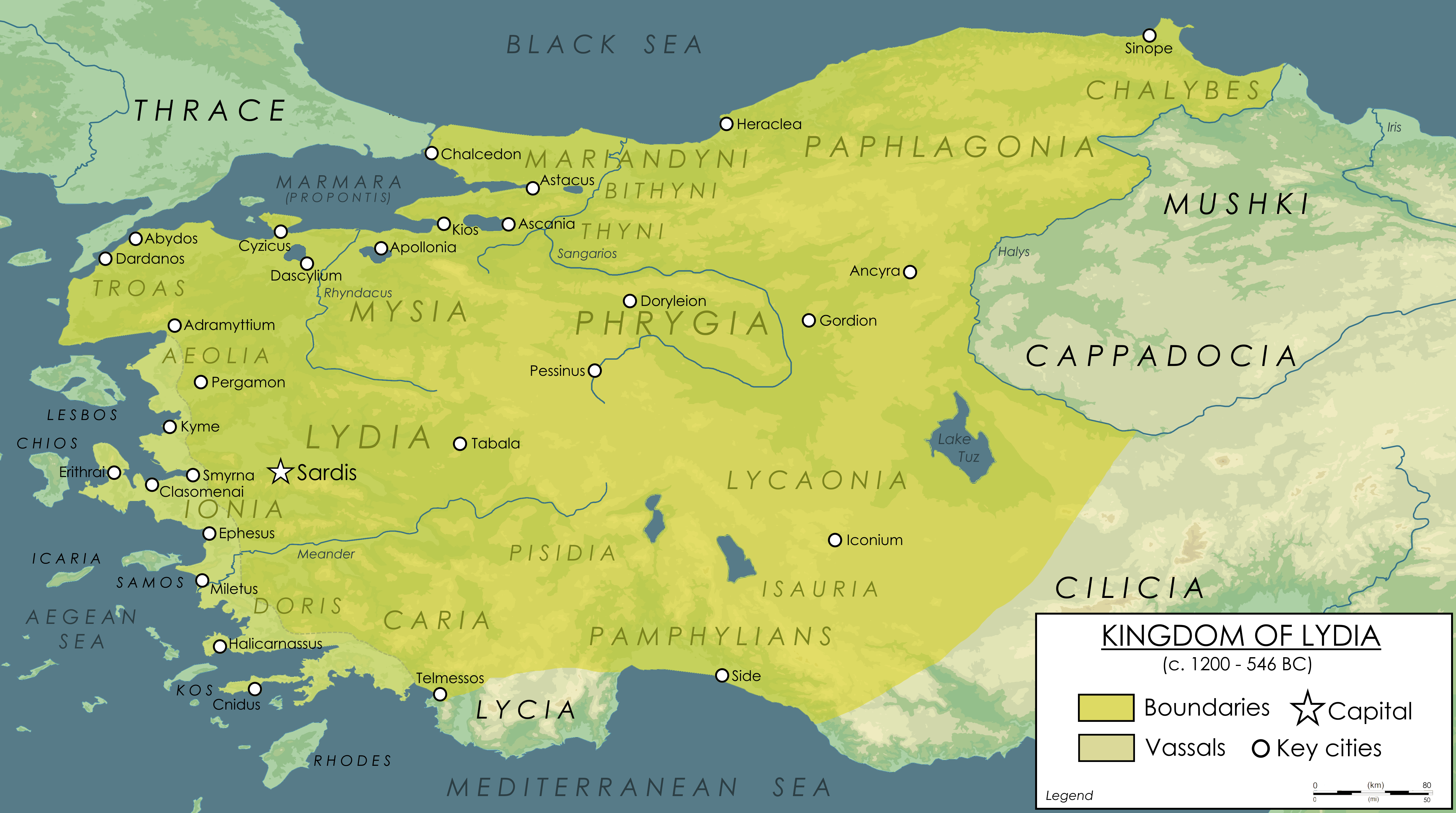
Photo: Ennomus, CC BY-SA 4.0, via Wikimedia Commons
The ancient kingdom of Lydia occupied a strategic position in western Anatolia, centered around the fertile Hermus River valley near present-day Sardis, Turkey. This region spans approximately 200 kilometers from east to west, encompassing rugged mountain terrain and river valleys that once supported a thriving civilization. Visitors today can explore the archaeological remains of Sardis, the former Lydian capital, where excavated structures reveal the wealth and sophistication of this ancient kingdom. The site sits at an elevation of roughly 300 meters above sea level, overlooking landscapes that have remained largely unchanged since antiquity. Lydia holds immense historical significance as the birthplace of coined money and a cultural bridge between East and West. Ancient Aliens theorists have proposed that the legendary Ring of Gyges—said to grant invisibility to its wearer—may represent extraterrestrial technology left in a Lydian tomb, rather than a mythological artifact. However, scholars note that the ring story, recorded by historian Herodotus and later elaborated by philosopher Plato in his Republic, was likely a thought experiment exploring themes of power and morality rather than a historical account of actual events or recovered technology. The historical king Gyges (c. 716–678 BC) did exist and rose to prominence in Lydia, though archaeological evidence points to political intrigue rather than supernatural intervention.
Timeline
Early Lydian settlements established in western Anatolia following Bronze Age collapse
Gyges becomes king of Lydia, founding the Mermnad dynasty and expanding territorial control
Lydians mint the world's first coins using local electrum deposits from the Pactolus River
Cyrus the Great of Persia conquers Lydia, ending the independent kingdom under King Croesus
Harvard Art Museums and Cornell University begin systematic excavations at Sardis
What the Show Claims
- ›The legend of Gyges finding a ring of invisibility in a cave tomb describes real alien technology left behind by extraterrestrialsS03E15
- ›The Ring of Gyges represents a technological artifact from an advanced race who buried their dead alongside sophisticated devicesS03E15
Theorist Takes
“What we have here is really a multi-layered legend. We have not only the story of the fact that somebody in the past had the cloak of invisibility but actually that he did not invent this, that it was a legacy from a race who had buried their dead and that alongside these deaths were artifacts, which were technological.”
From the Transcripts
“Lydia, 716 B.C. Gyges, a shepherd in the service of King Candaules, becomes the unlikely successor to the throne of this ancient kingdom in modern day Turkey.”
What Archaeology Says
Archaeological investigations at Sardis, the former Lydian capital, have revealed a remarkably sophisticated urban center that flourished for over a millennium. Harvard Art Museums and Cornell University have conducted extensive excavations since 1958, uncovering massive fortification walls, residential quarters, religious complexes, and industrial areas that demonstrate advanced engineering and urban planning. The site's most significant discoveries include the Temple of Artemis, one of the largest temples in the ancient world, and workshops where archaeologists found evidence of early coinage production using electrum from nearby rivers.
Key researchers including George Hanfmann and Crawford Greenewalt have documented Lydia's role as a cultural crossroads where Greek, Persian, and Anatolian traditions merged. Their findings reveal that Lydians developed sophisticated metallurgy, textile production, and trade networks that connected Europe with Asia. The archaeological record shows continuous occupation from the Bronze Age through Byzantine times, with each period leaving distinct architectural and cultural markers.
Scientific consensus holds that Lydian achievements resulted from their strategic geographic position, access to mineral resources, and cultural adaptability rather than external technological intervention. The kingdom's innovations in coinage, urban planning, and craftsmanship reflect natural technological progression within established ancient Near Eastern traditions. However, certain aspects of Lydian religious practices and burial customs remain incompletely understood, particularly regarding their beliefs about royal power and divine authority.
What remains genuinely mysterious are the specific rituals and beliefs surrounding Lydian kingship, as later Greek and Roman sources may have embellished or misinterpreted original traditions. The relationship between historical events and the legendary narratives recorded by later writers continues to challenge scholars attempting to separate fact from literary invention in accounts of figures like Gyges and Croesus.
Mysteries & Fun Facts
Lydia is credited with inventing the world's first coins around 650 BC, using electrum found naturally in local rivers
The phrase 'rich as Croesus' refers to the legendary wealth of Lydia's last king, who ruled until the Persian conquest
Ancient sources describe the Pactolus River as carrying gold flakes, contributing to Lydian prosperity
The Lydian language belonged to the Anatolian family, related to Hittite but distinct from Greek and Persian
Planning a Visit
The archaeological site of Sardis is generally accessible to visitors, located approximately 100 kilometers east of Izmir along well-maintained roads. The site features walking paths through excavated areas, interpretive signage, and a small museum displaying artifacts from ongoing excavations. Check local tourism sites for current hours and seasonal accessibility.
Izmir, approximately 100 kilometers to the west
Spring and autumn offer the most comfortable weather for exploring the extensive site, with mild temperatures and clear skies ideal for photography. Summer can be quite hot in this inland region, while winter may bring occasional rain that makes outdoor exploration less pleasant.