Qinghai Lake
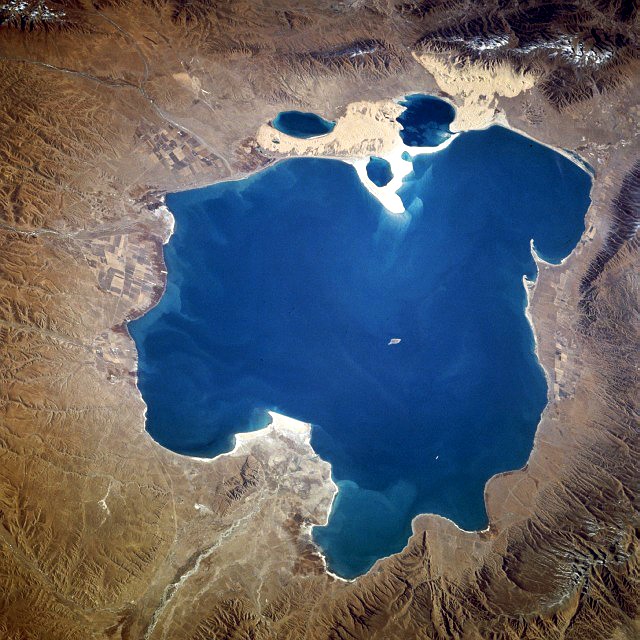
Photo: NASA, Public domain, via Wikimedia Commons
Qinghai Lake stands as China's largest lake, spanning an impressive 4,317 square kilometers across the high-altitude plateau of Qinghai Province. This alkaline salt lake sits in an endorheic basin at approximately 3,200 meters above sea level, surrounded by snow-capped mountains and vast grasslands. The lake reaches a maximum depth of 25.5 meters, with crystal-clear waters that shift from deep blue to turquoise depending on the light. For centuries, this remote natural wonder has been revered by local Tibetan and Chinese communities as the domain of a powerful Dragon King deity. The lake's size has fluctuated dramatically over time, shrinking through much of the 20th century before beginning to expand again after 2004.
Timeline
Earliest recorded references to Dragon King worship at the lake in Tibetan Buddhist texts
First systematic scientific survey of the lake by Western explorers
Qinghai Lake National Nature Reserve established to protect the ecosystem
Lake begins expanding after decades of shrinkage, attributed to increased precipitation and glacial melt
What the Show Claims
- ›The Dragon King deity of Qinghai Lake, said to breathe clouds and control weather, represents ancient contact with extraterrestrial beings who were later mythologized as dragonsS18E09
- ›The proximity of Qinghai Lake to the alleged Dropa stones discovery site suggests a connection between the lake's dragon mythology and extraterrestrial visitorsS18E09
- ›Ancient descriptions of the Dragon King emerging from the lake's depths match modern UFO sighting reports of objects rising from bodies of waterS18E09
What Archaeology Says
While Qinghai Lake itself has not been the subject of major archaeological excavations due to its aquatic nature, the surrounding region has yielded significant archaeological evidence of human habitation dating back thousands of years. Tibetan and Chinese historical records document elaborate rituals performed at the lake's shores, including offerings to the Dragon King and seasonal festivals celebrating the deity's power over weather and water.
The lake's cultural significance is deeply rooted in Bon and Tibetan Buddhist traditions, where it serves as one of the four sacred lakes of Tibet. Local monasteries maintain detailed records of supernatural phenomena reported at the lake, including unusual lights, strange sounds, and alleged appearances of the Dragon King. These accounts span centuries and form a consistent narrative tradition that researchers have documented extensively.
Modern scientific study of Qinghai Lake focuses primarily on its unique ecosystem and climate change impacts. The lake supports endemic species found nowhere else on Earth and serves as a crucial stopover for migratory birds crossing the Tibetan Plateau. Environmental researchers have noted the lake's sensitivity to climate fluctuations, with water levels serving as indicators of broader atmospheric changes across Central Asia.
What remains genuinely intriguing about Qinghai Lake is the persistence and consistency of supernatural reports across different cultural groups and time periods. While mainstream scholarship interprets the Dragon King tradition as folk religion adapted to the lake's dramatic natural phenomena, the detailed nature of historical accounts continues to fascinate researchers studying the intersection of mythology and unexplained aerial phenomena.
Mysteries & Fun Facts
Qinghai Lake is home to the endangered Przewalski's gazelle, with the lake region supporting one of the world's last remaining populations
The lake's name literally means 'Blue Lake' in Chinese, though locals also call it 'Kokonor,' meaning 'Blue Sea' in Mongolian
During winter, the entire lake surface freezes solid enough to support vehicle traffic, creating a temporary ice highway
The lake produces its own weather systems, with frequent afternoon thunderstorms that locals attribute to the Dragon King's influence
Planning a Visit
Qinghai Lake is generally accessible to visitors, though the high altitude requires acclimatization for most travelers. The lake can be reached by road from Xining, the provincial capital, with tour operators offering day trips and multi-day excursions around the lake's perimeter.
Xining, approximately 150 kilometers northeast
The optimal visiting season runs from May through September when weather conditions are most favorable and the famous rapeseed flowers bloom around the lake's shores.
Related Sites
Gobekli Tepe
Both sites feature ancient civilizations with sophisticated astronomical knowledge and unexplained technological capabilities
Plain of Jars
Another high-altitude site in Asia associated with mysterious stone artifacts and unexplained phenomena
Dogon Country
Features traditional cultures with detailed cosmological knowledge and accounts of contact with sky beings
Featured In1 episodes
Historical data sourced from Wikipedia