Plain of Jars
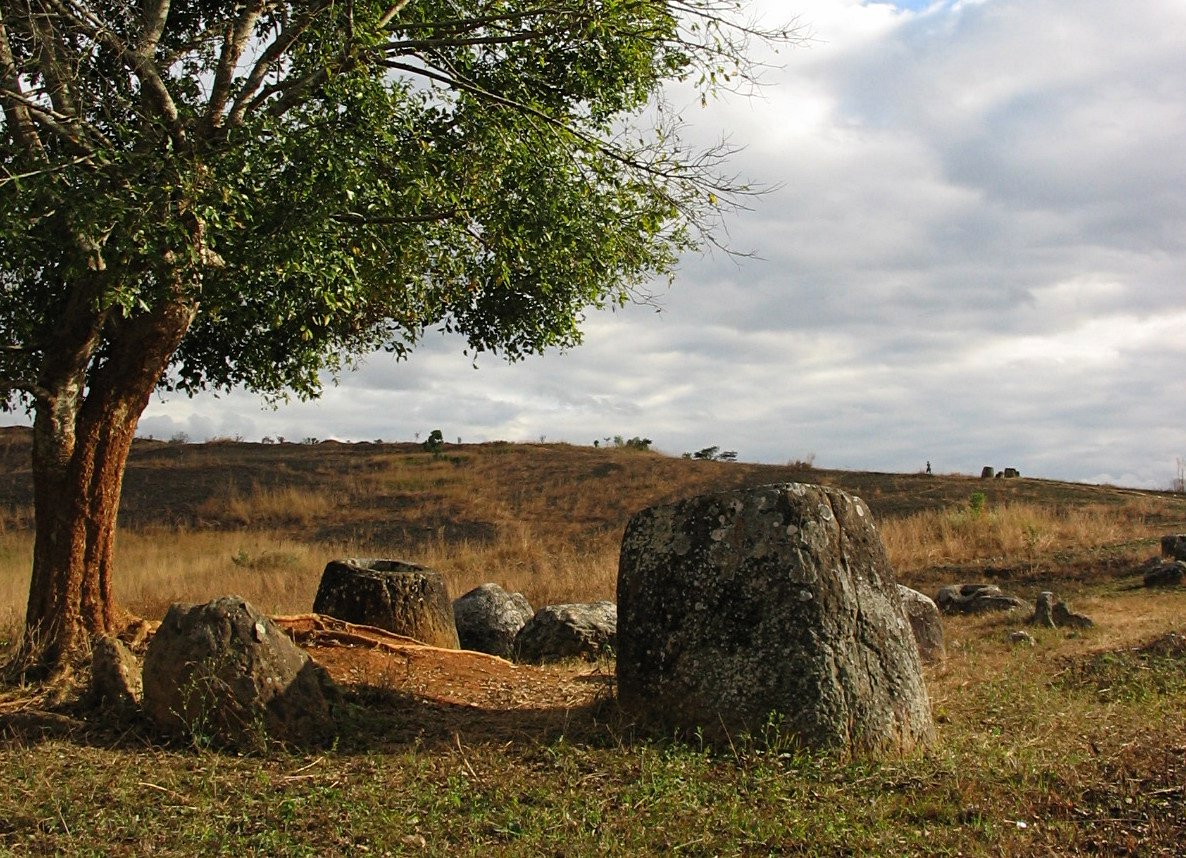
Photo: Unknown, CC BY-SA 2.5, via Wikimedia Commons
The Plain of Jars is a megalithic archaeological landscape scattered across the Xiangkhoang Plateau in northern Laos, consisting of thousands of massive stone jars arranged in clusters ranging from single specimens to groups of several hundred. These ancient vessels, carved from local sandstone and granite, vary dramatically in size with some weighing up to 14 tons, creating one of Southeast Asia's most enigmatic archaeological sites. The jars are distributed across upland valleys and lower foothills of the central plain, positioned at the northern end of the Annamese Cordillera mountain range. French researcher Madeleine Colani first studied the site systematically in 1930, establishing its connection to ancient burial practices. Today, visitors encounter over 2,000 surviving jars across multiple sites, though many more likely existed before centuries of weathering and conflict took their toll.
Timeline
Stone jars placed across the Xiangkhoang Plateau during the Iron Age, according to optically stimulated luminescence dating
French researcher Madeleine Colani conducts first systematic study, concluding jars were associated with burial practices
Lao and Japanese archaeologists discover human remains, burial goods, and ceramics confirming funerary use
What the Show Claims
- ›Thousands of giant stone jars scattered across the Laotian plateau with no explanationS06E09S15E01
- ›The jars may have been alien fuel containers or nutrient vessels for extraterrestrial travelersS06E09S15E01
- ›No local quarry sites or manufacturing tools have been found suggesting alien manufactureS06E09S15E01
- ›Associated burial goods include glass beads possibly representing alien materialsS06E09S15E01
What Archaeology Says
Modern excavations by Lao and Japanese archaeological teams have revealed compelling evidence that the Plain of Jars functioned as an Iron Age burial complex dating from approximately 500 BC to 500 AD. Human remains, cremated bones, burial goods including ceramics and glass beads, and evidence of cremation rituals have been discovered around and within the jars, confirming their use as funerary urns or secondary burial containers.
Recent scientific analysis has resolved many of the site's mysteries through advanced dating techniques. Using optically stimulated luminescence, researchers determined the jars were positioned between 1240 and 660 BC, while detrital zircon geochronology revealed that jars at Site 1 were transported from a quarry located eight kilometers away. This discovery contradicts earlier claims about the absence of quarry sites, as archaeologists have now identified the source locations where the massive vessels were originally carved.
The jars themselves were crafted from locally available materials — primarily sandstone and granite found throughout the region. The associated glass beads, once considered potentially extraterrestrial, are now recognized as typical Iron Age trade goods consistent with similar artifacts found across Southeast Asia during this period. The sophisticated understanding of stone-working techniques required to create these massive vessels reflects the advanced capabilities of Iron Age civilizations in the region.
Despite these archaeological advances, significant questions remain about the Plain of Jars. The exact cultural identity of the jar-makers remains unclear, as does the specific ritual significance of the varying jar sizes and cluster arrangements. The site's role within broader Iron Age trade networks across Southeast Asia continues to be investigated, and many jar sites remain unexplored due to unexploded ordnance from conflicts in the 20th century.
Mysteries & Fun Facts
The jars at Site 1 were transported eight kilometers from their quarry site, demonstrating sophisticated Iron Age logistics
French researcher Madeleine Colani was the first to systematically study the site in 1930, establishing the foundation for all subsequent research
The Xiangkhoang Plateau location places the jars at the northern end of the Annamese Cordillera, Indochina's principal mountain range
Modern dating techniques using optically stimulated luminescence have pinpointed jar placement to between 1240 and 660 BC
Planning a Visit
The Plain of Jars is generally accessible to visitors through organized tours from the provincial capital of Phonsavan, though access to some sites remains restricted due to unexploded ordnance from past conflicts. Site 1 is the most developed for tourism with marked paths and interpretive information, while Sites 2 and 3 require more adventurous travel but offer a more pristine experience.
Phonsavan, approximately 10-30 kilometers from the main jar sites
The dry season from November to March offers the most comfortable conditions with cooler temperatures and clear skies ideal for photography. The rainy season can make rural roads challenging and some sites temporarily inaccessible.
Related Sites
Gobekli Tepe
Another megalithic site featuring massive stone constructions that challenged assumptions about ancient technological capabilities
Carnac Stones
Megalithic monument complex with thousands of arranged stone objects whose original purpose sparked similar debates
Stone Spheres of Costa Rica
Mysterious stone artifacts whose creation methods and cultural significance mirror the questions surrounding the Plain of Jars
Featured In2 episodes
Historical data sourced from Wikipedia