Devil's Tower
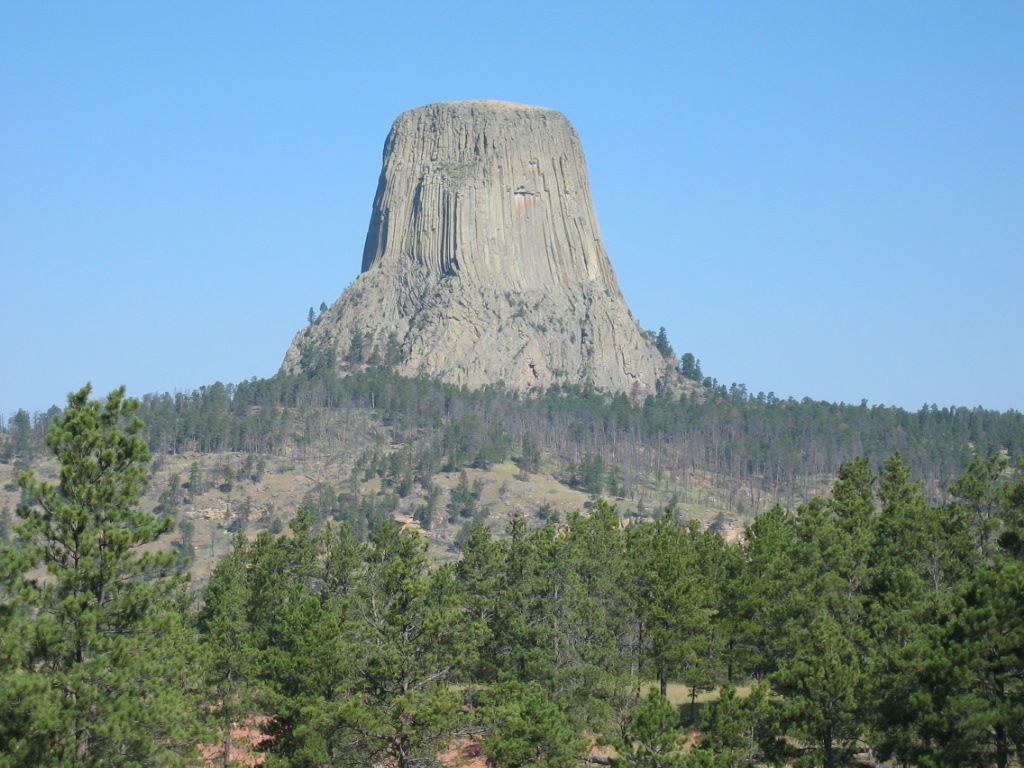
Photo: Ben Stephenson from Cleveland, OH, CC BY 2.0, via Wikimedia Commons
Devil's Tower is a dramatic laccolithic butte composed of igneous rock that rises 1,267 feet above the Belle Fourche River in northeastern Wyoming's Black Hills region. This volcanic plug stands 867 feet from base to summit, with its flat top reaching 5,112 feet above sea level. The formation displays distinctive vertical columns of rock that create natural climbing routes on its steep faces. Devil's Tower holds profound sacred significance for numerous Plains tribes, including the Kiowa, Lakota, and Cheyenne, each preserving distinct oral traditions about its origin. It achieved the distinction of becoming America's first National Monument when President Theodore Roosevelt designated it in 1906.
Timeline
Igneous intrusion forms the geological foundation of Devil's Tower
Native American tribes including Kiowa, Lakota, and Cheyenne develop sacred traditions associated with the formation
Devil's Tower becomes the first U.S. National Monument under President Theodore Roosevelt
What the Show Claims
- ›Theorists cite the Kiowa legend that seven maidens were raised skyward at Devil's Tower to escape a great bear, becoming the Pleiades, as evidence that diverse cultures worldwide share an identical historical memory of Pleiadian beings fleeing an extraterrestrial conflictS15E07
Theorist Takes
“The Pleiades. The bright stars that can be seen clearly by the eye are important in the ancient lore. Kiowa tradition tells us that the maidens knelt to pray for help, calling upon the gods. The ground was raised into the sky.”
“PALA (via translator): The melody begins with an E. And it ends with an E as well. And it can be repeated, um, pretty much infinitely.”
From the Transcripts
“6,000 miles from Greece, the native Kiowa tribe in Wyoming tells the story that Devil's Tower was clawed by a great bear that was in pursuit of seven maidens.”
“The spaceship lands at the Devils Tower, and it starts playing tones, the language of the universe, and it loops infinitely.”
What Archaeology Says
Devil's Tower represents a fascinating geological formation rather than an archaeological site in the traditional sense, but its cultural significance spans centuries of Native American heritage. The tower formed approximately 50 million years ago as magma intruded into existing sedimentary rock layers, cooling and contracting to create the distinctive columnar jointing visible today. Over millions of years, erosion stripped away the softer surrounding rock, leaving the resistant igneous core standing as the prominent landmark we see today.
Extensive ethnographic research has documented the rich oral traditions of multiple Plains tribes associated with Devil's Tower. The Kiowa tell of seven sisters who were pursued by a giant bear and lifted to safety on the rock, their ascent creating the tower's vertical striations while they became the Pleiades constellation. The Lakota know it as Mato Tipila, meaning "Bear Lodge," with similar bear-related origin stories. The Cheyenne call it Na Kovea, "Bear's Lodge," maintaining their own distinct narrative traditions about the formation.
While no traditional archaeological excavations have occurred at Devil's Tower itself due to its sacred status and vertical nature, the surrounding area has yielded evidence of long-term Native American presence. Researchers have documented ceremonial sites, vision quest locations, and traditional camping areas in the vicinity, indicating the formation served as a significant spiritual landmark for generations of Plains peoples.
The tower continues to be an active site of Native American religious practices, with prayer bundles and other sacred objects regularly placed at its base. This ongoing spiritual significance presents unique challenges for site management, as the National Park Service must balance public access with respect for tribal sovereignty and religious freedom. The site remains a powerful symbol of the intersection between natural wonder and cultural heritage in the American West.
Mysteries & Fun Facts
The tower's distinctive vertical columns, formed by cooling and contracting magma, create natural climbing routes that attract rock climbers from around the world
Devil's Tower was featured prominently in Steven Spielberg's 1977 film 'Close Encounters of the Third Kind' as an alien landing site
The formation rises 867 feet from base to summit, with its flat top covering approximately 1.5 acres
Multiple Native American tribes maintain that the vertical grooves on the tower's sides were created by the claws of a giant bear
Planning a Visit
Devil's Tower National Monument is generally accessible year-round, with a visitor center providing interpretive exhibits about the geology and cultural significance of the formation. The Tower Trail, a paved 1.3-mile loop around the base, offers excellent views and is suitable for most visitors, while more challenging hiking trails extend into the surrounding prairie and pine forests.
Rapid City, South Dakota, approximately 110 miles northeast
Late spring through early fall offers the most favorable weather conditions, with wildflowers blooming in early summer around the tower's base. Winter visits are possible but require preparation for snow and cold temperatures in this high-elevation location.
Featured Locations1 sites within this area
Devils Tower, Wyoming
United StatesThe episode references Devils Tower as the landing site in Close Encounters of the Third Kind where musical tones serve as a universal language of communication with extraterrestrials, used as an analogy to support the theory that Leonardo's encoded melody in the Last Supper was intended as a means of communicating with alien beings.
Related Sites
Chichen Itza - Kukulkan Temple
Both sites feature in Ancient Aliens episodes exploring connections between indigenous star knowledge and alleged extraterrestrial contact
Badlands Guardian
Another North American geological formation that theorists claim shows evidence of otherworldly influence
Avebury Stone Circle
Like Devil's Tower, this site represents an intersection of natural formation and ancient spiritual practices that theorists interpret as evidence of alien contact
Featured In1 episodes
Historical data sourced from Wikipedia