Badlands Guardian
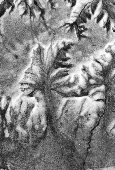
Photo: Unknown authorUnknown author, Public domain, via Wikimedia Commons
The Badlands Guardian is a remarkable geomorphological feature located near Medicine Hat in southeastern Alberta, Canada, that creates the optical illusion of a human head wearing traditional First Nations headdress when viewed from above. Discovered in 2005 by Lynn Hickox using Google Earth satellite imagery, this natural formation stretches approximately 225 meters from north to south and was carved entirely by wind and water erosion over millions of years. The feature sits within the Canadian Badlands, a region characterized by deeply incised valleys, exposed sedimentary rock layers, and dramatic erosional landscapes. What makes this formation particularly striking is how the natural contours of the eroded terrain create distinct facial features including what appears to be an eye, nose, and lips, along with what resembles a feathered headdress extending to the west.
Timeline
Sedimentary rock layers that would form the Badlands Guardian begin depositing during the late Cretaceous period
Post-glacial erosional processes intensify, gradually carving the distinctive features of the formation
Lynn Hickox discovers the Badlands Guardian formation while exploring Google Earth satellite imagery
What the Show Claims
- ›The Badlands Guardian formation may have been created or marked by extraterrestrials as a sign or monumentS14E02
- ›Ancient aliens may have used geographical landmarks like the Badlands Guardian to communicate or mark significant locationsS14E02
What Archaeology Says
Unlike traditional archaeological sites, the Badlands Guardian presents no evidence of human construction or modification throughout its formation history. Geological surveys of the area confirm that the distinctive facial features result entirely from natural erosional processes acting on sedimentary rock layers deposited during the Mesozoic Era. The Canadian Badlands region has been extensively studied by geologists and paleontologists, primarily for its rich fossil deposits rather than any archaeological significance.
No excavations have been conducted at the Badlands Guardian site itself, as remote sensing and geological analysis clearly demonstrate its natural origins. The formation sits within a landscape that has yielded significant paleontological discoveries, including dinosaur fossils and other Cretaceous period specimens, but shows no signs of ancient human activity or artificial modification. Researchers studying the broader Badlands region focus on understanding the geological processes that created these dramatic erosional features.
The scientific consensus firmly establishes the Badlands Guardian as a product of natural geological forces, specifically differential erosion acting on varying rock hardness and composition over millions of years. Wind, water, and freeze-thaw cycles gradually carved the distinctive contours that create the face-like appearance when viewed from above. What remains intriguing to researchers is the precise combination of geological factors that resulted in such a remarkably face-like formation, though this falls within the realm of natural geological processes rather than archaeological mystery.
While the formation's discovery through satellite imagery represents a modern technological achievement, there are no genuine archaeological unknowns surrounding the site. The apparent headdress portion of the formation includes a road and well pad that were constructed after the area's initial development, adding human-made elements to what is otherwise an entirely natural feature.
Mysteries & Fun Facts
The Badlands Guardian was completely unknown to humans until 2005, despite existing for millions of years, highlighting how satellite technology reveals hidden landscape features
The formation includes what appears to be earbuds or headphones, which is actually a road and oil well pad that were coincidentally placed in the perfect location to complete the illusion
Lynn Hickox discovered the formation while browsing Google Earth for interesting geographical features, making it one of the first major landscape discoveries made through civilian satellite imagery
The face-like appearance is only visible from directly above at a specific altitude range, demonstrating how perspective dramatically affects our perception of natural formations
Planning a Visit
The Badlands Guardian is located on private land and is not accessible for direct ground-level visits, making aerial viewing or satellite imagery the primary ways to appreciate its distinctive appearance. The formation is best observed through online satellite mapping services like Google Earth, where visitors can explore the feature from the aerial perspective that reveals its face-like qualities. Those interested in the broader Canadian Badlands region can visit nearby areas with public access for similar geological formations.
Medicine Hat, Alberta, approximately 17 kilometers northwest of the formation
Since the Badlands Guardian is primarily experienced through satellite imagery, it can be "visited" digitally year-round. For those exploring the surrounding Canadian Badlands region, late spring through early fall offers the most favorable weather conditions and clearest aerial visibility.
Related Sites
Tunguska explosion site
Both represent modern discoveries of unusual landscape features that have sparked theories about extraterrestrial involvement or marking
Crop Circle Hotspots (Wiltshire)
Like the Badlands Guardian, crop circles involve ground formations that are most clearly visible from aerial perspectives and have generated similar ancient astronaut theories
Mount Denali
Mount Denali represents another North American geographical landmark that some ancient astronaut theorists suggest could have served as a navigation marker for extraterrestrial visitors
Featured In1 episodes
Historical data sourced from Wikipedia