Crop Circle Phenomenon Sites (Britain)
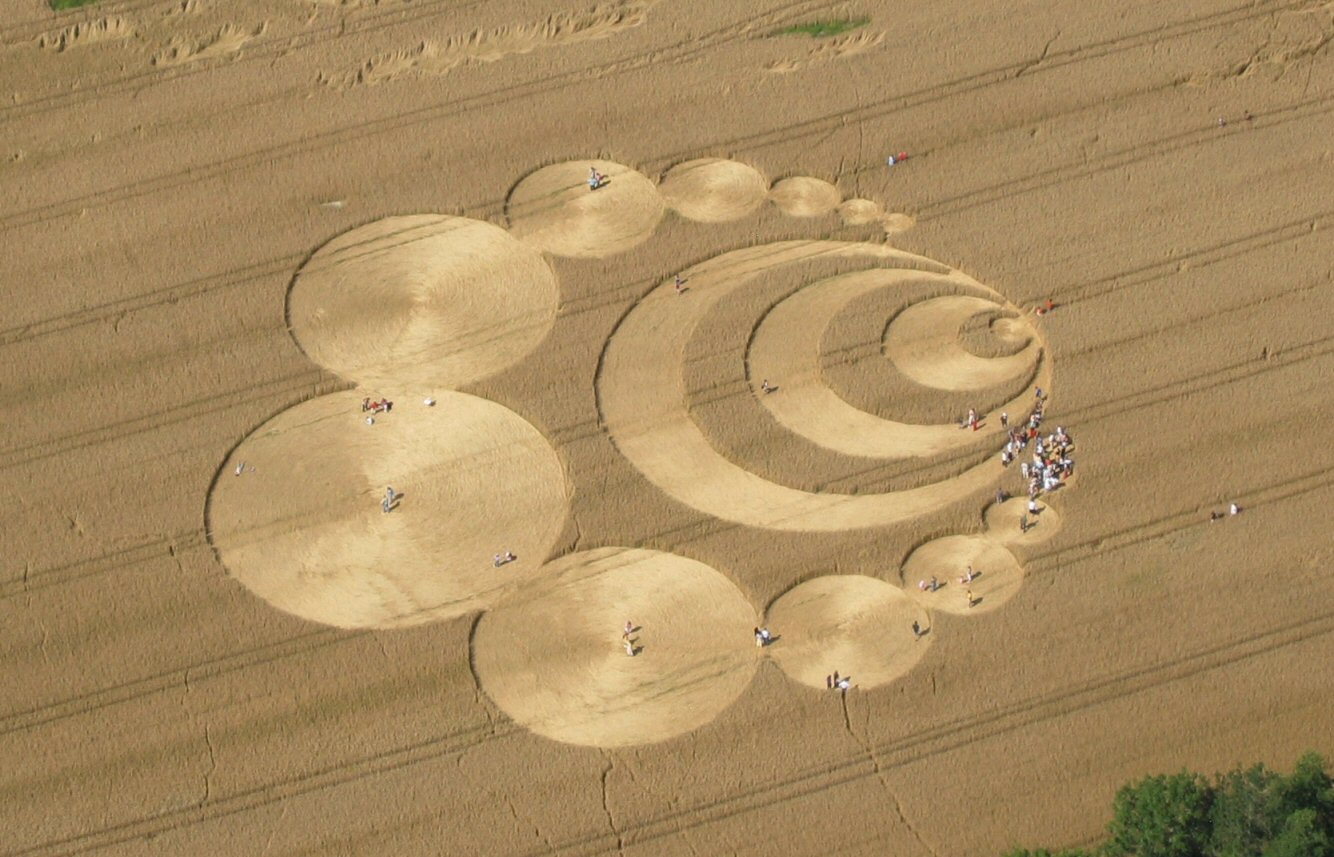
Photo: Jabberocky, Public domain, via Wikimedia Commons
Crop circle phenomena sites across Britain represent hundreds of intricate geometric patterns that have appeared in agricultural fields, primarily across the countryside of southern England. The formations range from simple circles to elaborate designs spanning several hundred feet in diameter, with some of the most complex patterns containing over 400 individual elements. These temporary installations appear predominantly in wheat, barley, and rapeseed fields during growing seasons, creating flattened crop patterns that are best viewed from elevated positions or aircraft. The phenomenon has been most concentrated in the counties of Wiltshire, Hampshire, and surrounding areas, where the chalk downs and ancient landscape features provide a dramatic backdrop for these controversial formations.
Timeline
First widely reported modern crop circle formations begin appearing in southern England
Doug Bower and Dave Chorley publicly demonstrate crop circle creation techniques, claiming responsibility for many early formations
Scientific studies using magnetometers and soil analysis begin systematic investigation of crop circle sites
Ancient Aliens explores British crop circles as potential evidence of extraterrestrial communication
What the Show Claims
- ›Crop circles represent evidence of extraterrestrial visitation and UFO activity across BritainS21E15
- ›The geometric complexity and precision of formations suggests non-human intelligenceS21E15
- ›Electromagnetic anomalies detected at crop circle sites indicate advanced technologyS21E15
What Archaeology Says
Scientific investigation of crop circle sites has revealed a complex phenomenon with both human and potentially natural explanations. Researchers have documented clear evidence of human creation in many formations, with bent crop stalks showing mechanical stress patterns consistent with planks and ropes. Soil analysis has occasionally detected unusual magnetic particle deposits and temporary changes in crystalline structure within formation areas, though these findings remain subjects of ongoing study.
Key investigators including biophysicist Dr. William Levengood and mathematician Gerald Hawkins have applied rigorous scientific methods to crop circle analysis. Levengood's research identified cellular changes in crops from certain formations, including enlarged cell wall pits and elongated nodes, suggesting rapid heating or microwave-like energy exposure. Hawkins discovered mathematical relationships in some formations that correspond to musical ratios and geometric theorems.
The scientific consensus acknowledges that while many crop circles are demonstrably human-made, a small percentage exhibit characteristics that remain unexplained by conventional means. These include formations appearing in minutes rather than hours, geometric precision beyond typical human capability using simple tools, and associated reports of electromagnetic effects on electronic equipment.
What remains genuinely mysterious are the documented cases of formations appearing rapidly in areas under observation, the occasional presence of unusual electromagnetic readings, and the mathematical sophistication of certain designs. The phenomenon continues to attract both serious researchers and skeptical investigators, with the question of non-human involvement remaining unresolved for a subset of documented cases.
Mysteries & Fun Facts
The term "crop circle" was first coined by researcher Colin Andrews in the early 1980s
Some formations have appeared to respond to human thoughts or requests made at previous sites, according to researcher observations
The most complex crop circles can contain mathematical concepts including fractals, DNA sequences, and astronomical alignments
Certain formations have been documented appearing in under 15 minutes in areas that would typically require hours of human work to complete
Planning a Visit
Many crop circle sites are located on private farmland, so respectful access requires landowner permission when formations are present. Several tour companies in Wiltshire offer guided visits during active seasons, typically between May and September when most formations appear.
Salisbury, Wiltshire, approximately 10-20 miles from most documented formation sites.
Late spring through early autumn offers the highest likelihood of encountering active formations, with peak activity generally occurring during July and August harvest seasons.
Featured Locations14 sites within this area
Wiltshire crop circle fields
United KingdomBristol (aerial craft account)
United KingdomGolden Ball Hill formation site
United KingdomKnap Hill, Wiltshire
United KingdomMilk Hill, Wiltshire
United KingdomChiseldon crop formation site
United KingdomAvebury ghost formation site
United KingdomCorsham Computer Centre (C.C.C.)
United KingdomAvebury
United KingdomWest Kennet Long Barrow
United KingdomWindmill Hill prehistoric earthwork, Wiltshire, England
United KingdomTawsmead Copse crop circle, Wiltshire, England
United KingdomMilk Hill, Wiltshire (crop circle formation site)
United KingdomCherhill, Wiltshire (crop circle site)
United KingdomRelated Sites
Avebury Stone Circle
Located in the heart of Wiltshire's crop circle country, this ancient stone circle is frequently associated with nearby formation appearances
Silbury Hill
This mysterious artificial hill sits in the center of major crop circle activity areas and has been linked to formation patterns
Rudloe Manor
This former RAF facility in Wiltshire has been connected to UFO research and sits within the region's most active crop circle zones