Cambridge University Department of Zoology
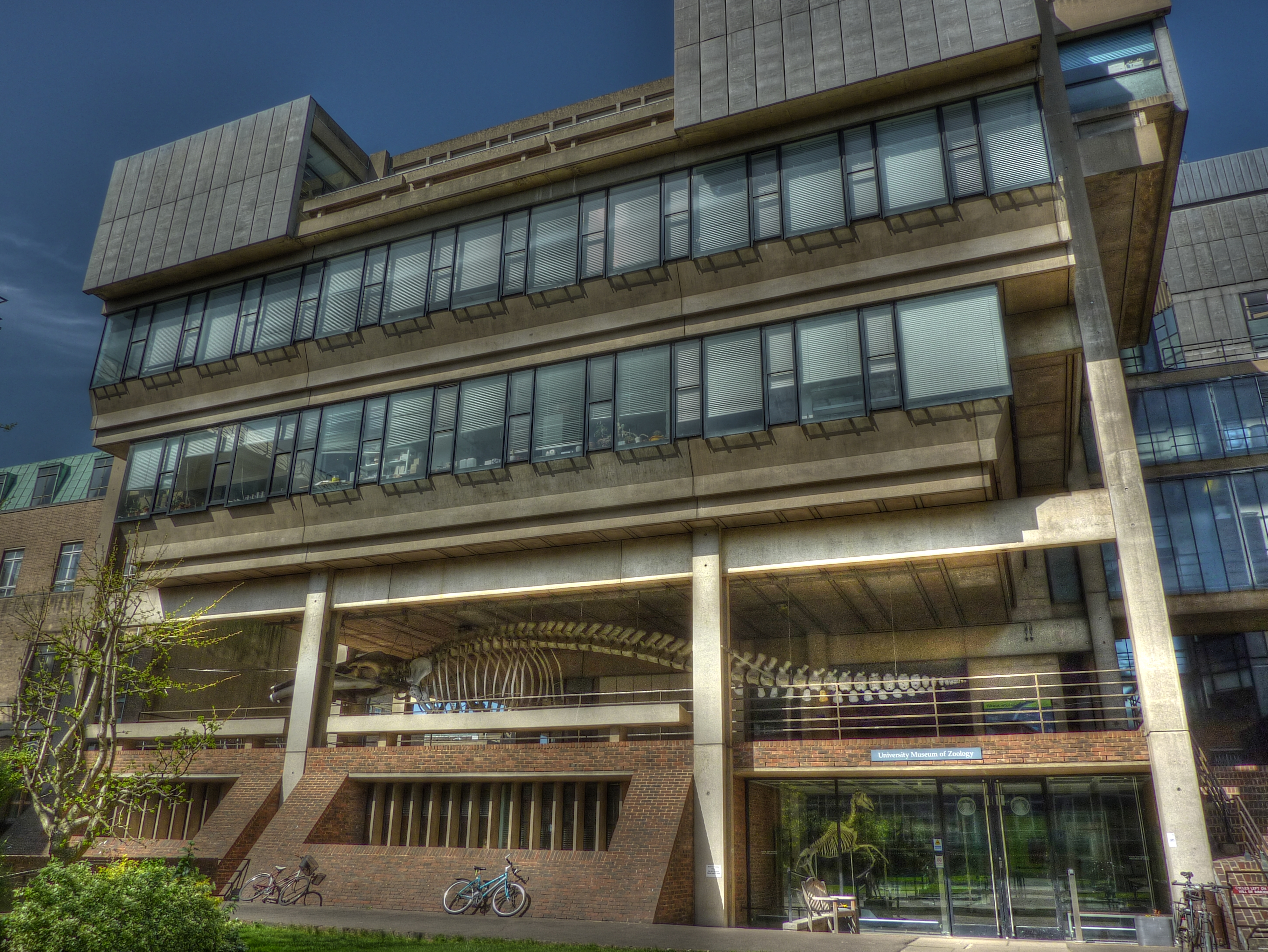
Photo: Magnus Manske, CC BY-SA 3.0, via Wikimedia Commons
Cambridge University's Department of Zoology is a modern research facility located in the heart of Cambridge, England, where groundbreaking biological discoveries continue to reshape our understanding of life on Earth. The department occupies several buildings across the university campus, with research laboratories spanning approximately 15,000 square meters of space dedicated to evolutionary biology, animal behavior, and biomechanics. Established in 1866, it stands as one of Britain's premier zoological research institutions, housed within the university's historic grounds that date back to 1209. Today, visitors can observe ongoing research that bridges the gap between ancient biological mysteries and cutting-edge scientific investigation.
Timeline
Cambridge University founded, establishing the academic foundation for future scientific research
Department of Zoology formally established at Cambridge University
Cambridge researchers publish discovery of mechanical gears in Issus plant-hopper insects
What the Show Claims
- ›The 2013 discovery of biological mechanical gears in the Issus insect represents evidence of engineered complexity suggesting extraterrestrial design or originS07E07
From the Transcripts
“Cambridge University, England. 2013. Using a high-speed camera with intense magnification, scientists from the department of zoology record the movement of a plant-hopping insect called Issus.”
What Archaeology Says
While Cambridge University itself is not an archaeological site in the traditional sense, the 2013 discovery made here represents a pivotal moment in our understanding of biological engineering that has captured the attention of ancient astronaut theorists. The research, led by Cambridge scientists, revealed that juvenile Issus plant-hoppers possess interlocking gear teeth on their hind legs - the first documented functional gear mechanism found in any living organism. These microscopic gears, measuring just 400 micrometers in length, work in perfect synchronization to coordinate the insect's powerful jumping motion.
The scientific team used high-speed cameras and electron microscopy to document how these biological gears function, showing that each tooth engages precisely with its counterpart to prevent the insect's legs from moving out of sync during jumps. The gears disappear in adult insects, replaced by a friction-based system, suggesting an evolutionary refinement rather than degradation. Mainstream evolutionary biologists explain this remarkable adaptation as a product of natural selection, where the mechanical advantage provided by gearing offered survival benefits over millions of years.
What remains genuinely intriguing is the precision of this biological engineering - the gear teeth show tolerances and design principles that mirror human-made mechanical systems. The discovery has sparked broader questions about the prevalence of sophisticated mechanical solutions in nature and whether similar biological engineering exists in other organisms yet to be studied. This finding represents one of many examples where modern scientific instruments reveal natural complexities that challenge our assumptions about the boundaries between biological and mechanical systems.
Mysteries & Fun Facts
The Issus insect gears rotate in perfect synchronization, with each gear tooth measuring less than half the width of a human hair
These biological gears only exist in juvenile insects and are replaced by a friction-based system when the insect molts into adulthood
The discovery overturned the long-held belief that gear mechanisms were exclusively human inventions
Cambridge University's Department of Zoology has produced numerous Nobel Prize winners and pioneered the field of animal behavior studies
Planning a Visit
The Cambridge University Department of Zoology is generally accessible to visitors through guided tours and special events, though active research areas require advance arrangements. The university campus welcomes tourists year-round, with the zoological collections and some laboratory spaces available for viewing during scheduled open days.
Cambridge city center, located directly within the university grounds.
Spring and summer months offer the best weather for campus exploration, while avoiding the busy student examination periods in May and June typically provides a more relaxed visiting experience.
Related Sites
Antikythera (mechanism discovery site)
Both sites involve the discovery of sophisticated mechanical systems that challenge our understanding of ancient and biological engineering capabilities
Royal Society, London
As Britain's premier scientific institution, the Royal Society has long been connected to Cambridge University research and the investigation of unexplained phenomena
Çatalhöyük
This ancient settlement reveals early human technological sophistication that parallels the complex biological engineering found in modern Cambridge research