Island of Crete
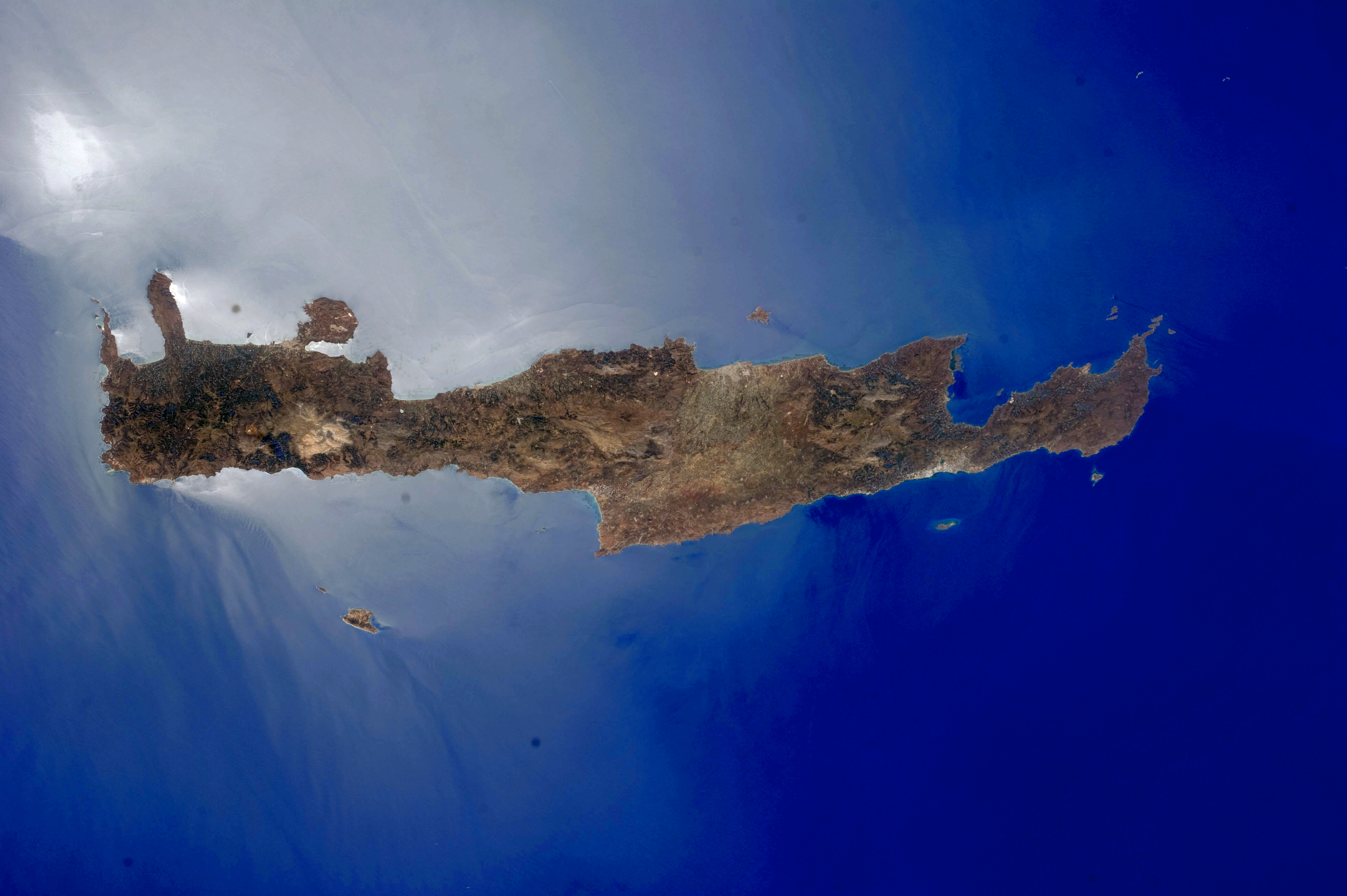
Photo: ISS Expedition 28 crew, Public domain, via Wikimedia Commons
The island of Crete, stretching approximately 260 kilometers from east to west, stands as the largest Greek island and the legendary birthplace of one of antiquity's most intriguing mythological figures: Talos, the bronze giant. Today, visitors to Crete encounter not only stunning Mediterranean landscapes and archaeological sites from the advanced Minoan civilization, but also the enduring mystery of ancient Greek accounts describing a mechanical guardian that supposedly protected the island's shores. The island's strategic position in the eastern Mediterranean made it a natural crossroads of ancient civilizations, where myth and reality often intertwined in ways that continue to fascinate researchers and visitors alike.
Timeline
Minoan civilization begins to flourish on Crete, developing one of Europe's earliest advanced cultures
Decline of Minoan civilization, possibly due to natural disasters or invasions
Apollonius of Rhodes writes the Argonautica, featuring detailed descriptions of Talos guarding Crete
British archaeologist Sir Arthur Evans begins major excavations at Knossos, revealing Minoan palace complexes
What the Show Claims
- ›The mythological bronze giant Talos was actually a functioning robot created with extraterrestrial technology by Hephaestus to guard CreteS10E03S13E15
- ›Talos represents evidence of ancient advanced technology that could have been inspired by actual mechanical devicesS10E03
Theorist Takes
“We have to ask ourselves, is it possible that the ancients were aware that the octopus is truly alien to this planet?”
From the Transcripts
“One of Hephaestus' most famous and amazing creations was Talos, a giant man made of bronze who protected the island of Crete.”
“For instance, in ancient Crete, there are numerous images and paintings of an octopus with bizarre, large eyes.”
What Archaeology Says
Archaeological investigations across Crete have revealed the sophisticated nature of Minoan civilization, particularly through Sir Arthur Evans' groundbreaking work at Knossos in the early 20th century. The Minoans demonstrated remarkable engineering capabilities, constructing multi-story palaces with advanced drainage systems, colorful frescoes, and complex storage facilities that suggest a highly organized society capable of impressive technological achievements for their time.
While no physical evidence of mechanical automatons has been discovered on Crete, the island's archaeological record does reveal a culture with sophisticated metallurgical skills and artistic traditions that frequently depicted fantastical creatures and divine figures. The Minoan civilization's sudden decline around 1450 BC remains partially mysterious, with theories ranging from natural disasters like the Thera volcanic eruption to invasions by Mycenaean Greeks.
The Talos legend itself appears prominently in later Greek literature, most notably in Apollonius of Rhodes' Argonautica, where the bronze giant is described as circling the island three times daily and using heat to destroy enemy ships. Classical scholars generally interpret Talos as a mythological representation of divine protection rather than a historical account of actual technology.
What remains genuinely intriguing is how ancient Greek writers described mechanical details of Talos with such specificity, including references to a single vein running from his neck to his ankle that could be his weakness. Whether this reflects cultural memory of actual advanced devices or simply represents the vivid imagination of ancient storytellers continues to generate discussion among researchers studying the intersection of mythology and technology in ancient cultures.
Mysteries & Fun Facts
According to Greek mythology, Talos was said to be made entirely of bronze except for a single vein running from his neck to his ankle
The Minoan civilization on Crete is considered Europe's first advanced civilization, predating classical Greek culture by over a millennium
Ancient accounts describe Talos as being able to heat his bronze body red-hot to incinerate enemies who came too close
Crete's position in the Mediterranean made it a crucial link between European, African, and Asian trade routes in antiquity
Planning a Visit
Crete is easily accessible to visitors via major airports in Heraklion and Chania, with numerous archaeological sites open to the public including the famous palace of Knossos. The island offers extensive tourism infrastructure with museums, guided tours, and information centers that explore both the historical Minoan civilization and the mythological traditions associated with the island.
Heraklion serves as Crete's largest city and main transportation hub
Late spring through early fall offers the most pleasant weather for exploring Crete's archaeological sites, with summer months being warmest but also most crowded.
Featured Locations1 sites within this area
Ancient Crete (Minoan octopus imagery sites)
GreeceTheorists argue that numerous Minoan images and paintings of octopuses with large, bizarre eyes found in ancient Crete indicate that ancient peoples recognized the octopus as a truly alien creature and possibly related to extraterrestrial visitors. Mainstream archaeologists regard octopus imagery in Minoan art as a common decorative and cultural motif reflecting the seafaring civilization's close relationship with the Mediterranean.
Related Sites
Antikythera (mechanism discovery site)
The nearby Antikythera mechanism discovery represents actual ancient Greek mechanical sophistication that parallels theories about advanced ancient technology
Kailasa Temple
Like the Talos legend, the Kailasa Temple raises questions about the technological capabilities of ancient civilizations
Gobekli Tepe
Gobekli Tepe represents another ancient site where sophisticated construction techniques challenge conventional timelines of human technological development