Mauna Loa
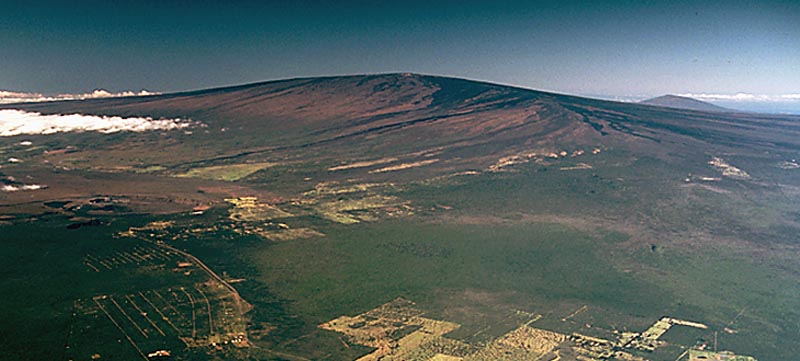
Photo: J.D. Griggs, Public domain, via Wikimedia Commons
Mauna Loa, meaning 'Long Mountain' in Hawaiian, is Earth's largest active volcano by both mass and volume, with an estimated volume of 18,000 cubic miles. This massive shield volcano rises from the Pacific Ocean floor to form nearly half of Hawaii's Big Island, though its peak stands about 125 feet lower than neighboring Mauna Kea. The volcano's gentle slopes and fluid lava flows create a distinctive shield shape that has been building for at least 700,000 years. Today, visitors encounter one of the most intensively monitored volcanic systems on Earth, with sophisticated equipment tracking every tremor and gas emission from multiple research stations.
Timeline
Mauna Loa begins erupting, starting formation of massive shield volcano
Volcano emerges above sea level, beginning island formation process
Hawaiian Volcano Observatory established, beginning intensive scientific monitoring
Major eruption lasts 22 days, threatening Hilo with lava flows
Most recent eruption begins November 27, ends December 13 after first activity since 1984
What the Show Claims
- ›Mauna Loa's location at 19.47 degrees north latitude corresponds to vertices of a star tetrahedron and mirrors volcanic features on Mars and Jupiter, indicating a cosmic energy portalS14E12
Theorist Takes
“Because of the planet's geometry, you're going to have hot spots that would be very strongly charged in such a way that you could use these hot spots to teleport from one point to the other.”
From the Transcripts
“Mauna Loa volcano in particular is located at 19.47 latitude in the Northern Hemisphere. That area sitting at 19.47 is called Kealakekua, which means 'Pathway of the Gods.'”
What Archaeology Says
While Mauna Loa itself predates human habitation, Native Hawaiian oral traditions and archaeological evidence reveal a rich cultural relationship with this volcanic giant spanning over 1,000 years. Ancient Hawaiians developed sophisticated understanding of volcanic cycles, incorporating Mauna Loa into their spiritual cosmology as the domain of Pele, the volcano goddess. Archaeological surveys have uncovered traditional Hawaiian sites on the volcano's slopes, including ceremonial platforms and ancient trails that connected coastal communities to high-altitude resources.
Modern scientific investigation began in earnest with the establishment of the Hawaiian Volcano Observatory in 1912, making Mauna Loa one of the longest continuously monitored volcanoes in the world. Researchers like Thomas Jaggar pioneered volcanic monitoring techniques here, developing methods now used globally. The volcano's well-documented eruption history, dating back to 1843, provides crucial data for understanding shield volcano behavior and magma chamber dynamics.
Geological consensus attributes Mauna Loa's formation to the Hawaiian hotspot, a stationary mantle plume that has created the entire Hawaiian Island chain as the Pacific Plate moves northwestward. Scientific analysis reveals the volcano's magma originates from depths of 60-100 kilometers, producing the characteristically fluid, silica-poor lavas that build shield volcanoes. Dating of rock samples confirms the volcano has been active for at least 700,000 years, with some specimens reaching 470,000 years old.
Despite extensive study, significant mysteries remain about Mauna Loa's internal structure and eruption triggers. Scientists continue investigating the complex relationship between the volcano and its neighbor Kīlauea, including whether they share magma sources. The precise mechanisms controlling eruption timing and duration remain subjects of active research, as does the volcano's future behavior as the Pacific Plate carries it away from the hotspot over the next 500,000 to one million years.
Mysteries & Fun Facts
Mauna Loa was considered the largest volcano on Earth until the discovery of the underwater Tamu Massif in 2013
The volcano produces roughly half the land area of Hawaii's Big Island
Lava flows from the late 19th century form part of the foundation beneath the city of Hilo
The Pacific Plate's movement will eventually carry Mauna Loa away from its hotspot source, causing it to become extinct in 500,000 to one million years
Planning a Visit
Hawaii Volcanoes National Park covers Mauna Loa's summit and portions of its southeastern and southwestern flanks, providing visitor access to this active geological wonder. The Mauna Loa Observatory Road offers vehicle access partway up the mountain, while hiking trails lead to the summit caldera. Visitors should be prepared for high-altitude conditions and rapidly changing weather.
Hilo, Hawaii, approximately 30 miles northeast of the volcano's base.
The dry season from April to October generally provides clearer skies and better visibility for viewing the volcanic landscape. However, high-altitude conditions can be harsh year-round, with temperatures dropping significantly above 10,000 feet elevation.
Related Sites
Mount Denali
Both represent mysterious geological formations that ancient alien theorists claim hold special significance due to their unique locations and properties
Tunguska explosion site
Another site where theorists propose cosmic or extraterrestrial influences shaped dramatic geological events
Plain of Jars
Like Mauna Loa, features unusual geological formations in remote locations that have sparked theories about ancient extraterrestrial activity
Featured In1 episodes
Historical data sourced from Wikipedia