Crete
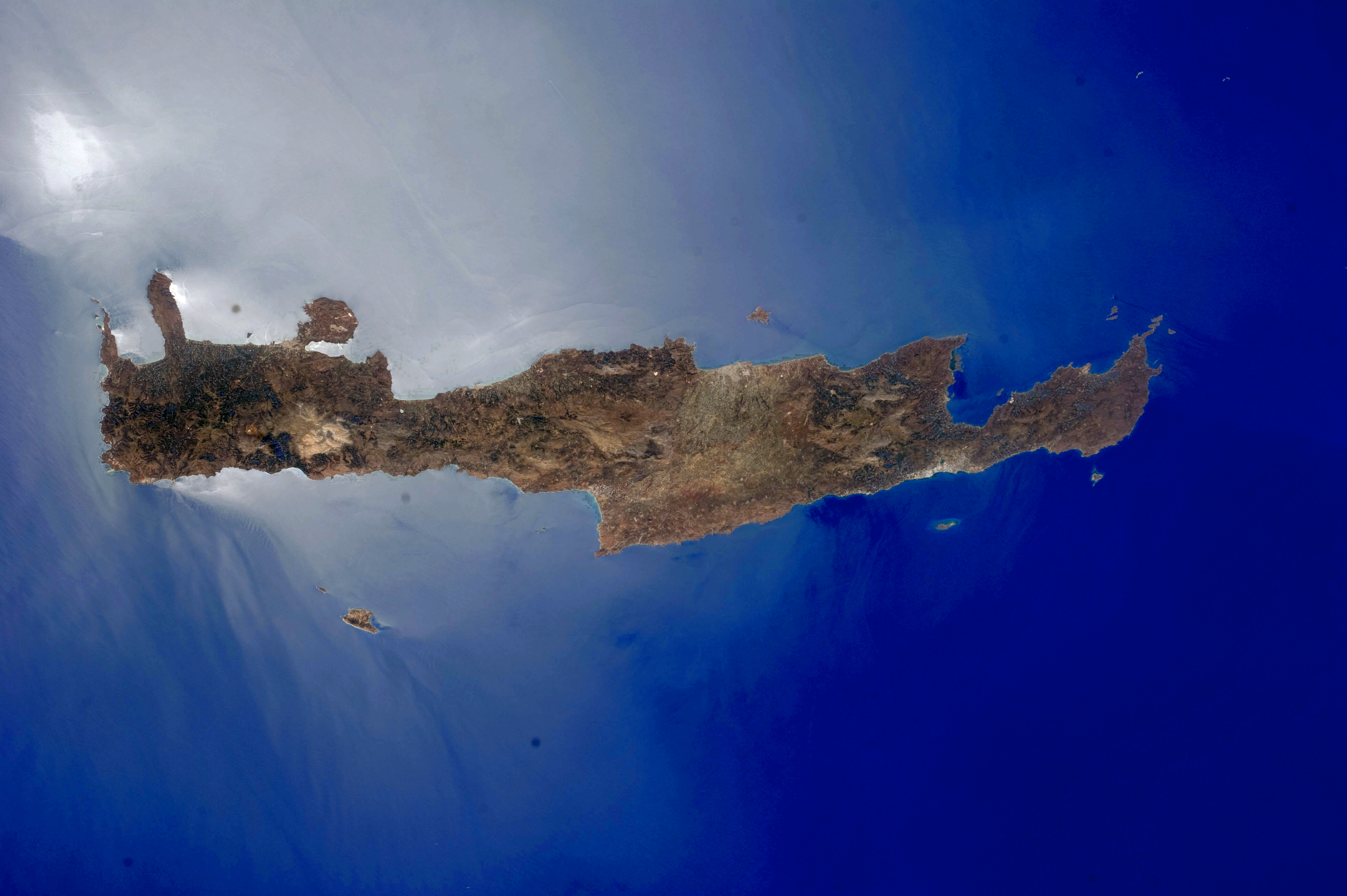
Photo: ISS Expedition 28 crew, Public domain, via Wikimedia Commons
Crete is Greece's largest island, stretching 260 kilometers from west to east across the southern Aegean Sea. With an area of 8,450 square kilometers and a coastline of 1,046 kilometers, this mountainous island serves as the cradle of Europe's first advanced civilization — the mysterious Minoans who flourished from 2700 to 1420 BC. Today, visitors can explore the reconstructed palace complex at Knossos near Heraklion, walk through the dramatic Samaria Gorge, and witness geological evidence of the catastrophic 365 AD earthquake that lifted portions of the island by approximately nine meters. The island's rugged terrain includes Mount Ida, Crete's highest peak, and the White Mountains with 30 summits exceeding 2,000 meters in elevation. Some theorists have speculated that the catastrophic 365 AD earthquake and tsunami that devastated Crete may have represented divine intervention by Poseidon or other supernatural forces, potentially linked to extraterrestrial influence reshaping the religious landscape of the ancient Mediterranean. Geological evidence, however, documents the event as a massive magnitude-8 undersea earthquake — a natural seismic phenomenon that physically elevated the island by nine meters and triggered tsunamis that devastated coastal cities across the region, demonstrating the raw power of tectonic forces without requiring intervention from beyond our world.
Timeline
Minoan civilization begins, establishing Europe's first advanced Bronze Age culture
Minoan civilization ends, possibly due to natural disasters or Mycenaean conquest
Massive undersea earthquake devastates Crete, lifting the island by nine meters
Crete achieves autonomy from the Ottoman Empire as the Cretan State
Crete officially becomes part of modern Greece
What the Show Claims
- ›The 365 AD earthquake and tsunami that devastated Crete may have been the wrath of Poseidon — potentially an extraterrestrial being wielding advanced technology — to destroy resurgent paganism and reshape Western civilizationS04E04
Theorist Takes
“This may be the wrath of Poseidon, because what was happening at that time was the early Christians were struggling against a resurgence of paganism... and that tsunami came... to destroy, finally, all the pagan religion in the area.”
From the Transcripts
“Here, in 365 AD, this once-quiet province of the Byzantine Empire was destroyed by a devastating underwater earthquake and subsequent tsunami.”
What Archaeology Says
Archaeological investigations across Crete have revealed the sophisticated nature of Minoan civilization, particularly at sites like Knossos, Phaistos, and Malia. These excavations have uncovered multi-story palace complexes with advanced drainage systems, colorful frescoes depicting bull-leaping ceremonies, and the still-undeciphered Linear A script. The sudden end of Minoan civilization around 1420 BC remains one of archaeology's great mysteries, with theories ranging from natural disasters to invasion by Mycenaean Greeks from the mainland.
The 365 AD earthquake represents one of the most dramatic geological events in recorded Mediterranean history. Geological surveys have confirmed that this massive seismic event, estimated at magnitude 8 or higher, physically raised portions of Crete by up to nine meters — evidence still visible today in elevated ancient shorelines and marine fossils found well above current sea level. The earthquake generated tsunamis that devastated coastal cities across the eastern Mediterranean, including Alexandria in Egypt.
Modern seismologists understand this catastrophe within the context of Crete's position along the Hellenic Arc, where the African plate subducts beneath the Eurasian plate. This tectonic setting makes the region highly susceptible to major earthquakes and tsunamis. While the scale of the 365 AD event was extraordinary, it fits established patterns of seismic activity in the eastern Mediterranean.
Despite extensive research, many aspects of Crete's ancient history remain enigmatic. The exact cause of the Minoan civilization's collapse continues to be debated, with volcanic eruptions, earthquakes, and social upheaval all proposed as contributing factors. The meaning of Linear A script remains undeciphered, leaving much of Minoan culture and beliefs mysterious to modern scholars.
Mysteries & Fun Facts
Crete is the fifth largest island in the Mediterranean Sea, after Sicily, Sardinia, Cyprus, and Corsica
The island spans three degrees of longitude but only half a degree of latitude, creating its distinctive elongated shape
Mount Ida on Crete is mythologically known as the birthplace of Zeus in Greek mythology
The 365 AD earthquake was so powerful it raised ancient shorelines by nine meters, still visible today as elevated marine terraces
Planning a Visit
Crete is easily accessible via international airports at Heraklion and Chania, with excellent ferry connections to mainland Greece. The island offers well-developed tourist infrastructure, from the reconstructed Minoan palace at Knossos to hiking trails through the Samaria Gorge and numerous archaeological museums.
Heraklion, the island's capital and largest city
Late spring through early fall offers the best weather for exploring archaeological sites and hiking. Summer can be crowded but provides ideal conditions for combining historical exploration with beach relaxation.
Featured Locations1 sites within this area
Palace of Knossos, Crete
GreeceRelated Sites
Also Covered In
Featured In1 episodes
Historical data sourced from Wikipedia