Masuda-no-Iwafune
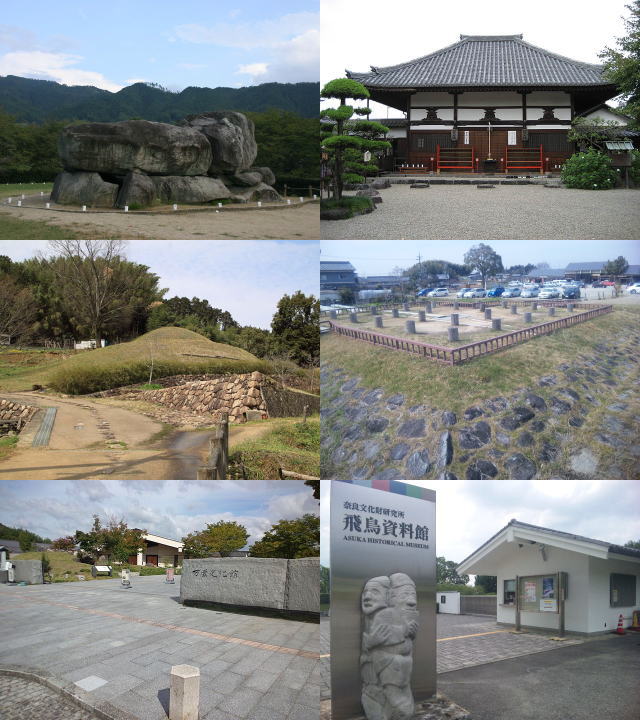
Photo: Terumasa 左列 ja:石舞台古墳-file:Ishibutaikofun.jpg(user:Yosemite) ja:マルコ山古墳-file:Marukoyamakofun.JPG(user:Shirasutarchan) ja:奈良県立万葉文化館-file:Man'yō- Museum Entrance3.jpg(user:Yanajin33) 右列 ja:飛鳥寺-file:Main Hall at Asuka-dera, Asuka, Nara.jpeg(user:Zeroyon) ja:飛鳥水落遺跡-file:Mizuochi-iseki-2.jpg(user:terumasa) ja:飛鳥資料館-file:Nabunken-asuka.jpg(user:terumasa), CC BY-SA 3.0, via Wikimedia Commons
The Masuda-no-Iwafune stands as one of Japan's most enigmatic ancient monuments, a massive granite megalith measuring approximately 11 meters long, 8 meters wide, and 4.7 meters high. This single block of stone, estimated to weigh around 800 tons, was carved with remarkable precision into a rectangular form with flat surfaces and clean edges that seem to defy the primitive tools typically associated with its uncertain age. Located in the historically rich Asuka region of Nara Prefecture, the monument sits among rolling hills that have yielded numerous archaeological treasures from Japan's ancient past. What makes this stone particularly puzzling is that its architectural style matches no known Japanese building tradition, leaving researchers to speculate about its original creators and purpose. Some theorists have proposed that the stone's name—"Ama no Iwafune," or "heavenly stone ship"—and its ship-like rectangular form suggest it was carved to represent the flying vessels described in Japanese mythology as divine transportation from the heavens. However, archaeologists note that the monument's actual age and purpose remain undetermined, and its resemblance to a ship may reflect symbolic or ritual significance within Japan's indigenous spiritual traditions rather than a literal representation of celestial craft. The stone's precision craftsmanship does raise legitimate questions about the tools and techniques available to its builders, a challenge that mainstream researchers continue to investigate through comparative analysis with other megalithic cultures.
Timeline
Estimated period of construction based on regional archaeological context, though precise dating remains uncertain
Local traditions and folklore about the 'stone ship' begin appearing in regional records
First detailed archaeological survey conducted, documenting precise measurements and carved features
Featured on Ancient Aliens television series, bringing international attention to the mysterious megalith
What the Show Claims
- ›The Masuda-no-Iwafune was carved to depict or commemorate the flying stone boats (Ama no Iwafune) described in ancient Japanese texts as vehicles used by gods descending from the heavensS12E14
- ›The monument's name literally translates to 'stone ship' or 'rock ship,' suggesting ancient knowledge of aerial vehiclesS12E14
- ›The precision carving of an 800-ton granite block indicates advanced ancient technology beyond conventional tools of the eraS12E14
Theorist Takes
“So, I guess with the combination of the mythologies of celestial beings, this could be some type of representation of one of those flying vehicles that our ancestors perhaps witnessed.”
From the Transcripts
“"Masuda" is the name of the region, and "iwafune" literally means "stone ship" or "rock ship."”
What Archaeology Says
Archaeological investigations of the Masuda-no-Iwafune have yielded more questions than answers about this remarkable monument. The initial comprehensive survey in 1935 established the megalith's precise dimensions and documented the sophisticated carving techniques used to shape the massive granite block. Researchers noted that the stone's surfaces are remarkably flat and smooth, with edges cut at precise angles that would challenge even modern stone-working equipment.
The monument's purpose remains one of Japan's greatest archaeological mysteries. Some scholars have proposed it served as an elaborate tomb, pointing to its proximity to other burial sites in the Asuka region. Others suggest it functioned as an astronomical observatory, noting potential alignments with celestial events, though no definitive astronomical correlations have been established. The lack of any interior chambers or obvious functional features has made these theories difficult to verify through conventional archaeological methods.
What particularly puzzles researchers is the monument's apparent age and the advanced techniques required for its construction. The Masuda-no-Iwafune predates the introduction of Buddhism to Japan and shows no stylistic connections to known Japanese architectural traditions of any period. The precision required to carve such clean lines and flat surfaces from a single 800-ton granite block suggests a level of technological sophistication that seems incongruous with the primitive tools typically associated with ancient Japanese stone-working.
Despite decades of study, the monument continues to defy easy categorization. Modern archaeological techniques have confirmed the exceptional craftsmanship but have not revealed clear evidence of its builders' identity or intentions. The site remains an active area of research, with scholars hoping that future discoveries in the surrounding Asuka region might provide crucial context for understanding this enigmatic stone ship that has captured imaginations for centuries.
Mysteries & Fun Facts
The monument weighs an estimated 800 tons, roughly equivalent to 400 compact cars stacked together
Despite its massive size, the stone surfaces are carved with precision that creates perfectly flat planes and clean right angles
The name 'Masuda-no-Iwafune' combines the local area name Masuda with 'iwafune,' meaning stone ship in Japanese
The site is part of the broader Asuka region, which served as Japan's ancient capital and contains numerous mysterious stone monuments
Planning a Visit
The Masuda-no-Iwafune is generally accessible to visitors, located along walking paths in the scenic Asuka region of Nara Prefecture. The site can be reached by a moderate hike through rural countryside, and the monument stands in an open area where visitors can examine its carved surfaces up close and appreciate its massive scale.
Nara, approximately 20 kilometers northeast of the site
Spring and autumn offer the most comfortable weather for hiking to the site, with pleasant temperatures and beautiful seasonal colors in the surrounding landscape. Summer visits are possible but can be quite hot and humid.
Featured Locations1 sites within this area
Masuda-no-Iwafune Megalith
JapanRelated Sites
Gobekli Tepe
Both sites feature massive stone blocks carved with precision that challenges assumptions about ancient technological capabilities
Sacsayhuaman
Like Masuda-no-Iwafune, Sacsayhuaman demonstrates sophisticated stone-cutting techniques applied to multi-ton granite blocks
Carnac Stones
The Carnac Stones represent another mysterious megalithic site where the original purpose and construction methods remain hotly debated