Mystery Hill (America's Stonehenge)
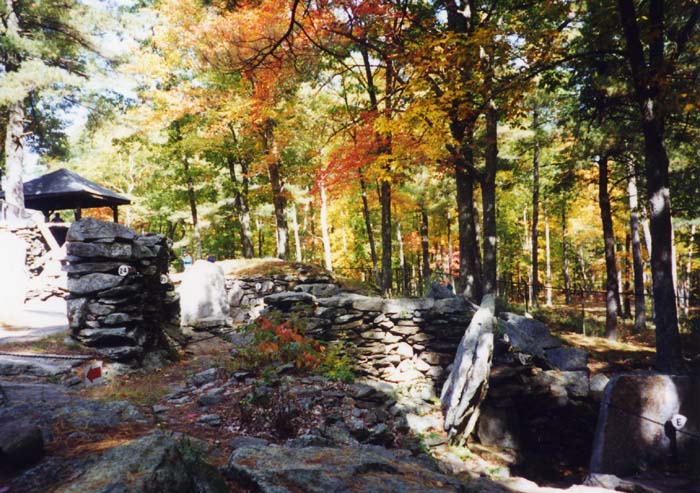
Photo: User:Stan Shebs, CC BY-SA 3.0, via Wikimedia Commons
Mystery Hill, also known as America's Stonehenge, is a 30-acre archaeological site in Salem, New Hampshire, featuring a complex of stone structures, chambers, and alleged astronomical alignments. The site contains approximately 20 stone chambers built from massive granite slabs, with the largest chamber measuring roughly 8 feet wide by 12 feet long. Visitors encounter a maze-like arrangement of stone walls, underground passages, and what proponents claim is a sacrificial table — a 4.5-ton grooved stone slab positioned atop stone legs. The structures are built into and around natural granite outcroppings in New Hampshire's rocky landscape, creating an enigmatic complex that has puzzled researchers for decades. Some theorists have proposed that ogham inscriptions at the site represent evidence of ancient Celtic Druid visitation to New England, pointing to the astronomical alignments and stone chambers as supporting this hypothesis. However, mainstream archaeologists remain skeptical of the ogham identifications, with most scholars attributing the structures to either colonial-era construction or pre-Columbian Native American builders, and noting that the site's layout and materials align more closely with documented regional building practices than with known Celtic archaeological signatures.
Timeline
Alleged construction period according to Celtic migration theories, though this dating is highly disputed
Possible Native American use of the site, based on some archaeological interpretations
First recorded documentation of the stone structures by European-American settlers
William Goodwin purchases the site and begins restoration, theorizing it as a Celtic monastery
Barry Fell claims inscriptions are ancient Celtic ogham script, sparking major controversy
Site opens to the public as 'America's Stonehenge' tourist attraction
What the Show Claims
- ›Ogham script inscriptions prove ancient Celtic Druids visited New England thousands of years agoS14E07
- ›Astronomical alignments in the stone structures demonstrate sophisticated ancient knowledgeS14E07
- ›Stone chambers served as Celtic ritual spaces and the sacrificial table confirms Druidic practicesS14E07
- ›The site predates Native American occupation and represents trans-oceanic contact in ancient times
Theorist Takes
“It's an area that covers 12 acres. It has multiple stone chambers. It has megalithic construction, such as standing stones, which have now been found to be astronomically aligned from the center of the site.”
From the Transcripts
“Salem, New Hampshire. July 9, 1975. At one of New England's most popular archaeological sites, Mystery Hill, also known as 'America's Stonehenge,' Harvard professor Barry Fell discovers a stone tablet with a mysterious script carved into it.”
What Archaeology Says
Archaeological investigations at Mystery Hill have yielded mixed results, with carbon dating of organic materials found within the structures producing dates ranging from the colonial period back to approximately 2000 years ago. However, the relationship between these dated materials and the actual construction of the stone structures remains unclear, as the organic matter could represent later use rather than original construction.
The site's most controversial aspect involves the alleged ogham inscriptions identified by Harvard professor Barry Fell in the 1970s. Fell claimed to have translated these markings as ancient Celtic script, but his interpretations have been widely rejected by mainstream archaeologists and linguists who argue that the markings are either natural stone formations, colonial-era tool marks, or modern scratches. The Epigraphic Society, which Fell founded, continues to support these interpretations, while academic institutions generally dismiss them as pseudoarchaeological.
Most professional archaeologists who have studied Mystery Hill believe the structures are likely colonial-era root cellars, farm buildings, or possibly pre-colonial Native American constructions that were later modified by European settlers. The astronomical alignments, while present, are not considered unusual given that many stone structures can appear to align with celestial events by chance or practical necessity.
What remains genuinely mysterious is the exact purpose and dating of some of the more elaborate chambers, particularly given the effort required to construct them using massive stone slabs. The site's true origins may represent a combination of different construction periods and purposes, making it difficult to assign a single explanation to the entire complex.
Mysteries & Fun Facts
The site's 4.5-ton 'sacrificial table' has a precisely carved groove around its perimeter that channels liquid to a spout
Some researchers claim the stone alignments mark important dates including summer and winter solstices
The site was originally called 'Jonathan Pattee's Caves' after an early 19th-century owner
Barry Fell's ogham interpretations included claims of Phoenician and Iberian script in addition to Celtic markings
Planning a Visit
Mystery Hill operates as a commercial tourist attraction generally open to the public during warmer months, though visitors should check current hours and admission requirements. The site features marked trails that guide visitors through the stone chambers and structures, with interpretive signs explaining both the alternative theories and mainstream archaeological perspectives.
Manchester, New Hampshire (approximately 25 miles southeast)
Late spring through early fall offers the most comfortable weather for exploring the outdoor stone structures and walking trails. Winter visits may be limited due to New England weather conditions and potential site closures.
Related Sites
Externsteine
This German rock formation also features alleged ancient inscriptions and astronomical alignments disputed by mainstream archaeology
Avebury Stone Circle
Like Mystery Hill, this British stone circle combines megalithic construction with claimed Celtic connections and astronomical significance