Temple of Angkor Wat
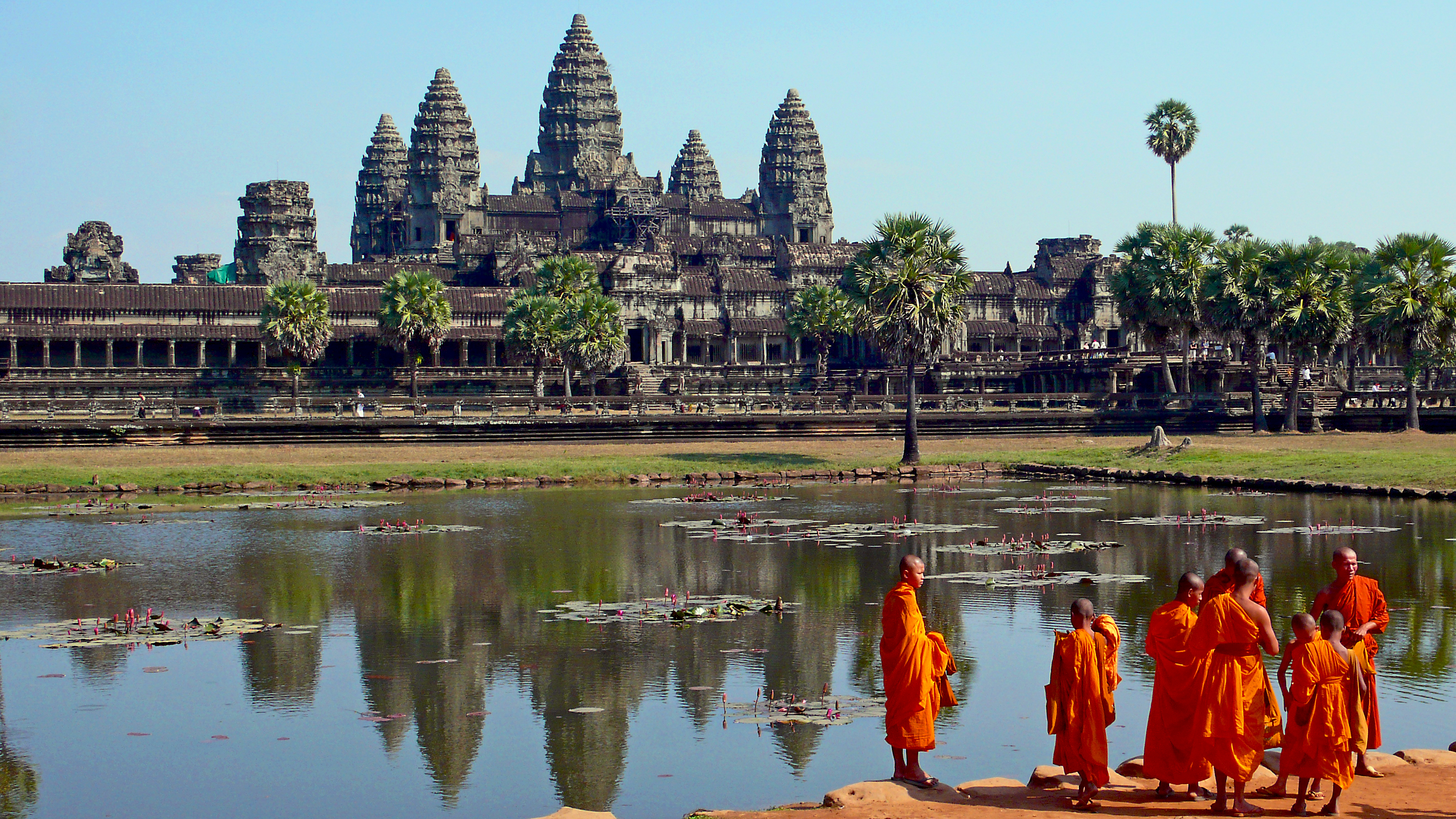
Photo: sam garza, CC BY 2.0, via Wikimedia Commons
Angkor Wat stands as the world's largest religious temple complex, covering approximately 400 acres within the greater Angkor Archaeological Park in northwestern Cambodia. Built in the early 12th century during the reign of King Suryavarman VII, this magnificent Hindu temple was originally dedicated to the god Vishnu before gradually transforming into a Buddhist site. The central temple rises 65 meters above ground level, surrounded by an elaborate system of galleries, courtyards, and towers that represent Mount Meru, the center of the universe in Hindu cosmology. Visitors today encounter intricate bas-relief carvings covering over 3,000 square meters of wall space, depicting scenes from Hindu epics, celestial dancers, and complex mythological narratives. The temple's precise astronomical alignment and sophisticated hydraulic engineering demonstrate the advanced mathematical and architectural knowledge of the Khmer Empire.
Timeline
Construction of Angkor Wat under King Suryavarman VII as a Hindu temple dedicated to Vishnu
Angkor abandoned as Khmer capital; temple gradually converted to Buddhist use
French explorer Henri Mouhot brings Angkor Wat to Western attention
Angkor Archaeological Park inscribed as UNESCO World Heritage Site
What the Show Claims
- ›Carvings within Angkor Wat's megalithic ruins depict a stegosaurus dinosaur, suggesting ancient peoples had knowledge of extinct animals through possible alien contactS04E10
What Archaeology Says
Archaeological investigations at Angkor Wat have revealed a construction timeline spanning several decades in the early 12th century, with evidence of sophisticated urban planning and hydraulic engineering throughout the greater Angkor complex. The temple's sandstone blocks, some weighing several tons, were quarried from Phnom Kulen mountains approximately 40 kilometers northeast and transported via an elaborate canal system that researchers believe demonstrates advanced understanding of water management and logistics.
French colonial archaeologists beginning with the École française d'Extrême-Orient in the early 20th century conducted the first systematic studies of the site's architecture and iconography. More recent research by international teams has focused on understanding the broader urban landscape of Angkor, using LiDAR technology to map previously unknown temple complexes and water management systems across hundreds of square kilometers. These discoveries have revealed Angkor as one of the world's largest pre-industrial urban centers, supporting a population estimated between 750,000 to one million people at its peak.
The scientific consensus attributes all of Angkor Wat's remarkable features to the sophisticated knowledge and artistic traditions of the Khmer Empire, drawing from Hindu-Buddhist cosmology, advanced mathematics, and centuries of architectural innovation. The temple's precise alignment with celestial bodies reflects deep astronomical knowledge that was well-documented in contemporary Sanskrit texts and inscription records found throughout the site.
While much has been learned about Angkor Wat's construction and purpose, significant mysteries remain about the specific techniques used to transport and position massive stone blocks, the exact workforce organization required for such an undertaking, and the reasons behind the eventual abandonment of the greater Angkor complex in the 15th century.
Mysteries & Fun Facts
The temple's central towers are aligned to catch the spring equinox sunrise directly behind the main spire
Angkor Wat appears on Cambodia's national flag, making it one of the few buildings featured on a national flag
The temple's gallery walls contain over 1,200 square meters of bas-relief carvings depicting approximately 2,000 individual figures
The moat surrounding Angkor Wat is 190 meters wide and was designed to represent the cosmic ocean in Hindu mythology
Planning a Visit
Angkor Wat is generally accessible to visitors year-round through the town of Siem Reap, located about 5.5 kilometers away. The site requires an Angkor Archaeological Park pass, and visitors typically need several hours to explore the main temple complex thoroughly. Early morning visits are particularly rewarding for witnessing sunrise over the temple's iconic silhouette and avoiding larger crowds.
Siem Reap, approximately 5.5 kilometers southeast
The dry season from November to March offers the most comfortable weather conditions with lower humidity and minimal rainfall. Early morning hours between 5:30-7:30 AM provide the best lighting for photography and cooler temperatures for exploration.
Featured Locations1 sites within this area
Tonle Sap Lake
CambodiaRelated Sites
Gobekli Tepe
Both sites feature massive stone construction that challenges conventional understanding of ancient engineering capabilities
Puma Punku
Ancient Aliens frequently compares the precision stonework and megalithic construction techniques between these South American and Southeast Asian sites
Sacsayhuaman
The show often groups these sites together when discussing evidence of advanced ancient civilizations or possible extraterrestrial influence on human development