Parthenon, Athens
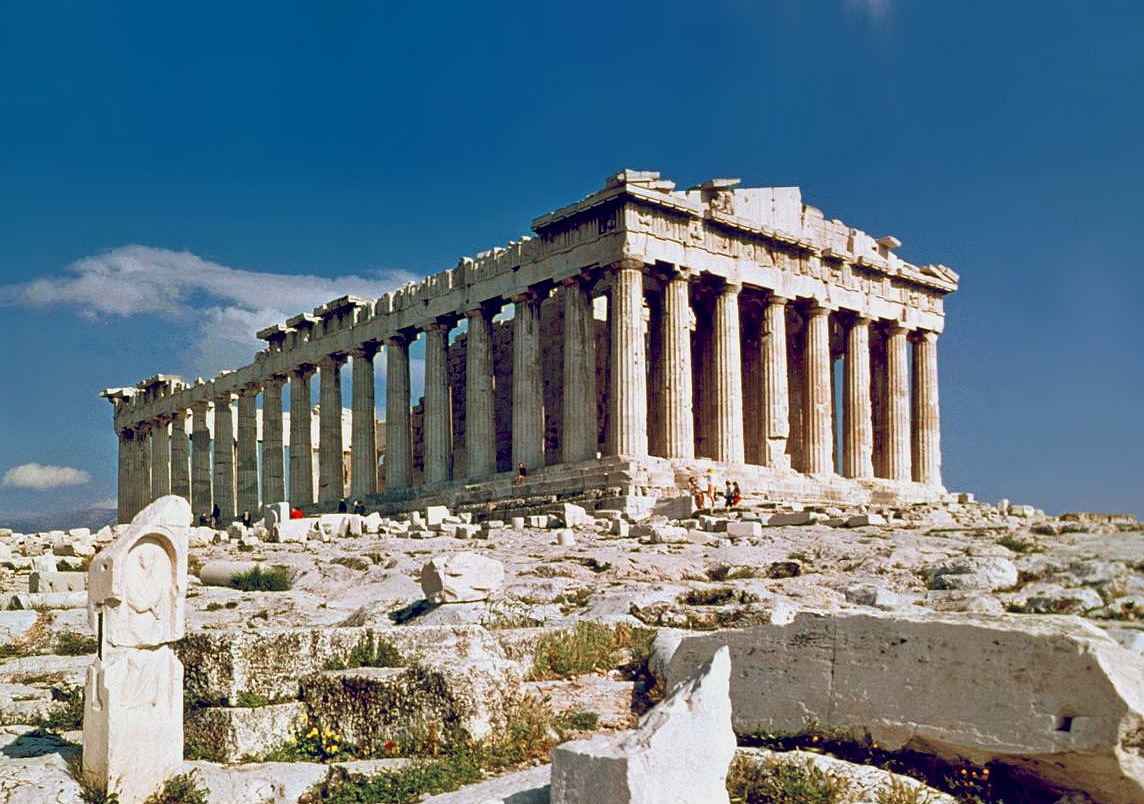
Photo: Steve Swayne, CC BY 2.0, via Wikimedia Commons
The Parthenon stands majestically atop the Acropolis of Athens, rising approximately 158 meters above sea level on this ancient limestone plateau. This iconic marble temple measures roughly 69.5 meters long by 30.9 meters wide, supported by 46 massive Doric columns that have weathered nearly 2,500 years of history. Visitors today see a partially reconstructed monument, with ongoing restoration efforts preserving what many consider the pinnacle of classical Greek architecture. The temple's commanding position offers panoramic views across modern Athens, while its precise mathematical proportions continue to influence architects worldwide. Some researchers have proposed alternative chronologies for the Parthenon based on astronomical alignments, suggesting far more ancient origins than traditionally accepted. However, archaeological evidence—including ancient Greek records, construction techniques, and dated artifacts found on the Acropolis—consistently places the temple's construction between 447 and 432 BC under Pericles' leadership. The precision of the Parthenon's design reflects the sophisticated mathematical knowledge of classical Greece rather than evidence for a dramatically earlier construction date.
Timeline
Construction begins under Pericles during Athens' Golden Age
Temple completed and dedicated to Athena Parthenos
Venetian bombardment severely damages the structure during Ottoman siege
Acropolis of Athens inscribed as UNESCO World Heritage Site
What the Show Claims
- ›Dr. Carlotto claims the Parthenon's orientation aligns with the Northern Greenland pole, suggesting construction 50,000 years agoS15E06
From the Transcripts
“And let's take a look at a third site, the Parthenon in Athens. We believe that the original structures at these sites‐‐ in other words, the original sites themselves‐‐ were established as long ago as 50,000 years.”
What Archaeology Says
Archaeological investigations of the Parthenon have revealed a complex construction history built upon even earlier sacred foundations. Excavations around the Acropolis have uncovered evidence of continuous religious activity dating back to the Bronze Age, with the current Parthenon built atop the remains of an earlier temple destroyed by the Persians in 480 BC. The precision of its construction reflects advanced understanding of mathematics and engineering, with subtle optical corrections built into the columns and platform to create the illusion of perfect straightness.
Modern archaeological consensus firmly places the Parthenon's construction between 447 and 432 BC, during the height of Athenian power under Pericles. The building served as a temple to Athena Parthenos, housing Phidias's massive gold and ivory statue of the goddess. Extensive documentation from ancient sources, combined with analysis of construction techniques and materials, provides detailed understanding of how this masterpiece was created using period-appropriate tools and methods.
What remains genuinely intriguing to researchers is the sophisticated mathematical relationships embedded throughout the structure. The building incorporates complex geometric proportions and subtle architectural refinements that demonstrate remarkable technical knowledge. While some suggest these features point to advanced ancient wisdom, mainstream archaeology views them as evidence of the high level of mathematical and artistic achievement reached by classical Greek civilization during its golden age.
Mysteries & Fun Facts
The Parthenon's columns bulge slightly in the middle, an optical illusion called entasis that makes them appear perfectly straight
The building once housed a 12-meter-tall gold and ivory statue of Athena worth more than the entire construction cost
No two stones in the Parthenon are exactly alike, yet they fit together without mortar
The temple survived as a Christian church for over 1,000 years before becoming an Ottoman mosque
Planning a Visit
The Parthenon is accessible to visitors as part of the Acropolis archaeological site, though access to the interior is restricted to preserve the ancient structure. Tickets must be purchased for the entire Acropolis complex, and comfortable walking shoes are essential for navigating the marble pathways and steps. The site can become quite crowded, particularly during peak tourist seasons.
Athens city center, approximately 2 kilometers from the Acropolis
Early morning or late afternoon visits offer the best experience, avoiding midday crowds and harsh sunlight while providing optimal lighting for photography. Spring and autumn generally provide more comfortable weather conditions for exploring the exposed hilltop site.
Related Sites
Gobekli Tepe
Ancient Aliens theorists often compare precisely aligned ancient temples across different civilizations
Great Zimbabwe
Another example of sophisticated ancient architecture that challenges conventional timelines
Chichen Itza - Kukulkan Temple
Mayan temple featuring advanced astronomical alignments and mathematical precision similar to Greek temples