Nan Madol: The City That Floats on a Reef
There is a city in the middle of the Pacific Ocean that was built on top of the water.
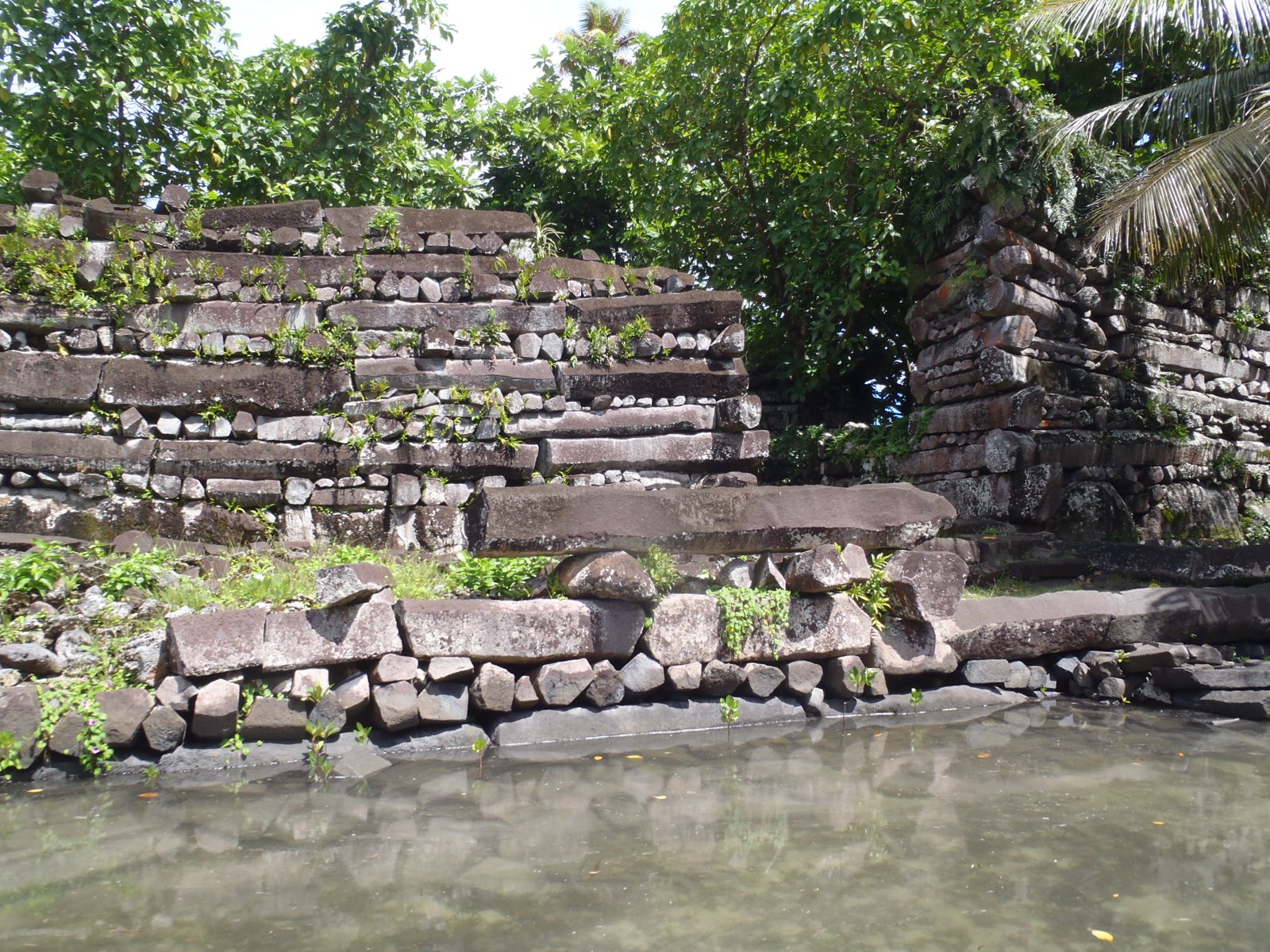
Not beside it. Not overlooking it. On it. Off the eastern shore of Pohnpei, in the Federated States of Micronesia, roughly 92 artificial islands rise out of a tidal lagoon, separated by canals and built from stacked columns of basalt — long, naturally hexagonal stone "logs" laid crosswise like the world's heaviest cabin walls. The total mass of stone moved to build it is estimated at around 750,000 tons. Some individual pieces are estimated to weigh as much as 50 tons.
The people who built it had no metal tools, no wheels, no pulleys, and no draft animals. They lived on a remote volcanic island thousands of miles from the nearest continent. And when you ask the Pohnpeians how the city got there, the oral tradition gives a consistent answer: the stones flew.
The Place
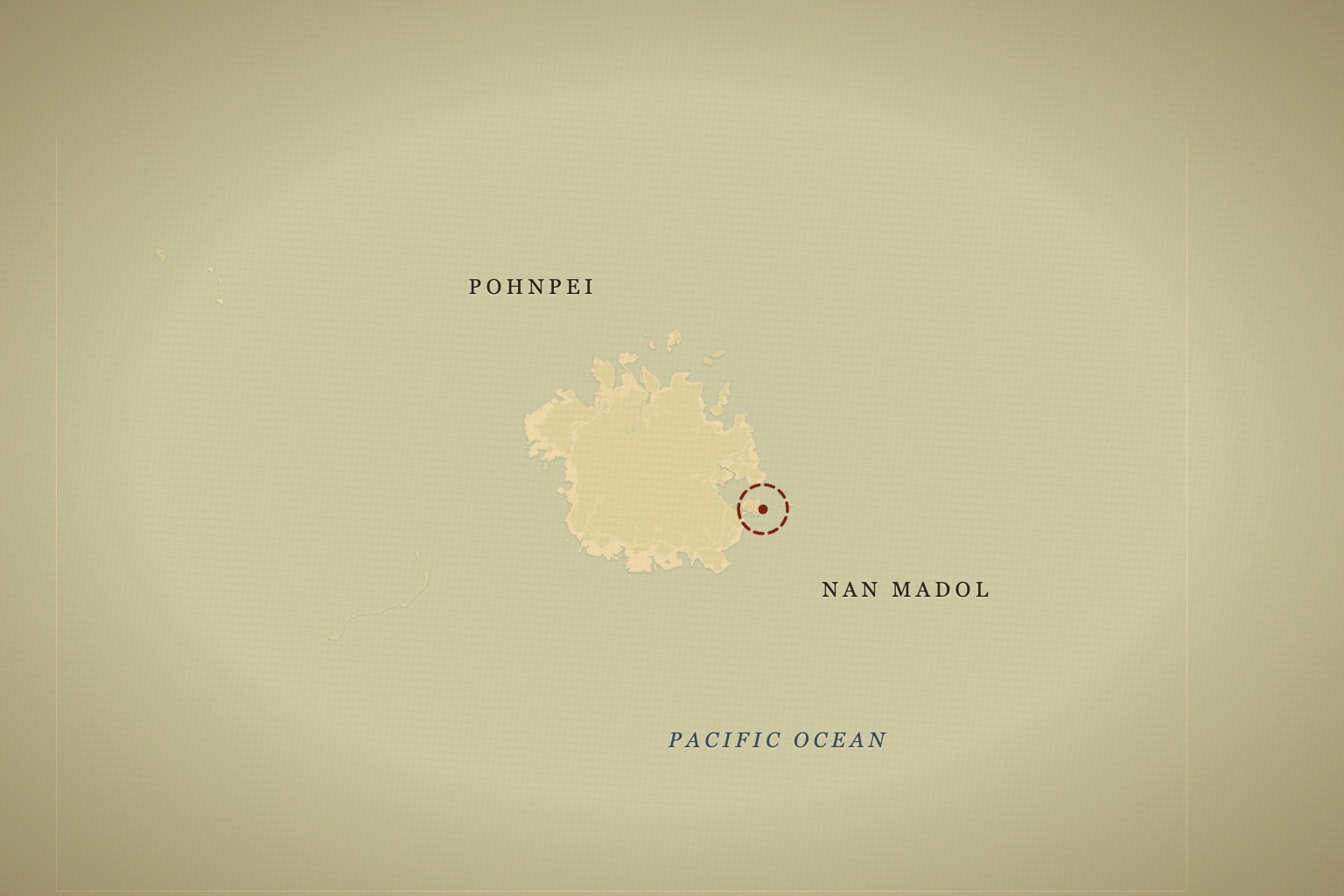
Nan Madol sits on a reef flat beside Temwen Island, on the southeast side of Pohnpei. The name is usually translated as "within the intervals" or "the spaces between," referring to the network of tidal canals that thread between the islets — which is why nearly every article ever written about it calls it "the Venice of the Pacific." An older name recorded for the area, Soun Nan-leng, has been translated as "Reef of Heaven."
This was the ceremonial and political capital of the Saudeleur dynasty, the line of rulers who unified Pohnpei and governed it until around 1628. The megalithic construction is generally dated to roughly the 12th–13th centuries onward, with the great walled compounds rising over the following centuries. The most imposing of them, the royal mortuary compound of Nandauwas, has outer walls of stacked basalt rising as high as 25 feet.
The city was a place of priests, nobility, and the dead — a purpose-built seat of power set apart from ordinary life, on a foundation that had to be manufactured islet by islet out of coral fill and stone before anything could stand on it. And it was zoned, deliberately. Early surveys and Pohnpeian tradition divide the city into two districts: Madol Powe, the upper town to the northeast, was the mortuary and ritual sector — priests and tombs; Madol Pah, the lower town to the southwest, held the administrative center and the residences of nobles. Individual islets had individual jobs: canoe building on one, food preparation on another, coconut-oil production on a third. On the islet of Idehd, tradition holds, priests kept a sacred eel and fed it the offerings of an annual ceremony. This was not a settlement that grew. It was a capital that was designed — and then manufactured, one artificial island at a time.
It ended the way it began: in legend. Pohnpeian oral history says the later Saudeleur rulers grew tyrannical, and that around 1628 a culture hero named Isokelekel arrived from the island of Kosrae with 333 warriors, overthrew the dynasty, and founded the nahnmwarki system of chiefly titles that still governs Pohnpei today. The new rulers eventually abandoned Nan Madol as a residence, and the city of priests went quiet on its reef.
Nan Madol was inscribed as a UNESCO World Heritage Site in 2016 — and simultaneously placed on the List of World Heritage in Danger, as mangroves and storm surge slowly work on the ruins. You can still visit today: it's a boat or guided trip from Kolonia, best explored by canoe at low tide, with the black columns rising straight out of the green water.
What the Show Claims
Ancient Aliens has returned to Nan Madol again and again — it appears as early as Season 2, gets extended treatment in "Aliens and Forbidden Islands" (Season 6), and eventually receives an entire episode, "The Mystery of Nan Madol" (Season 15, Episode 1).
The show's case rests on a few pillars. First, the logistics: columns weighing many tons — up to 50, by some estimates — were quarried on the far side of Pohnpei and somehow moved across an island of jungle, mountains, and open water, then stacked with precision on a submerged reef. The show argues there is no fully demonstrated explanation for how that was done.
Second, the location: why build your capital on water at all, at staggering cost, when the island itself is right there?
Third, the stones themselves. The columnar basalt of Nan Madol is rich in magnetite, and the show has made much of reports that compasses behave strangely near certain columns — needles swinging, refusing to settle. Theorists fold that into a larger argument: that the stone was chosen for its magnetic properties, that the city was some kind of machine or energy site rather than merely a capital.
Fourth — and this is the part the show leans on hardest — the legend. Pohnpeian oral tradition holds that the city was founded by twin sorcerers, Olisihpa and Olosohpa, who arrived from elsewhere seeking a place to worship and made the massive stones fly through the air into position, with the help of a flying dragon. The show reads that tradition the way it reads similar stories worldwide: as a memory of technology, not magic — levitation, aerial craft, something misunderstood and mythologized. It also points seaward, to local accounts of submerged ruins beyond the visible city — a drowned counterpart sometimes called Kanamwayso — as evidence that what we can see is only part of what was built.
What Archaeology Says
Archaeology takes none of the wonder away from Nan Madol. If anything, the closer researchers look, the more audacious the project becomes.
The outside world has been trying to make sense of the place for two centuries. The first Western description comes from James O'Connell, an Irish castaway who lived on Pohnpei in the late 1820s and early 1830s and published his account in 1836 — he found the ruins already ancient, already abandoned, and already feared by the islanders who guided him. The naturalist F. W. Christian dug at Nandauwas in 1896. In 1907, the German governor Victor Berg had a tomb at Nandauwas opened — and died suddenly the following day, a coincidence that attached a curse story to the site that has never quite let go. Then, in 1910, came the survey everything since has rested on: the German ethnographer Paul Hambruch, working with the Hamburg South Sea Expedition, systematically mapped the city, numbered its islets, and recorded the oral traditions of the people around it. The figure of roughly 92 artificial islets that every modern account cites — including this one — is Hambruch's count.
Television found the place too. In October 2010, Josh Gates brought his Destination Truth crew to Pohnpei for an episode called "Haunted Island Ruins," spending a night among the islets chasing the same taboo O'Connell had recorded nearly two centuries earlier — Pohnpeians still warn against remaining in the city after dark. The team came home with unsettling atmosphere rather than proof, which is roughly the honest ratio at Nan Madol: the place has never needed embellishment to unnerve its visitors.
Modern archaeology has sharpened the picture considerably. Excavations from the 1970s onward, led by researchers including William Ayres of the University of Oregon working alongside Pohnpeian colleagues, established that people were using the reef flat many centuries before the megalithic city rose — the stone architecture is the late, spectacular phase of a much longer occupation. And in 2016, a team led by archaeologist Mark McCoy applied uranium-thorium dating to coral incorporated into the walls of Nandauwas, pinning construction of the great tomb to roughly 1180–1200 AD. That result matters more than it sounds: it places Nan Madol among the earliest examples of truly monumental construction anywhere in the remote Pacific — earlier than the giant moai of Rapa Nui. The same research used geochemical fingerprinting to match the tomb's basalt to quarry sources elsewhere on Pohnpei, including sites on the far side of the island. So we know where the stone came from, and we know the columns crossed a serious stretch of coastline to get here.
The columns themselves are natural: columnar basalt fractures into those prismatic "logs" on its own, which is a genuinely elegant answer to "how did they shape them" — they largely didn't have to. The magnetism is natural too: basalt is rich in magnetite, and magnetic quirks are a property of the stone, not evidence of a technology. Though it's fair to note that nobody can say whether the builders knew their stone was special — or whether, to them, that was part of the point.
The standard transport hypothesis is that columns were moved along the coast, likely floated on rafts and maneuvered at high tide. It's plausible. It is also, as researchers themselves acknowledge, largely theoretical — moving a multi-ton stone column on a raft built from island materials is a monstrous engineering problem, and the full logistics of shifting three-quarters of a million tons of stone this way have never been demonstrated at scale. The honest scholarly position is that Pohnpeians accomplished it with the means available to them, and that we cannot yet fully reconstruct how.
And that's the recurring pattern here: every solved question at Nan Madol opens onto a harder one. We know who built it — but a society of modest size on a remote island sustained a construction effort, generation after generation, that would strain a small state. We know where the stone came from — but not, with certainty, how it crossed the water. We know what the city was for — but not why it had to be there, on a reef, at the price of building the very ground beneath it.
The Verdict
Nan Madol is one of those rare places where the archaeology and the legend are both, in their own ways, telling you the same thing: something extraordinary happened here, and the full story hasn't survived.
The stones didn't fly. Probably. But the tradition that says they did is the only surviving eyewitness account we have, passed down by the descendants of the builders themselves — and the version we can reconstruct with science still ends in an open question mark, out on the water where the rafts would have gone.
And the Pohnpeians themselves have never treated the place casually. Nan Madol remains sacred ground, hedged with old prohibitions; many islanders will not linger there after dark, and the stories — the sorcerer twins, the flying stones, the drowned city of Kanamwayso out beyond the reef, the governor who opened a tomb and was dead by morning — are not told as entertainment. They are told as warnings. A place keeps that kind of reputation for eight hundred years only if it earned it.
The city is still there, black stone on green water, slowly being taken back by the mangroves. Go while it's still visible. Drift down the canals at low tide, look up at the walls of Nandauwas, and ask yourself the question the reef has been asking for eight hundred years: how do you build a city on the sea — and what would make you want to?
Covered On Screen
- The Mystery of Nan MadolAncient Aliens · S15 E1
Track the 1 site from this post on your map.
Free account · mark visited sites · build your bucket list.
Start tracking