Easter Island's Moai: The Statues That Walked
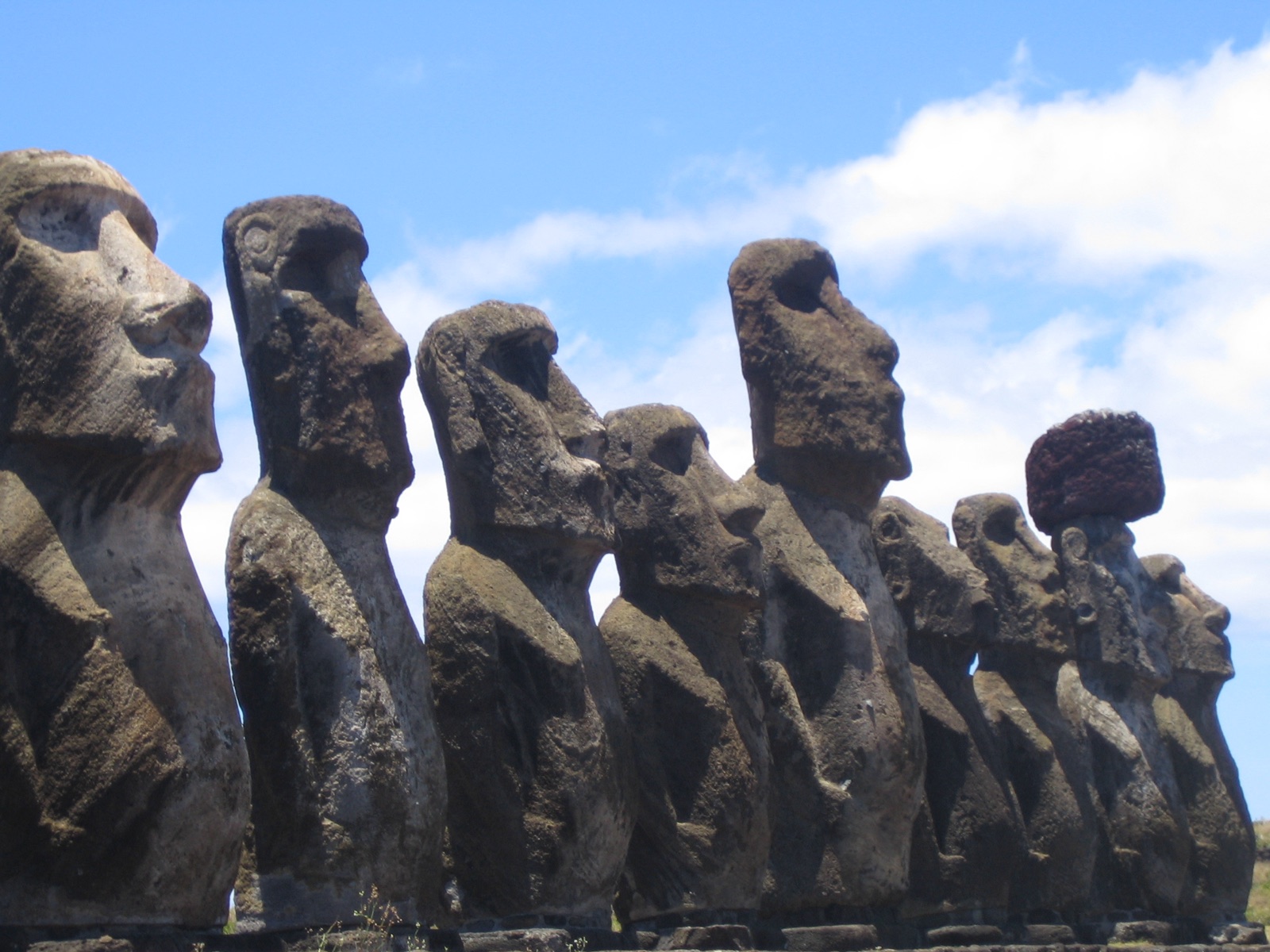
There's a moment at Rano Raraku — the volcanic crater that served as the moai quarry — that stops people cold. The hillside is covered with statues, hundreds of them, frozen in mid-creation. Some are still attached to the bedrock, their backs not yet cut free. Others have been released from the stone but never moved, half-buried in sediment up to their chins, looking out across the Pacific with the same expression as all the rest: stern, solemn, certain.
At the quarry's rim, one unfinished giant runs nearly 70 feet from base to crown and weighs an estimated 270 tons. It was never moved. Whatever happened to the project that was underway when work at the quarry stopped, this figure never made it to its destination. It just stayed where it was, half-born from the hillside, for six hundred years.
The Place
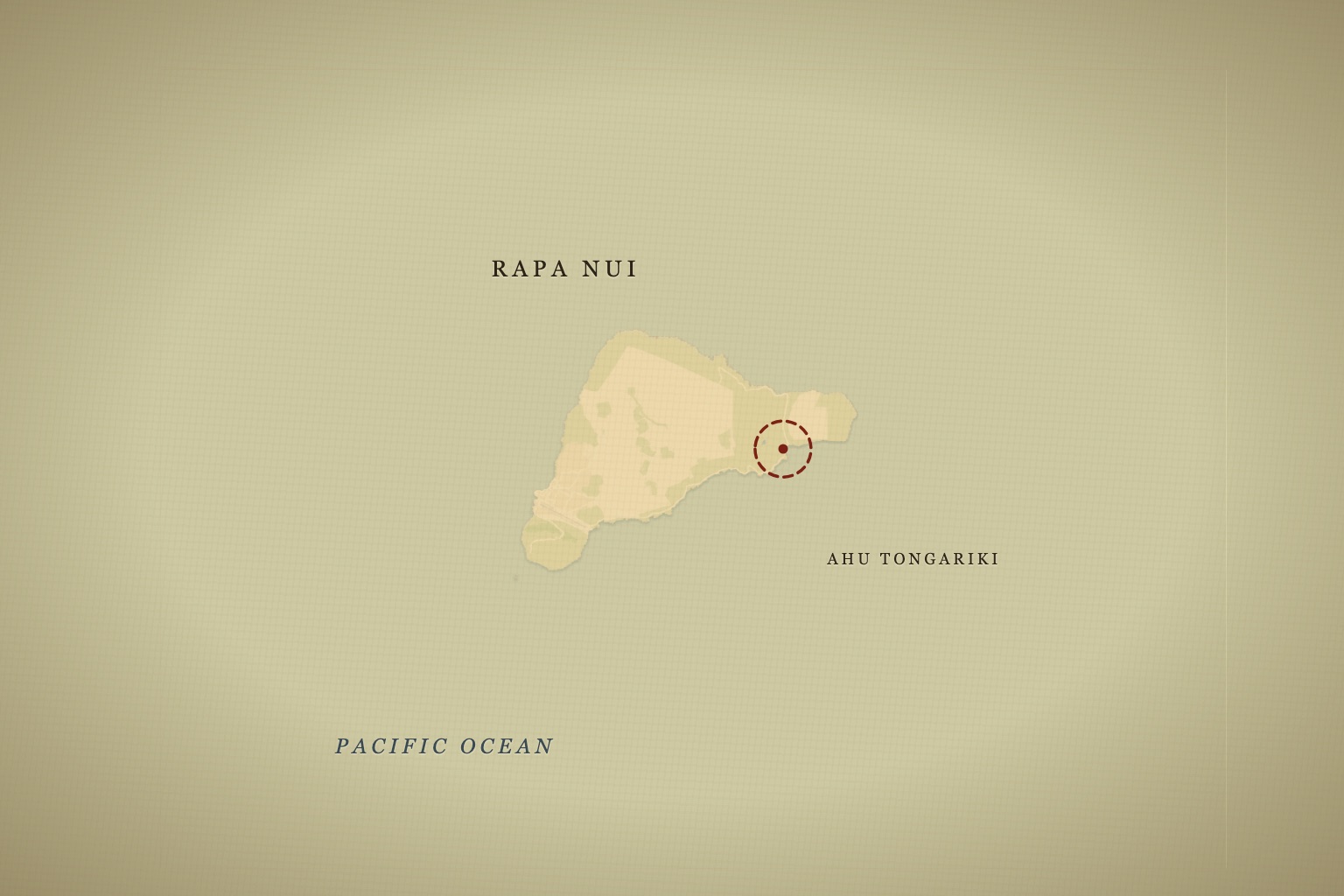
Easter Island — Rapa Nui in the Polynesian language of its people — sits in the southeastern Pacific Ocean, 2,300 miles west of the Chilean coast and about 1,300 miles from the nearest inhabited island. It is one of the most remote permanently inhabited places on Earth. Its 64 square miles hold three extinct volcanoes, dramatic coastal cliffs, and nearly 1,000 megalithic stone statues.
The Rapa Nui people are Polynesian — their ancestors made their way to the island around 1200 AD, in one of the most extraordinary feats of open-ocean navigation in human history. They brought with them the agricultural knowledge, social structures, and cultural practices of their Polynesian origin. And then, on a speck of land more isolated than almost anywhere humans have ever lived, they did something no one had told them to do.
The moai were carved primarily between 1200 and 1700 AD from the soft volcanic tuff of Rano Raraku. They were transported to stone platforms called ahu distributed around the island's coastline, most facing inland toward the villages they were meant to watch over. Only one group — at Ahu Akivi — faces the ocean.
The island is reached by flight from Santiago, Chile (roughly five hours), or from Tahiti. It has basic tourist infrastructure and is absolutely worth the journey. The solstice alignments at Ahu Akivi, the quarry at Rano Raraku, and the ceremonial village at Orongo on the Rano Kau crater rim together tell a story of an extraordinarily sophisticated culture operating at the edge of the inhabitable world.
What the Show Claims
Ancient Aliens addressed Easter Island in Season 3's "Aliens and Lost Worlds" and returned in Season 6's "Aliens and Forbidden Islands."
The show focuses primarily on the logistics of the moai. How were they moved? The smallest finished moai weighs around 10 tons; the average transported statue weighs perhaps 12-15 tons. The largest successfully erected statue stands about 32 feet and weighs approximately 82 tons. Moving these across miles of rough volcanic terrain, the show argues, required technology beyond what the Rapa Nui had available.
A particular point of emphasis is the pukao — the red scoria topknots placed on top of some statues. These cylindrical "hats" weigh between 2 and 20 tons and were somehow lifted to the tops of statues that were already 15 feet tall. The show presents this as an unsolved engineering problem.
The buried bodies are another recurring claim. The moai we see above ground are mostly heads — the rest of the statues extend several meters into the earth as the result of sediment accumulation over centuries. When archaeologists excavated to expose the full bodies, the show seized on this as evidence that the statues were "much larger than visible," implying something was hidden deliberately.
The island's undeciphered script — rongorongo, a system of glyphs found on wooden tablets — is presented as possible alien writing, transmitted to the Rapa Nui by beings from elsewhere.
What Archaeology Says
Archaeologists came at the movement question from a direction nobody expected — by taking the islanders at their word. A pair of anthropologists, Carl Lipo of Binghamton University and Terry Hunt of the University of Hawaii, paired experimental archaeology with the Rapa Nui oral tradition in 2011. And that tradition has never been coy about how the statues reached the coast. It says they walked.
The astonishing part is that the islanders may have meant it almost literally. Lipo and Hunt built a full-scale model moai and showed that a statue can be "walked" upright using three teams of ropes — two pulling side to side to set up a rocking motion, one pulling from behind to keep it from pitching forward. Fewer than 20 people in the experiment could move a multi-ton statue this way. And the technique leaves tell-tale damage on the base of the statues — damage consistent with what archaeologists find in the record. The oral tradition, in other words, may have been a literal engineering manual all along, hiding in plain sight for centuries inside a single verb.
> Update — July 2026: The walking hypothesis has since received its most rigorous test yet — a 2025 Journal of Archaeological Science study built on 3D models of the road moai and the physics of how a statue leans into each step. We've given the full seventy-year transport debate, and the new evidence, its own deep dive: How the Moai Walked.
The pukao seem to have been rolled to the base of an erected moai on a ramp of earth, then levered or rocked up into place by something like the same logic that moved the statues. Picture that for a moment: a whole population of multi-ton figures, each crowned with its own heavy stone hat, raised by people with no metal, no wheels, no draft animals — only rope, leverage, and an uncanny read on the physics of their own stone. The achievement gets stranger the more of it you explain.
The buried bodies turn out to be the slow work of geology — six centuries of sediment quietly swallowing the torsos. But the excavations at Rano Raraku by archaeologist Jo Anne Van Tilburg and her team found something underneath the dirt that the show never mentions: petroglyphs carved into the buried torsos. The full bodies weren't hidden from us; they were decorated — covered in markings the carvers expected almost no one to ever see again. What those symbols meant, and for whom, is still open.
The rongorongo script is, genuinely, undeciphered — and that's not a small thing to leave hanging. The Rapa Nui appear to have invented one of the only writing systems in all of Oceania, and we can no longer read a word of it. The tablets that survive are pitifully few. The handful of people who could still read them were carried off in the Peruvian slave raids of the 1860s, and the knowledge went with them. So we're left with rows of glyphs that someone clearly meant to say something — and no living thread back to the meaning. That's not an answer. That's a door that closed in front of us, and we're still standing at it.
The Verdict
Archaeology has handed us better questions, not final answers. The walking is demonstrated. The pukao have a plausible mechanism. The buried bodies have a geological cause. And yet none of that touches the thing that actually haunts this island.
The Rapa Nui did all of this on 64 square miles, with no metal tools, no draft animals, and no wheels. They organized an entire society around the carving, transport, and erection of statues of escalating ambition, century after century — coordinating labor, marshalling resources, passing down specialized knowledge across generations until the figures stood in rows along the coast, watching. That obsession is real, and we can describe it. We cannot fully explain why it gripped them the way it did.
And then, around 1700, it stopped. The carving ceased. The monuments were toppled. The ecologists' account, deforestation driven by population pressure and competition between clans, is supported by the paleobotanical record and is almost certainly part of the story. But it doesn't quite reach the bottom of it. Why the totality? Why pull down the very faces a culture had spent five centuries raising? A society can lose its forests slowly; the way this one turned on its own gods looks fast, and deliberate, and grieved.
That's the question the island keeps asking, and it's a more unsettling one than aliens ever posed. Here is what a small, isolated human community can build entirely on its own — and here is how completely it can come undone. The statues that never walked are still half-born in the quarry wall. The script no one can read is still waiting on its tablets. Go stand at Rano Raraku, look up at the 33-foot figure that never left the hillside, and let the silence ask you directly: what were they reaching for, and what did they lose?
Covered On Screen
- Top Ten Mysterious SitesAncient Aliens · S17 E2
Track the 1 site from this post on your map.
Free account · mark visited sites · build your bucket list.
Start tracking