How the Moai Walked: The Physics Behind Easter Island's Strangest Legend
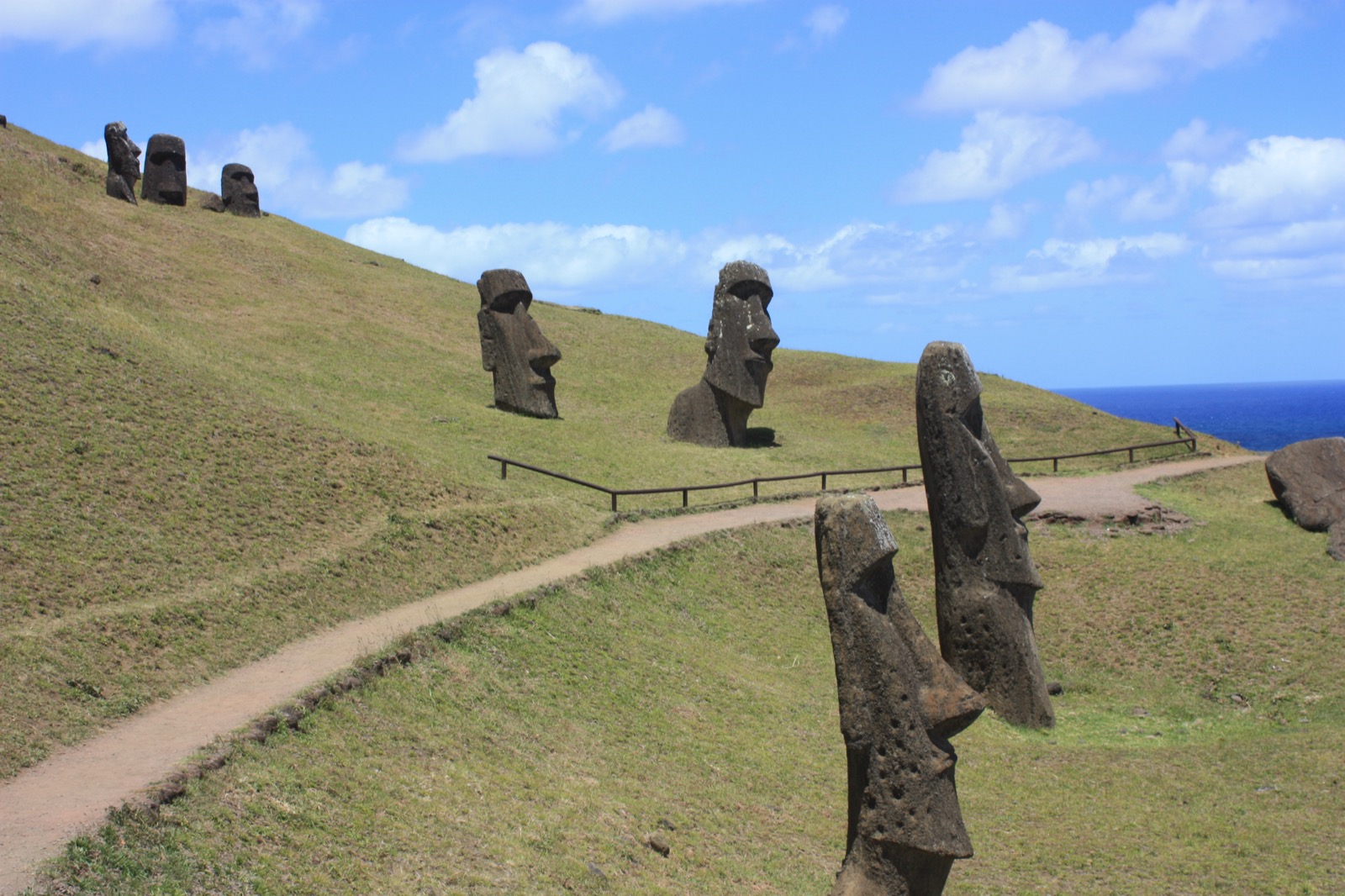
Ask the Rapa Nui how the moai got from the quarry to the coast and the answer has never changed. Not in the 1830s, not when Katherine Routledge recorded it in 1919, not today. The statues walked. There's even a specific word for it — neke neke, walking without legs, inching forward. For most of a century, science filed that answer under folklore: a lovely way of saying "we no longer remember."
Then, in 2011, on a ranch road in Hawaii, a pair of anthropologists stood a 4.35-ton replica moai upright, handed three ropes to 18 people, and watched the statue rock, pivot, and walk 100 meters in 40 minutes. And in October 2025, the same researchers published the most rigorous test of the idea yet — a physics analysis of the statues themselves, arguing that the moai weren't just capable of walking. They were engineered for it.
The legend, it turns out, may have been a technical manual all along.
The Problem
We covered the island's full story — the quarry, the toppling, the undeciphered script — in our deep dive on Rapa Nui. This is the part of that story that refuses to stay settled: the transport problem.
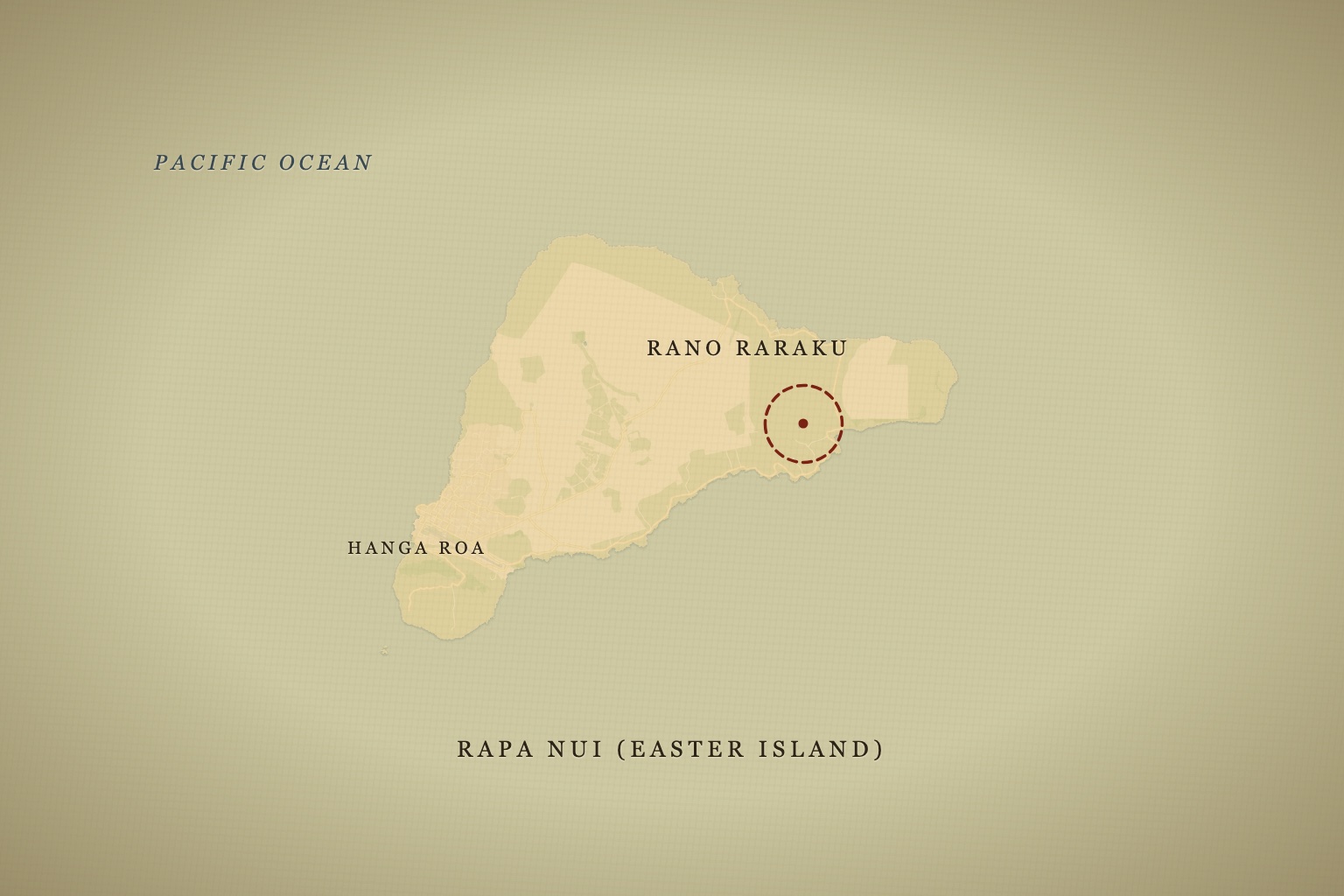
The numbers are the problem. Nearly 1,000 moai were carved from the volcanic tuff of Rano Raraku between roughly 1200 and 1700 AD. The average statue that actually reached an ahu platform weighs on the order of 12 to 15 tons; the largest ever successfully erected weighs about 82 tons. The platforms are scattered around the island's entire coastline — some destinations lie more than 10 kilometers from the quarry, across rolling volcanic terrain.
The Rapa Nui had no metal, no wheels, no draft animals. What they had was rope, wood, and whatever they knew that we don't.
And they left us a crime scene: a network of old roads radiating out of Rano Raraku, and dozens of statues lying abandoned along them — moai that set out for the coast and never arrived. Any theory of transport has to explain those roads, those failures, and the sheer routine confidence of a society that moved multi-ton statues for five hundred years.
What the Show Claims
Ancient Aliens has returned to Easter Island repeatedly (most directly in Season 3's "Aliens and Lost Worlds" and Season 6's "Aliens and Forbidden Islands"), and the logistics of the moai are the heart of its case. Moving 80-plus tons across kilometers of rough ground, the show argues, is beyond the reach of a small island society with Stone Age tools — the implication being that the Rapa Nui had help, or at least technology we haven't credited.
To be fair to the show: for decades, mainstream science struggled with the same problem. Every conventional answer required armies of people and forests of timber that a small, wind-scoured island could barely spare. The transport question wasn't a fringe mystery. It was a genuine hole in the archaeology — and the show planted its flag squarely inside it.
Seventy Years of Trying to Drag a Statue
The experimental record reads like a long argument with the island itself.
1956 — Thor Heyerdahl lashed a roughly 10-ton moai to a wooden sledge, on its back, and had about 180 islanders haul it with ropes. It moved — barely. Scaling up, Heyerdahl estimated the largest statues would need on the order of 1,500 haulers. On an island whose population may never have exceeded a few thousand, that math was uncomfortable from the start.
1970 — William Mulloy, one of the archaeologists from Heyerdahl's expedition, proposed something cleverer: sling the statue face-down from a giant wooden bipod and swing it forward in pendulum steps, pivoting on its belly. His published calculations got the 82-ton statue Paro down to roughly 90 movers. But the rig would grind stress into the statue's neck — its thinnest, most fragile point — and it only really worked for statues with rounded bellies.
1986 — Pavel Pavel, a Czech engineer, had already walked a 12-ton concrete replica across a field in Strakonice in 1982 with just 17 people, ropes at the head and base, twisting it forward like you'd shuffle a refrigerator. Heyerdahl brought him back to Easter Island to try it on real moai — 8 people walked a 5-ton statue, 16 walked a 9-ton one. It worked so well the experiment was halted early: the bases were chipping, and no one wanted to sacrifice an original statue to a hypothesis.
1999 — Jo Anne Van Tilburg of UCLA, who has spent a career documenting every moai on the island, answered with the horizontal school's best experiment: a roughly 9-ton replica of the statistically average moai, laid supine on a "canoe ladder" — a sledge-and-track rig adapted from Polynesian canoe-hauling. Forty pullers moved it 50 meters, up an 8% grade. Her framing was elegant — statue moving as an extension of the same technology that crossed the Pacific.
Both camps could move a statue. Neither could explain everything the island shows us. Horizontal transport needs timber in quantities that deepen the island's deforestation tragedy, and it doesn't explain the abandoned road statues — found face-down on downhill grades and on their backs going uphill, exactly the falls you'd expect from a statue that was standing when it died.
The Statues That Were Built to Walk
Carl Lipo (Binghamton University) and Terry Hunt (University of Arizona) took the islanders' verb seriously. Their 2011 book The Statues That Walked and their National Geographic-backed field trials that year at Kualoa Ranch on Oʻahu — the 4.35-ton replica, 18 people, 100 meters in 40 minutes — made the case that rocking a statue forward with three rope teams isn't just possible, it's easy. "Once you get it moving, it isn't hard at all," Lipo has said. "People are pulling with one arm. It conserves energy, and it moves really quickly."
Critics called it a stunt — Van Tilburg's word, in fact: "a stunt and not an experiment," performed with a replica shaped to succeed. So in October 2025, Lipo and Hunt published their formal answer in the Journal of Archaeological Science: a systematic analysis of 962 moai, centered on high-resolution 3D models of 62 road moai — the statues abandoned in transit.
What the models show is hard to dismiss as coincidence. The road moai aren't smaller copies of the finished statues on the platforms. They're a distinct engineering configuration:
- Wide, D-shaped bases with a beveled front edge that acts as the pivot for each step — measurably broader than the bases of statues that reached their platforms, which were re-carved flat after arrival.
- A forward lean of roughly 5 to 15 degrees, which pushes the center of mass to the front edge of the base. Useless for standing. Essential for walking: the statue naturally falls into each step and rocks side to side with minimal effort.
- No eye sockets. The eyes — the feature that made a moai a finished, inhabited ancestor — were carved only after arrival. The road statues are blanks in transit.
- The roads themselves: about 4.5 meters wide with a concave cross-section that cradles a rocking base — a shape that actively hinders sledge-dragging. "Every time they're moving a statue, it looks like they're making a road," Lipo notes. "The road is part of moving the statue."
The paper's physics modeling puts numbers on the walk: steps of just under a meter, roughly 300 meters an hour once rocking, a crew of perhaps 15 to 60 to start the motion and far fewer to sustain it. A 10-kilometer journey works out to something like 11,000 steps. And the counterintuitive punchline: the mechanics get more favorable as the statues get bigger, not less. "As it gets bigger, it still works," Lipo argues — for the largest statues, walking may have been the only way.
Even the failures line up. More than half the abandoned road moai lie within two kilometers of the quarry — exactly the fall-off you'd expect from transport accidents, not ceremonial placement. When they fell, they were walking.
The debate is not closed — this is archaeology, and feasibility is not proof. Van Tilburg's camp still holds the horizontal line, and UCL's Sue Hamilton, reviewing the 2025 paper, called the work ingenious while cautioning that showing something could happen doesn't show it did. Lipo's response is essentially an open dare: "Find some evidence that shows it couldn't be walking. Because nothing we've seen anywhere disproves that."
The Verdict
Sit with what the 2025 paper is actually claiming, because it's stranger than the alien version. A society of a few thousand people, on 64 square miles of grass and volcanic rock, looked at a multi-ton block of tuff and solved a problem in applied physics — center of mass, base geometry, pendulum dynamics — that Western science needed seventy years of failed experiments, 3D modeling, and a physics engine to reverse-engineer. Then they encoded the solution so deeply into their craft that the statues themselves are the blueprint: lean the body forward, widen the base, round the back edge, carve the eyes last, shape the road like a cradle.
And questions still stand open. How do you start an 80-ton statue rocking? How were the walkers raised onto their platforms at journey's end? Why does the quarry hold a 270-ton giant that could never have walked anywhere? The oral tradition kept the answer inside a single verb for centuries while outsiders dragged replicas around on sledges. It makes you wonder what else the island has been telling us all along, in words we keep mistaking for poetry.
Go stand on one of those old roads at dusk, look back toward Rano Raraku, and picture it: a stone ancestor ten feet tall, rocking down the causeway toward the sea, walking. The islanders always said so. The physics now agrees. Neke neke.
Covered On Screen
- Top Ten Mysterious SitesAncient Aliens · S17 E2
Track the 1 site from this post on your map.
Free account · mark visited sites · build your bucket list.
Start tracking