Philadelphia Naval Yard
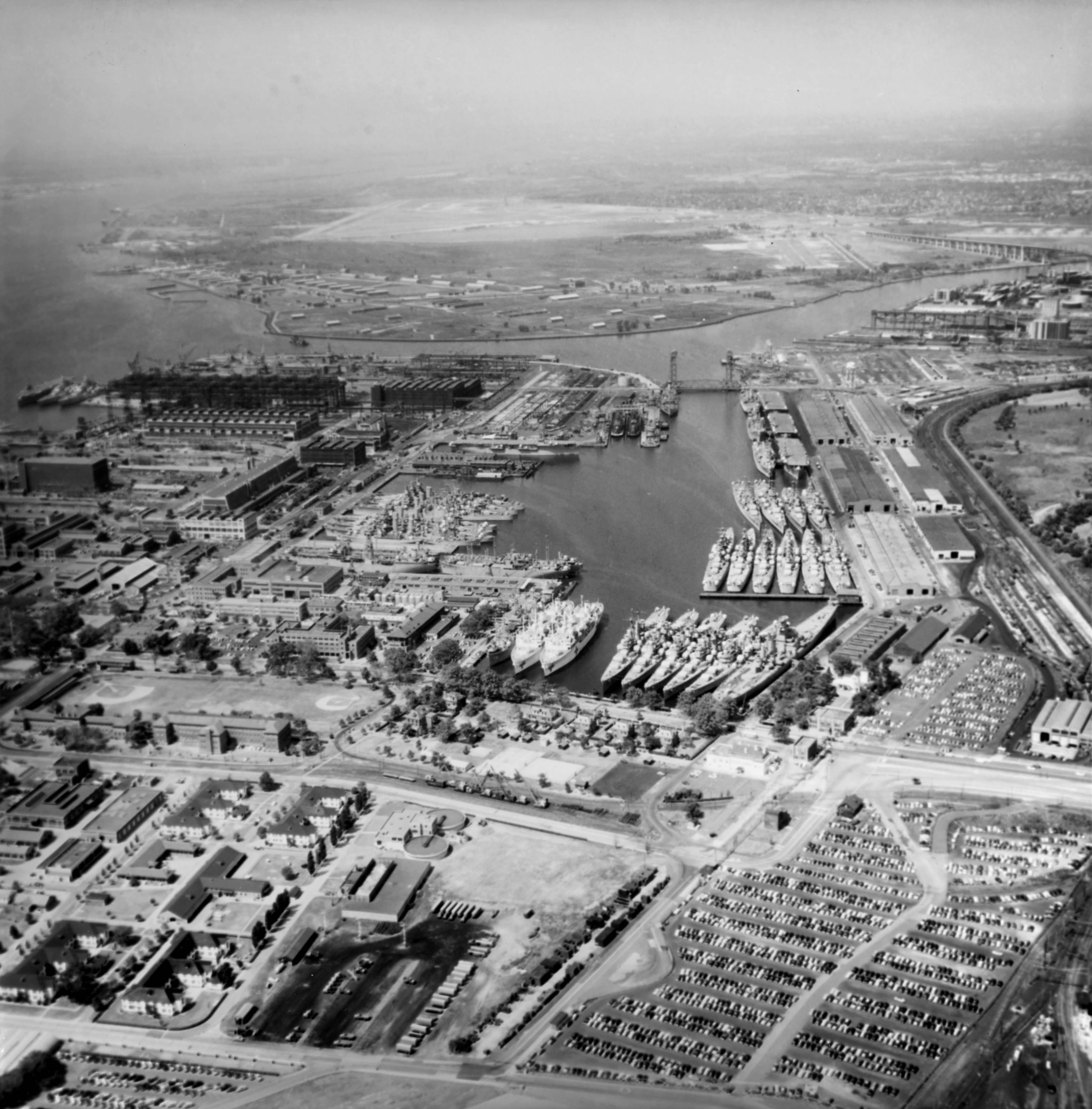
Photo: Unknown authorUnknown author, Public domain, via Wikimedia Commons
The Philadelphia Naval Shipyard, established in 1801 on the Delaware River, holds the distinction of being the first United States Navy shipyard. Spanning over 1,200 acres along the Philadelphia waterfront, the facility served as a critical naval manufacturing and repair center for nearly two centuries. Today, visitors can see remnants of the historic dry docks, administrative buildings, and shipbuilding infrastructure that once employed thousands of workers. The shipyard's strategic location approximately 6 miles south of downtown Philadelphia made it ideal for both Atlantic Ocean access and inland protection during wartime. The shipyard gained renewed attention in popular culture through the "Philadelphia Experiment" theory, which claims Tesla and Einstein collaborated with the U.S. Navy here in 1943 to render the USS Eldridge invisible using electromagnetic technology, allegedly with disturbing effects on the crew. Naval historians and physicists have found no documentary evidence supporting this account, which first emerged publicly in the 1950s—decades after the alleged incident—and the USS Eldridge's actual service records place the vessel elsewhere during the purported experiment. The enduring appeal of the story reflects broader fascination with Tesla's capabilities and classified military research, even as mainstream science points to misidentification and legend rather than historical fact.
Timeline
Philadelphia Naval Shipyard established as the first U.S. Navy shipyard
Alleged Philadelphia Experiment supposedly conducted at the facility
Naval shipyard officially closed after 195 years of operation
What the Show Claims
- ›Tesla worked with Einstein and the U.S. Navy to create an electromagnetic invisibility cloak for the USS EldridgeS08E06
- ›The experiment caused the USS Eldridge to teleport between Philadelphia and NorfolkS08E06
- ›Crew members became embedded in the ship's metal hull as a result of the experimentS08E06
- ›The experiment demonstrated Tesla's mastery of space-time manipulation technologyS08E06
Theorist Takes
“We have leaked testimony from classified levels of secrecy in the U.S. government the Philadelphia Experiment was real, that the soldiers on that ship got disoriented, and they ended up walking into the hull.”
From the Transcripts
“According to reports, right before Tesla's death, he was working with Albert Einstein and the United States Navy at the Philadelphia Naval Yard to create an electromagnetically charged invisibility cloak for the USS Eldridge.”
What Archaeology Says
The Philadelphia Naval Shipyard represents a significant piece of American naval and industrial history rather than ancient archaeology. Historical research has focused on documenting the facility's role in shipbuilding during major conflicts, particularly World War II when it operated at peak capacity. Naval historians and archivists have thoroughly examined wartime records from the shipyard, finding extensive documentation of conventional naval operations but no evidence supporting extraordinary experiments.
The alleged Philadelphia Experiment story first emerged publicly in the 1950s through the claims of Carl Allen (also known as Carlos Allende), who wrote letters to UFO researcher Morris Jessup describing the supposed invisibility experiment. Subsequent investigation by naval historians, including those at the Naval Historical Center, found no documentation of such experiments in official records. The USS Eldridge's actual service records show it was never stationed in Philadelphia during October 1943.
Physicists have also examined the theoretical claims underlying the Philadelphia Experiment, particularly regarding electromagnetic field manipulation for invisibility. While the U.S. Navy did conduct research into degaussing (reducing magnetic signatures to avoid mines), the technology described in the Philadelphia Experiment stories violates well-established principles of physics. The scientific consensus maintains that the alleged effects described would require energy levels and field strengths far beyond what was technologically possible in 1943.
What remains genuinely documented is the shipyard's legitimate historical importance as a center of American naval shipbuilding. The facility's actual contributions to naval technology and wartime production represent a remarkable chapter in industrial history, even without extraordinary claims of space-time manipulation.
Mysteries & Fun Facts
The shipyard was the birthplace of the first steam warship USS Fulton in 1816
During World War II, the facility employed over 40,000 workers at its peak
The shipyard built and launched 53 vessels during World War II alone
The facility's dry docks were among the largest on the East Coast during their operational period
Planning a Visit
The former Philadelphia Naval Shipyard site is now largely redeveloped for commercial and industrial use, with public access generally limited to designated areas. Visitors interested in naval history can explore nearby Independence Seaport Museum, which houses exhibits on Philadelphia's maritime heritage.
Philadelphia, Pennsylvania (approximately 6 miles to downtown)
Spring through fall offers the most comfortable weather for exploring the waterfront area and nearby historical sites.
Related Sites
Roswell
Both sites are associated with alleged government cover-ups of advanced technology experiments
White Sands Proving Ground
Another U.S. military facility linked to claims of secret experimental programs and advanced propulsion research
Silicon Valley (Way of the Future Church)
Modern technological hub connected to theories about artificial intelligence and advanced computational experiments
Also Covered In
Featured In1 episodes
Historical data sourced from Wikipedia