Majlis al Jinn Cave
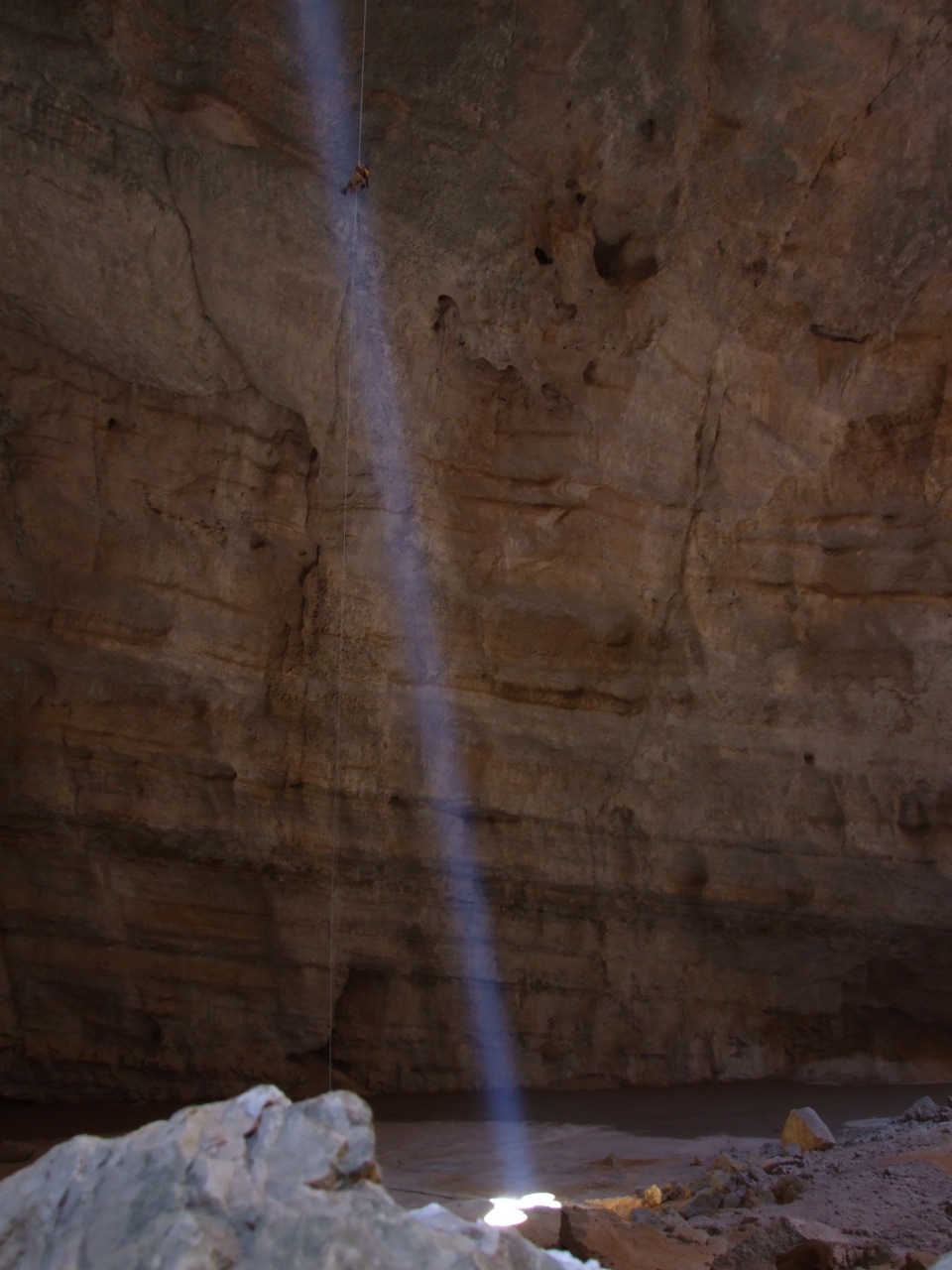
Photo: The original uploader was Michaelmcandrew at English Wikipedia., CC BY-SA 3.0, via Wikimedia Commons
Majlis al Jinn Cave in Oman ranks among the world's largest underground chambers, with its main hall spanning approximately 14 acres and reaching heights of over 120 meters. Visitors descend through narrow entrance shafts into a cathedral-like void so vast that multiple football fields could fit inside with room to spare. The cave formed through natural karst processes over millions of years as groundwater dissolved the surrounding limestone bedrock. Its name translates to "Assembly of the Jinn," reflecting deep-rooted Arabian folklore about supernatural beings who gather in remote underground spaces. Some theorists propose that the cave's name—"Assembly of the Jinn"—may preserve ancient memories of non-human beings who used underground spaces, with jinn entities potentially employing advanced technology to manifest as supernatural visitors. However, archaeologists and folklorists trace the jinn tradition to pre-Islamic and Islamic Arabian cosmology, where these supernatural beings were understood as part of the spiritual landscape rather than historical visitors, and the cave's actual formation occurred through well-understood geological processes spanning millions of years.
Timeline
Pre-Islamic Arabian folklore establishes jinn traditions associated with caves and remote places
Cave officially discovered by cavers exploring the Selma Plateau region
Scientific surveys confirm Majlis al Jinn as one of the world's ten largest cave chambers by volume
What the Show Claims
- ›The cave's name 'meeting place of the jinn' reflects ancient folk memory of extraterrestrial encountersS02E07S09E03
- ›Jinn-like entities may have used holographic technology to appear as supernatural messengersS05E09S08E04
- ›Underground spaces served as bases for non-human intelligences throughout historyS02E07
Theorist Takes
“If you have a little container, and you push a button and a hologram comes out, then could that be a genie in a bottle? And according to the ancient astronaut theory, that is exactly what happened. Where extraterrestrials used holograms in order to relay messages.”
From the Transcripts
“Deep inside the middle eastern country of Oman, a mysterious cavern lies hidden far beneath the surface. Called majlis al jinn, or "meeting place of the jinn," it stretches more than 14 acres underground, and is one of the world's ten largest caves.”
What Archaeology Says
Scientific exploration of Majlis al Jinn began in earnest following its modern discovery in 1983, though the cave system likely remained known to local Bedouin communities for generations. Geological surveys have mapped the chamber's extraordinary dimensions and confirmed its formation through standard limestone dissolution processes over geological time scales.
The cave's connection to Arabian folklore predates formal archaeological study, with jinn traditions deeply embedded in both pre-Islamic and Islamic cultural memory. These supernatural beings, according to traditional accounts, possessed the ability to inhabit spaces between worlds and could appear in various forms to interact with humans. The association of such entities with caves and underground spaces reflects a widespread cultural pattern found across many ancient civilizations.
Modern speleological research focuses primarily on the cave's geological formation and ecosystem, with limited archaeological investigation of potential human occupation or ritual use. The extreme difficulty of access—requiring technical rappelling skills—suggests that any historical human activity would have been minimal and likely ceremonial in nature.
What remains genuinely intriguing is the persistence of jinn-related folklore specifically associated with this location, despite the cave's remote position and challenging access. The relationship between geological phenomena and supernatural traditions continues to offer fertile ground for both anthropological study and speculative interpretation.
Mysteries & Fun Facts
The main chamber is so large that the entire Statue of Liberty could fit inside with room to spare
Three separate entrance shafts lead down into the cave, each requiring rappelling skills to navigate
The cave maintains a constant temperature year-round, providing natural climate control in Oman's desert environment
Local Bedouin traditions suggest the cave served as a neutral meeting ground for desert tribes in ancient times
Planning a Visit
Access to Majlis al Jinn requires advanced technical climbing skills and specialized rappelling equipment, as entry involves descending through narrow vertical shafts up to 158 meters deep. The cave is generally accessible to experienced cavers with proper permits from Oman's tourism authorities, though guided expeditions are strongly recommended for safety.
Muscat, approximately 150 kilometers northeast
The optimal visiting season runs from October through March when temperatures in the Selma Plateau region remain more moderate. Summer months can be extremely hot, making the challenging descent even more demanding for visitors.
Related Sites
Cave of Altamira
Another significant cave system with cultural and supernatural associations spanning thousands of years
Wieliczka Salt Mine
Underground complex featuring chambers that local folklore connects to otherworldly encounters
Externsteine
Rock formation site in Germany where ancient peoples attributed supernatural significance to natural geological features