Aurora Cemetery
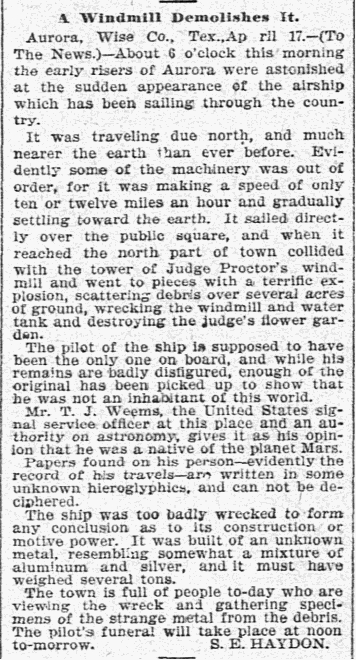
Photo: S. E. Haydon (Life time: fl. 1897), Public domain, via Wikimedia Commons
Aurora Cemetery sits on approximately 2.5 acres in the small town of Aurora, Texas, about 35 miles northwest of Dallas. This quiet rural graveyard, established in the 1860s, contains weathered limestone and marble headstones typical of late 19th-century Texas cemeteries. Today, visitors find roughly 800 marked graves scattered among native Texas oak trees, with the oldest dated burials from the 1870s. The cemetery gained modern notoriety due to claims that it contains the grave of an alleged extraterrestrial visitor from an 1897 spacecraft incident. In recent decades, the cemetery has become the focus of UFO folklore claims, with some theorists suggesting it may contain evidence of extraterrestrial contact from an alleged 1897 spacecraft incident in the area. However, cemetery records and historical documentation from the 19th century contain no corroborating evidence of such an event, and researchers trace the story's origins to modern retellings rather than contemporary accounts. The legend illustrates how local mysteries can evolve into cultural narratives, even in places with well-documented historical records.
Timeline
Aurora Cemetery established to serve the growing frontier community
Alleged UFO crash and alien burial according to local folklore
UFO researchers begin investigating the Aurora incident claims
Media attention brings national focus to the cemetery's alleged alien grave
What the Show Claims
- ›Aurora, Texas cemetery holds the body of an alien whose spacecraft crashed there in 1897, representing documented extraterrestrial visitation to the American WestS03E01
What Archaeology Says
No formal archaeological excavations have been conducted at Aurora Cemetery, as it remains an active burial ground under local community stewardship. The 1897 alien crash story appears to have emerged decades after the supposed incident, with no contemporary newspaper accounts or official records from that time period supporting the claims. Local historians note that the town of Aurora was indeed struggling economically in 1897, leading some researchers to suggest the alien story may have been created as a publicity stunt to attract attention and visitors.
Investigations by UFO researchers in the 1970s and 1980s found no physical evidence to support the extraterrestrial burial claims. Metal detector surveys of the cemetery have failed to locate any unusual metallic objects or grave markers that would indicate an alien burial site. Cemetery records from the period show typical frontier burials, with causes of death documented as common illnesses and accidents of the era.
The scientific consensus treats the Aurora incident as folklore rather than historical fact. Researchers emphasize that extraordinary claims require extraordinary evidence, and the Aurora case lacks the documentation and physical proof necessary to support alien visitation. What remains genuinely unknown is the exact origin of the story and whether any unusual event in 1897 may have inspired the later folklore, though conventional explanations seem most plausible.
Mysteries & Fun Facts
Aurora was once considered for a major railroad junction in the 1890s but lost out to nearby communities
The town's population peaked at around 3,000 residents in the late 1800s but dwindled to fewer than 400 today
Local legend claims the alleged alien was buried with debris from its spacecraft
The Aurora incident predates the famous Roswell incident by 50 years
Planning a Visit
Aurora Cemetery is generally accessible to respectful visitors during daylight hours, though it remains an active burial ground where local families continue to inter loved ones. The small cemetery sits along country roads in rural Wise County, with limited parking available along the roadside.
Dallas, approximately 35 miles southeast
Spring and fall offer the most comfortable weather for exploring this outdoor site. Summer temperatures in North Texas can be quite intense.
Related Sites
Roswell
Both locations are associated with alleged UFO incidents and extraterrestrial visitation claims
Tunguska explosion site
Another site of mysterious aerial phenomenon from the early 20th century
White Sands Proving Ground
Military installation connected to early aerospace testing and UFO encounter reports