Caral-Supe
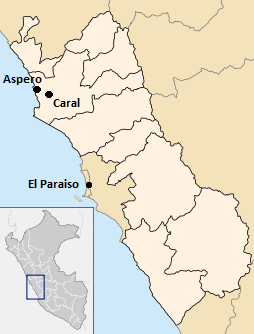
Photo: Ontrvet, CC BY-SA 3.0, via Wikimedia Commons
Caral-Supe represents one of the world's earliest urban civilizations, sprawling across thirty major population centers in Peru's north-central coastal region. The main site at Caral features six large stepped pyramids, the largest measuring approximately 150 meters long and 20 meters high, alongside sunken circular plazas and residential complexes that once housed up to 3,000 inhabitants. Located in the arid Supe Valley about 200 kilometers north of Lima, this ancient metropolis sits on terraced land between the Andes foothills and the Pacific coast. The site's remarkably preserved architecture includes sophisticated urban planning with clearly defined public, residential, and ceremonial areas that demonstrate advanced social organization dating back over 4,000 years. Some theorists propose that Caral's urban layout reflects celestial alignments to the Pleiades star cluster and that its pyramid architecture parallels contemporary structures in Egypt and Mesopotamia, suggesting possible extraterrestrial influence or shared advanced knowledge. However, archaeologists like Ruth Shady Solís point to extensive evidence of indigenous innovation—including distinctive pottery styles, local agricultural adaptation, and trade networks spanning coastal and highland regions—that accounts for Caral's architectural achievements as products of sophisticated Andean societies developing independently around 2600 BC. The site's complexity demonstrates that monumental urban planning emerged spontaneously in multiple world civilizations during this period, without requiring external intervention to explain its origins.
Timeline
First city established at Huaricanga in the Fortaleza area
Large-scale human settlement and communal construction begins at Caral
Caral reaches its peak as a major urban center with monumental architecture
Period of decline begins across the Caral-Supe civilization
Peruvian archaeologist Ruth Shady Solís begins systematic excavations
Caral designated as UNESCO World Heritage Site
What the Show Claims
- ›Caral's layout mirrors the Pleiades star cluster arrangementS17E01
- ›Pyramid construction parallels contemporaneous structures in Egypt and MesopotamiaS17E01
- ›Associated Staff God imagery links to extraterrestrial visitors known as ViracochaS17E01
Theorist Takes
“Caral could be the mother culture of the whole of south america.”
“The caral geoglyph is the oldest known in peru or bolivia. It's at least 2,000 years older than nazca, maybe more.”
From the Transcripts
“The dating of caral has really put into question the origins of civilization and the planet. This site went back at least to 2600 bc or earlier.”
“In the year 2000, while excavating caral, archaeologists discovered a geoglyph that they believe dates to the same period as the ancient city itself, which would make it, by far, the oldest geoglyph ever found in peru.”
What Archaeology Says
Systematic excavations led by Ruth Shady Solís since 1994 have revealed Caral as a sophisticated urban center with remarkable preservation due to the arid coastal climate. The site contains six main pyramids constructed using the "shicra" technique, where stones were placed in reed bags and stacked to create massive platforms. Archaeological evidence shows the civilization engaged in extensive trade networks, with cotton, anchovies, and other goods exchanged across coastal, highland, and Amazonian regions.
The scientific consensus identifies Caral-Supe as an entirely indigenous development, representing one of the world's six cradles of civilization alongside Mesopotamia, Egypt, the Indus Valley, China, and Mesoamerica. Radiocarbon dating of organic materials has confirmed the site's antiquity, with some structures dating to around 2600 BCE or earlier. The absence of warfare evidence, defensive walls, or weapons suggests a peaceful society organized around trade, agriculture, and ceremonial activities.
Key discoveries include sophisticated irrigation systems, textile production areas, and musical instruments such as flutes made from pelican and condor bones. The circular sunken plazas appear to have served ceremonial functions, with evidence of ritual fires and gatherings. However, many aspects of Caral remain mysterious, including the specific religious practices, the nature of their writing system if any existed, and the exact reasons for the civilization's eventual decline around 1800 BCE.
Mysteries & Fun Facts
Caral is contemporary with the Egyptian pyramids at Giza, making it one of the oldest cities in the Americas
The civilization developed without pottery, metal tools, or the wheel, yet created monumental architecture
Musical instruments found at the site include 32 flutes made from pelican and condor bones
The site covers approximately 626 hectares and includes evidence of one of the earliest known amphitheaters
Planning a Visit
Caral is generally accessible to visitors through organized tours from Lima, though the site requires a guided visit due to its archaeological importance and remote location. The journey involves a several-hour drive through desert terrain, and visitors should be prepared for hot, dry conditions with limited shade.
Lima, approximately 200 kilometers to the south
The dry season from May to October offers the most comfortable weather conditions, with clear skies and moderate temperatures ideal for exploring the expansive site.
Featured Locations1 sites within this area
Caral Geoglyph
PeruTheorists argue the Caral geoglyph, depicting a face visible only from the air, is at least 2,000 years older than the Nazca lines and was similarly designed for aerial observation by gods or extraterrestrials, making it the forerunner to all Nazca geoglyphs. Archaeologists discovered the geoglyph during excavations around 2000 AD and believe it dates to the same period as the ancient city of Caral, circa 2600 BC, making it the oldest known geoglyph in Peru or Bolivia.
Related Sites
Featured In1 episodes
Historical data sourced from Wikipedia