Antarctica
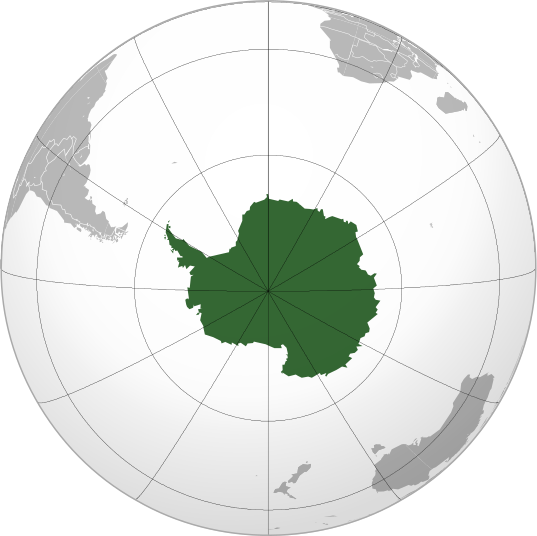
Photo: Heraldry, CC BY-SA 3.0, via Wikimedia Commons
Antarctica is Earth's southernmost and least-populated continent, covering an area of 14,200,000 km² (5,500,000 sq mi) — about 40% larger than Europe. The continent is buried beneath the Antarctic ice sheet, which averages 1.9 km (1.2 mi) in thickness and contains approximately 70% of the world's freshwater reserves. This polar desert experiences the planet's most extreme conditions, holding the record for the lowest measured temperature at -89.2°C (-128.6°F). Ancient Aliens theorists point to satellite imagery revealing what they claim are geometric structures beneath the ice, suggesting a pre-ice age civilization, though mainstream science identifies these formations as natural geological features. The continent remains one of Earth's most mysterious and inaccessible frontiers, governed by the Antarctic Treaty System and populated only by rotating research teams.
Timeline
First sighting of Antarctic ice shelves during Russian expedition led by Fabian Gottlieb von Bellingshausen and Mikhail Lazarev
First confirmed landing on Antarctica by Norwegian team
British explorers Douglas Mawson, Edgeworth David, and Alistair Mackay first reach the magnetic South Pole
Norwegian explorer Roald Amundsen becomes first to reach the geographic South Pole
Antarctic Treaty System established, prohibiting military activity and nuclear testing while promoting scientific cooperation
What the Show Claims
- ›Satellite imagery has revealed apparent man-made pyramids scattered beneath Antarctica's iceS11E01S14E01S20E03
- ›An ice-free Antarctica was colonized by extraterrestrials until a global catastrophe caused an ice ageS11E01S14E01
- ›Antarctica serves as a hidden alien base beneath the iceS20E03
What Archaeology Says
No traditional archaeological excavations have been conducted in Antarctica due to the continent's extreme conditions and the Antarctic Treaty System's environmental protections. The ice sheet averages 1.9 km thick across most of the continent, making any potential archaeological investigation extraordinarily challenging and currently technologically unfeasible. Scientific research in Antarctica focuses primarily on glaciology, climate research, and studying the continent's unique ecosystems rather than archaeological exploration.
The alleged 'pyramid' structures identified through satellite imagery are consistently explained by glaciologists and geologists as natural rock formations called nunataks — mountain peaks that protrude through the ice sheet. These formations can appear geometric or pyramid-like due to natural weathering processes and the way ice flows around resistant rock formations. No peer-reviewed scientific studies have identified any artificial structures beneath Antarctica's ice.
The scientific consensus maintains that Antarctica has been covered by ice for millions of years, with the current ice sheet forming approximately 34 million years ago during the Eocene-Oligocene boundary. Core samples from the ice provide detailed climate records spanning hundreds of thousands of years, showing no evidence of periods when the continent was ice-free and habitable during human history. While some coastal areas may have experienced brief warming periods, the interior has remained frozen throughout any timeframe relevant to human or hypothetical extraterrestrial colonization.
What remains genuinely unknown is the full topography beneath Antarctica's ice sheet, as only portions have been mapped using ice-penetrating radar. Ongoing projects like NASA's Operation IceBridge continue to reveal the continent's hidden landscape, but these surveys consistently identify geological rather than archaeological features. The continent's extreme isolation and harsh conditions make it one of Earth's least understood regions, contributing to speculation about what might lie beneath the ice.
Mysteries & Fun Facts
Antarctica contains approximately 70% of the world's freshwater, which if melted would raise global sea levels by almost 60 meters
The continent is on average the coldest, driest, and windiest of all continents with the highest average elevation
About 5,000 people reside at research stations during summer months, dropping to around 1,000 in winter
Antarctica is governed by about 30 countries under the 1959 Antarctic Treaty System, making it a continent dedicated to peaceful scientific cooperation
Planning a Visit
Antarctica is not accessible to casual tourism, with visits limited to specialized expedition cruises that operate during the Antarctic summer (October through March) and require significant advance planning and expense. Research stations accommodate only scientists and support personnel, typically requiring government sponsorship or academic affiliation for access.
Ushuaia, Argentina, approximately 1,000 km away, serves as the primary departure point for Antarctic expeditions.
The Antarctic summer months from November to February offer the most favorable conditions, with nearly 24 hours of daylight and temperatures that can reach above freezing along the coast.
Related Sites
Allen Hills, Antarctica (ALH 84001 meteorite find site)
Another Antarctic location featured on Ancient Aliens, where a meteorite allegedly containing evidence of ancient Martian life was discovered
Tunguska explosion site
Remote location where an unexplained explosion occurred, leading to theories about extraterrestrial involvement similar to Antarctica speculation
Dogon Country
African region where indigenous people possess detailed astronomical knowledge, often cited alongside Antarctica as evidence of ancient alien contact
Featured In3 episodes
Historical data sourced from Wikipedia