Uluru (Ayers Rock)
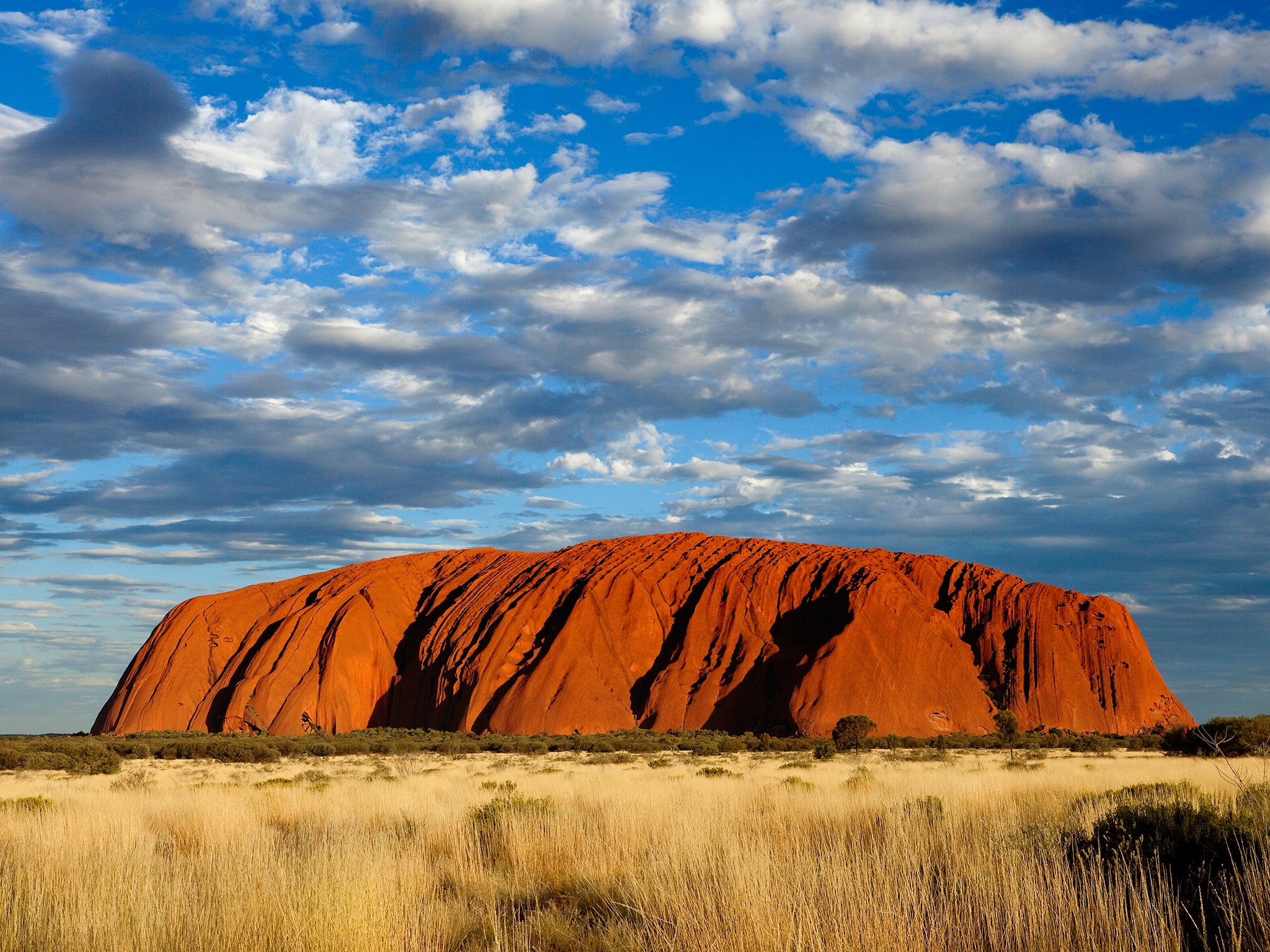
Photo: Ek2030372672, CC BY-SA 4.0, via Wikimedia Commons
Uluru, also known as Ayers Rock, is a massive sandstone monolith rising approximately 348 meters above the surrounding desert plain in Australia's Northern Territory. The formation extends roughly 3.6 kilometers long and 1.9 kilometers wide, with much of its bulk believed to extend deep underground. This geological marvel sits within Uluru-Kata Tjuta National Park, surrounded by red desert sands and sparse vegetation typical of central Australia. The rock face displays dramatic color changes throughout the day, shifting from deep red at sunrise and sunset to brilliant orange and purple hues. Some theorists propose that Aboriginal oral traditions describing celestial visitors and sky beings may represent accounts of extraterrestrial contact preserved across tens of thousands of years, with Uluru suggested as a site of potential ancient interaction. Archaeological and anthropological research, however, interprets these creation stories within the context of Aboriginal spiritual beliefs and deep cultural knowledge systems developed over millennia of inhabitation. The Anangu people themselves have clarified the spiritual and cultural significance of their traditions, emphasizing their own explanations for the sacred meaning of Uluru rather than extraterrestrial origins.
Timeline
Aboriginal peoples believed to have first inhabited the Uluru region
European explorer William Gosse first documented the formation, naming it Ayers Rock
Uluru returned to traditional Aboriginal ownership and jointly managed with Parks Australia
Uluru-Kata Tjuta National Park designated as UNESCO World Heritage Site
What the Show Claims
- ›Aboriginal oral traditions spanning over 60,000 years describe sky gods visiting Earth in fire-spewing crafts, potentially representing extraterrestrial contactS11E07
- ›Sacred Aboriginal sites around Uluru contain evidence of humanity's extraterrestrial past embedded in creation storiesS11E07
Theorist Takes
“An elder we're in good contact with told us a story about Uluru, which is quite fascinating. That we were actually seeded from the spear from the Pleiades through space. And it actually hit the ground, and where that place was is Uluru.”
From the Transcripts
“Uluru Rock, also known as Ayers Rock, is located nearly in the center of the continent, over 1,200 miles from the nearest major Australian city. This geological anomaly is one of the largest isolated rocks in the world.”
What Archaeology Says
Archaeological evidence indicates continuous Aboriginal habitation around Uluru for tens of thousands of years, with the Anangu people maintaining deep spiritual connections to the site throughout this period. Rock art galleries near the base contain paintings estimated to span thousands of years, depicting traditional Dreamtime stories, hunting scenes, and ceremonial practices. These artistic records provide invaluable insights into one of the world's oldest continuous cultures.
Traditional archaeological interpretation focuses on the geological formation of Uluru approximately 550 million years ago through sedimentary processes, with the monolith representing an exposed portion of much larger underground rock formations. The site's cultural significance centers on Tjukurpa, the foundation of Anangu law and culture, which encompasses creation stories explaining the landscape's formation through ancestral beings' journeys.
Scientific consensus attributes Aboriginal creation stories to sophisticated spiritual and cultural frameworks developed over millennia of intimate connection with the landscape. Researchers emphasize that oral traditions serve multiple functions beyond historical record-keeping, including moral instruction, environmental knowledge, and cultural identity preservation.
While the antiquity and complexity of Aboriginal oral traditions remain subjects of ongoing research, determining precise historical accuracy of stories spanning such vast timescales presents significant methodological challenges. The intersection of geological deep time and human cultural memory continues to fascinate researchers studying Australia's indigenous heritage.
Mysteries & Fun Facts
Uluru extends an estimated 2.5 kilometers underground, making the visible portion only the tip of a massive geological formation
The rock face changes color throughout the day due to iron oxide content and varying angles of sunlight
Traditional Aboriginal law restricts photography in certain areas around the base considered sacred
The formation is composed of sandstone laid down approximately 550 million years ago in an ancient sea
Planning a Visit
Uluru is generally accessible to visitors through guided tours and designated walking tracks around the base, though climbing the rock was permanently banned in 2019 out of respect for Aboriginal cultural sensitivities. The site requires entry through Uluru-Kata Tjuta National Park, with visitor centers providing cultural context and tour information.
Alice Springs, approximately 450 kilometers northeast
The optimal visiting season is during Australia's winter months from May to September when temperatures are cooler and rainfall minimal. Summer months can be extremely hot with temperatures exceeding 40°C.
Related Sites
Gosford Glyphs, Brisbane Water National Park
Another Australian site where Ancient Aliens explores Aboriginal connections to ancient astronaut theories
Wolfe Creek Crater (Kandimalal)
Australian meteorite impact crater also featured in ancient astronaut discussions about cosmic connections
Mount Yengo
Sacred Aboriginal site in Australia with traditional stories that some interpret as extraterrestrial encounters