Roswell Incident Site
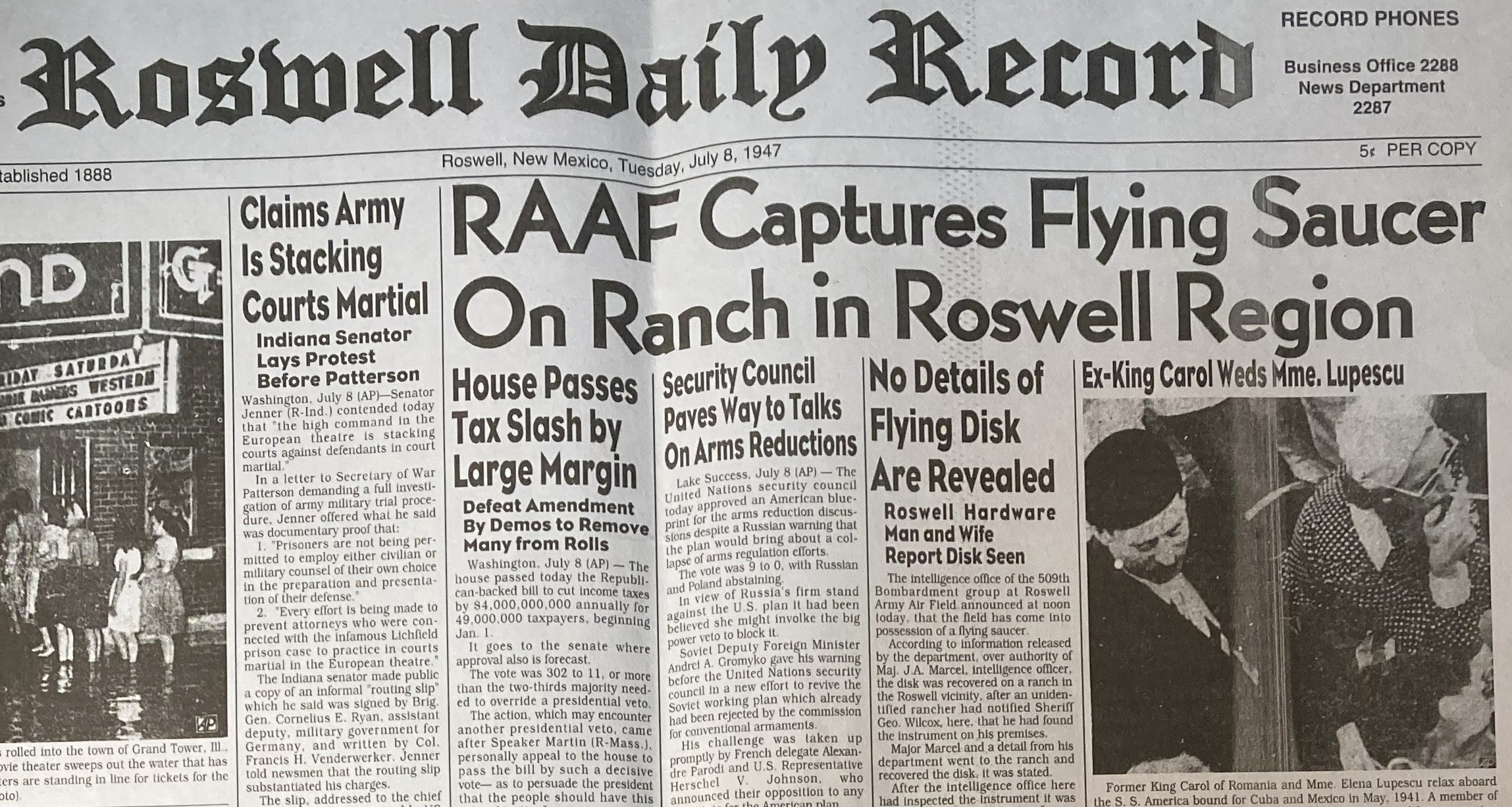
Photo: Roswell Daily Record., Public domain, via Wikimedia Commons
The Roswell Incident Site encompasses the debris field approximately 75 miles northwest of Roswell, New Mexico, where rancher William "Mac" Brazel discovered strange materials in July 1947. The original crash site is located on what was then the J.B. Foster Ranch, spanning several acres of high desert terrain characterized by scrubland and sparse vegetation. Today, visitors find a remote, largely unchanged landscape with rolling hills and scattered ranching operations. The incident gained worldwide attention when the Roswell Army Air Field initially announced the recovery of a "flying disc" before quickly retracting the statement. The site has become one of the most famous UFO-related locations in the world, drawing thousands of visitors annually to the general area. Some proponents of the ancient astronaut theory suggest the recovered materials were evidence of extraterrestrial technology, with theorists proposing that classified retrieval efforts may have overlooked additional debris containing advanced alien engineering. However, the U.S. government later declassified documents revealing the debris was part of Project Mogul, a Cold War-era classified program designed to detect Soviet nuclear detonations through high-altitude balloon sensors. While the initial military announcement of a "flying disc" fueled decades of speculation, this explanation accounts for the materials recovered and the subsequent official retraction.
Timeline
Rancher Mac Brazel discovers debris field on Foster Ranch in early July
Roswell Army Air Field announces recovery of 'flying disc' on July 8, then retracts statement claiming weather balloon
UFO researcher Stanton Friedman interviews Major Jesse Marcel, reigniting public interest in the incident
U.S. Air Force releases report revealing debris was from classified Project Mogul
What the Show Claims
- ›The 1947 debris collected near Roswell was from an extraterrestrial spacecraft rather than a weather balloonS15E02
- ›Wreckage may still exist that recovery teams overlooked, containing evidence of alien technologyS15E02
- ›The military conducted an extensive cover-up operation to hide evidence of extraterrestrial contact
What Archaeology Says
Unlike traditional archaeological sites, the Roswell location presents unique challenges for investigation since the original debris was reportedly collected by military personnel in 1947. Various researchers and UFO investigators have conducted searches of the general debris field area over the decades, but no verified extraterrestrial materials have been recovered from the site. The terrain consists of typical high desert environment with scattered vegetation and occasional ranch structures.
Key figures in Roswell research include Major Jesse Marcel, the intelligence officer who initially examined the debris, and later researchers like Stanton Friedman and Donald Schmitt who interviewed witnesses and investigated the incident. The scientific consensus, supported by declassified military documents, indicates the debris came from Project Mogul, a top-secret program designed to detect Soviet nuclear tests using high-altitude balloons carrying sensitive acoustic equipment.
What remains genuinely unknown is the exact composition and appearance of some materials described by witnesses, as the original debris was never independently analyzed by civilian scientists. Witness accounts describe materials with unusual properties, though these descriptions vary significantly and may reflect the confusion and secrecy surrounding the classified military operation. The site continues to be a subject of investigation by both UFO researchers and skeptical investigators.
Mysteries & Fun Facts
The term 'flying saucer' became popularized just weeks before the Roswell incident following Kenneth Arnold's UFO sighting near Mount Rainier
Project Mogul balloons could reach altitudes of over 60,000 feet and carried classified acoustic detection equipment
The Roswell incident received little media attention initially and wasn't widely discussed until the late 1970s
An estimated 200,000 people visit Roswell annually, many drawn by the UFO connection
Planning a Visit
The original debris field is located on private ranch land and is not officially accessible to the public. Visitors typically explore the general Roswell area, including the International UFO Museum and Research Center in town, which provides context and exhibits related to the incident.
Roswell, New Mexico, approximately 75 miles southeast
Spring through fall offers the best weather for exploring the Roswell area, though summer temperatures can be quite high in the high desert climate.
Related Sites
White Sands Proving Ground
Located nearby in New Mexico and associated with classified military testing during the same era as Roswell
Tunguska explosion site
Another site where unexplained aerial phenomena and debris recovery created lasting mysteries and speculation
GIMBAL UAP Incident Site (Atlantic Coast of Florida)
Modern military UAP encounter site that Ancient Aliens connects to ongoing government knowledge of aerial phenomena