Sagamore Hill
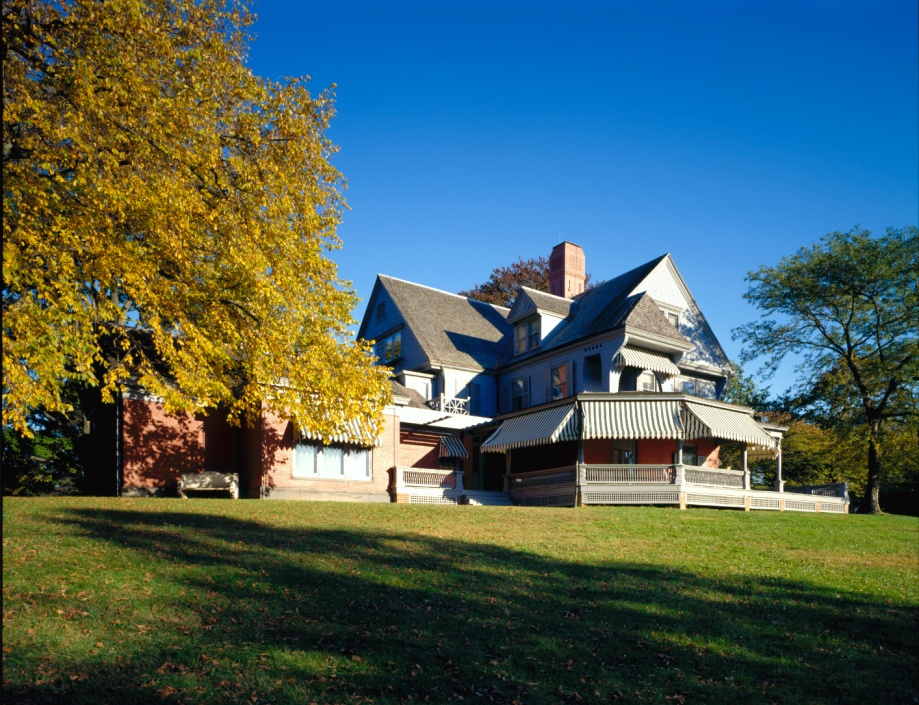
Photo: Unknown, Public domain, via Wikimedia Commons
Sagamore Hill stands as the preserved 23-room Victorian mansion that served as Theodore Roosevelt's beloved family home and Summer White House from 1885 until his death in 1919. Located on 83 acres in Cove Neck, New York, approximately 25 miles east of Manhattan on Long Island's North Shore, the site overlooks Oyster Bay and Cold Spring Harbor. The Queen Anne-style house, completed in 1885, features Roosevelt's famous library containing over 10,000 books, his trophy room filled with hunting specimens, and the North Room where he conducted presidential business during summers from 1901-1909. Today, visitors can explore the meticulously preserved mansion and grounds, now operated as the Sagamore Hill National Historic Site, which includes the Theodore Roosevelt Museum housed in a separate building constructed in 1950. In 1907, the year Roosevelt was actively advancing his naval expansion agenda, some theorists have pointed to reported sightings of an unusual luminous object hovering over Sagamore Hill as potentially connected to his visionary geopolitical ambitions. Historical records indicate that Roosevelt's focus during this period was grounded in conventional strategic planning—developing naval capabilities and establishing American global influence through traditional military and diplomatic means. The reported aerial phenomenon remains undocumented in official historical accounts, leaving open questions about what witnesses may have observed in the early 20th-century sky above Long Island.
Timeline
Theodore Roosevelt begins construction of Sagamore Hill as his family home
Roosevelt family moves into the completed 23-room Victorian mansion
Sagamore Hill serves as the Summer White House during Roosevelt's presidency
Alleged UFO sighting occurs over the property, witnessed by numerous neighbors
Theodore Roosevelt dies at Sagamore Hill on January 6
Site becomes Sagamore Hill National Historic Site under National Park Service
What the Show Claims
- ›A spectacular UFO — a giant orb of light witnessed by dozens of neighbors — hovered in the sky for nearly two hours over Sagamore Hill in 1907, possibly connected to Roosevelt's visionary planning for U.S. naval supremacy and global leadershipS15E12
What Archaeology Says
While Sagamore Hill is not an archaeological site in the traditional sense, extensive historical preservation work has revealed fascinating insights into early 20th-century presidential life. The National Park Service has maintained the house essentially as Roosevelt left it, with 95% of the furnishings being original Roosevelt family pieces. Careful restoration work has preserved Roosevelt's extensive personal library, his hunting trophies from around the world, and the exact desk where he conducted presidential correspondence.
Historians and curators have documented Roosevelt's use of Sagamore Hill as more than just a retreat — it functioned as a genuine working White House during summer months. The North Room served as his office, where he met with diplomats, cabinet members, and foreign dignitaries. Archaeological surveys of the grounds have revealed the foundations of various outbuildings, including stables and servant quarters that supported the estate's operations during Roosevelt's era.
The scientific consensus views Sagamore Hill as an exceptionally well-preserved example of a Gilded Age estate that doubled as a seat of presidential power. Roosevelt's own documentation and contemporary newspaper accounts provide detailed records of the property's use and significance. What remains intriguing to researchers is the extent to which Roosevelt's global vision and policies may have been shaped by his time spent in this peaceful Long Island setting, far from the pressures of Washington D.C.
Mysteries & Fun Facts
Roosevelt named the house 'Sagamore Hill' after the Sagamore Mohannis, a chief of the local Matinecock tribe
The house contains over 10,000 books from Roosevelt's personal library, many with his handwritten notes in the margins
Roosevelt's trophy room displays hunting specimens from his expeditions to Africa and the American West, including a rhinoceros head
The North Room served as the Summer White House office where Roosevelt negotiated the end of the Russo-Japanese War, earning him the Nobel Peace Prize
Planning a Visit
Sagamore Hill National Historic Site is open to the public year-round, with guided tours available of both the historic house and the Theodore Roosevelt Museum. Visitors can explore the preserved mansion rooms, including Roosevelt's famous library and trophy room, as well as walk the grounds overlooking Oyster Bay. The site is easily accessible by car and offers parking facilities for guests.
New York City, approximately 25 miles southwest
Spring through fall offers the most pleasant weather for exploring both the house and extensive grounds, with the gardens at their peak during late spring and summer. Winter visits provide a more intimate experience with smaller crowds, though some outdoor areas may have limited access.
Related Sites
White Sands Proving Ground
Both locations are connected to claims of government involvement with unexplained aerial phenomena in the early-to-mid 20th century
Roswell
The famous 1947 Roswell incident shares thematic connections to unexplained aerial sightings near sites of American political and military significance
Silicon Valley (Way of the Future Church)
Silicon Valley represents the modern intersection of technology, visionary leadership, and speculation about advanced phenomena, echoing Roosevelt's era of rapid technological advancement
Featured In1 episodes
Historical data sourced from Wikipedia