Madras (Chennai), India
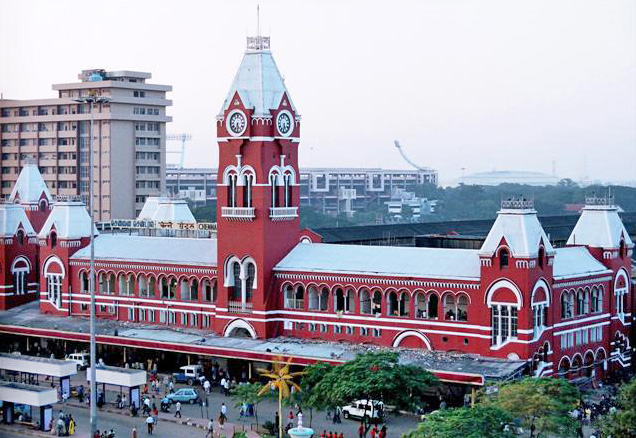
Photo: jamal haider from india, CC BY-SA 2.0, via Wikimedia Commons
Chennai (formerly Madras), India's fourth-largest city with over 7 million residents, is located on the Bay of Bengal in Tamil Nadu state. The city spans approximately 426 square kilometers and serves as a major cultural and educational center of South India. While Chennai itself is a modern metropolis, it sits in a region rich with ancient Hindu temples, including the 8th-century Kapaleeshwarar Temple and the historic Fort St. George built by the British East India Company in 1644. The city gained particular significance in mathematical history as the birthplace and home of Srinivasa Ramanujan, whose modest family residence stood in the Sarangapani Street area of Georgetown.
Timeline
Early settlement established in the region, with Tamil Sangam literature referencing the area
British East India Company establishes Fort St. George, creating the foundation of modern Chennai
Srinivasa Ramanujan born in Erode, later moves to Chennai for education
Ramanujan begins correspondence with Cambridge mathematician G.H. Hardy
Ramanujan returns to Chennai from Cambridge, continuing his mathematical work until his death in 1920
What the Show Claims
- ›Mathematician Srinivasa Ramanujan received advanced mathematical theorems through dreams attributed to the Hindu goddess Namagiri, suggesting extraterrestrial or divine transmission of complex knowledgeS09E04
Theorist Takes
“He claimed that a goddess, a Hindu goddess known as Namagiri transmitted these theorems to him. These theorems came to be known as modular functions, and still to this day, they are the most advanced form of mathematics that is used by physicists dealing with relativity and quantum mechanics.”
From the Transcripts
“Madras, India. In the first decade of the 20th century, Srinivasa Ramanujan... a young mathematician with no formal training... repeatedly stuns the academic world with innovative theorems.”
What Archaeology Says
While Chennai itself has limited archaeological excavations due to its status as a continuously inhabited urban center, the broader region contains significant historical sites. The Kapaleeshwarar Temple, believed to date to the 7th-8th centuries, represents Dravidian architectural traditions, though much of the current structure reflects later Vijayanagara period reconstructions. British colonial archaeological surveys in the late 19th and early 20th centuries documented various ancient Tamil inscriptions and structural remains throughout the region.
The most significant "archaeological" investigation related to Chennai involves the scholarly examination of Ramanujan's mathematical notebooks and manuscripts. After his death in 1920, mathematicians including G.H. Hardy and later researchers like Bruce Berndt spent decades analyzing his unpublished work. These mathematical "excavations" revealed thousands of theorems and formulas, many of which anticipated mathematical discoveries made decades later by other researchers using modern computational methods.
Scientific consensus attributes Ramanujan's extraordinary mathematical insights to his exceptional intuitive understanding of number patterns, developed through intensive self-study of limited mathematical texts. Researchers note that his background in South Indian mathematical traditions, including ancient Tamil mathematical works, may have influenced his unique approaches to problems. However, the source of some of his most profound insights remains genuinely mysterious to mathematicians.
What remains unknown is the exact process by which Ramanujan developed many of his most sophisticated theorems. His own accounts of receiving mathematical revelations through dreams and divine inspiration continue to puzzle researchers, as the complexity of some formulas seems to exceed what could be derived through the mathematical resources available to him at the time.
Mysteries & Fun Facts
Ramanujan discovered over 3,900 mathematical results during his short 32-year life, many without formal proof
His famous taxi-cab number 1729 is the smallest number expressible as the sum of two cubes in two different ways
Ramanujan claimed the goddess Namagiri would appear in his dreams and show him mathematical formulas on a red screen
Modern physicists use Ramanujan's work on modular functions in string theory and black hole research
Planning a Visit
Chennai is easily accessible to visitors as a major metropolitan center with an international airport and extensive transportation networks. While Ramanujan's original family home no longer stands, visitors can explore related sites including the Government Arts College where he studied, and various temples he frequented. The city offers numerous hotels, restaurants, and cultural attractions beyond its mathematical significance.
Chennai is itself a major city; the nearest other significant urban center is Bangalore, approximately 350 kilometers inland.
The best time to visit Chennai is during the cooler months from November to February, when temperatures are more comfortable and monsoon rains have subsided. This period offers the most pleasant conditions for exploring the city's outdoor sites and temples.