Operation Highjump (Antarctic waters)
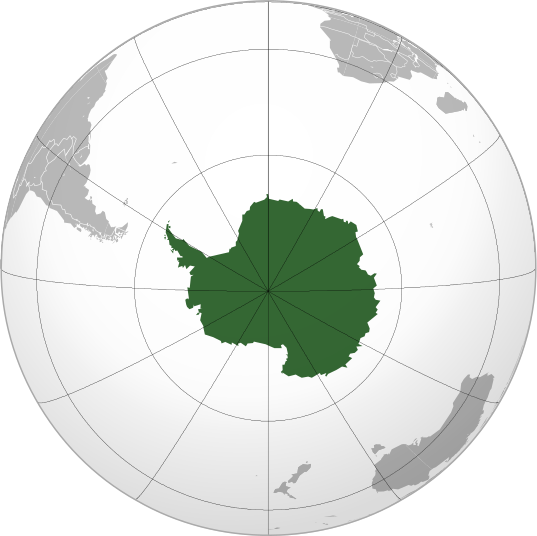
Photo: Heraldry, CC BY-SA 3.0, via Wikimedia Commons
Operation Highjump represents one of the most ambitious polar expeditions in history, conducted across the vast Antarctic continent and its surrounding waters between 1946 and 1947. This massive U.S. Navy operation covered approximately 60% of Antarctica's coastline, deploying 4,700 personnel across 13 ships including the aircraft carrier USS Philippine Sea and the command ship USS Mount Olympus. The expedition established temporary bases on the Ross Ice Shelf and conducted extensive aerial photography missions, mapping over 537,000 square miles of previously uncharted Antarctic territory. Today, the legacy of Operation Highjump lives on through the detailed maps and scientific data collected, though the harsh Antarctic environment has long since erased any physical traces of the temporary installations.
Timeline
Operation Highjump launched under Admiral Richard Byrd with the largest Antarctic expedition force ever assembled
Fleet conducts extensive mapping operations and establishes temporary research stations across Antarctic coastline
Operation ends several months ahead of schedule, officially due to harsh weather conditions and logistical challenges
What the Show Claims
- ›U.S. naval fleet encountered technologically superior flying saucers rising from Antarctic waters during the operationS11E01
- ›Extraterrestrial craft allegedly used energy beams to cut ships in half and shot down military aircraftS11E01
- ›The expedition's early termination was due to hostile encounters with non-human technology rather than weather conditionsS11E01
Theorist Takes
“Saucers were coming up out of the water, and were shooting them with some sort of beam, literally cutting ships in half. They were shooting planes out of the sky.”
From the Transcripts
“In 1946, one year after the end of World War II, the U.S. government launched its own large-scale mission to Antarctica. Operation Highjump deployed 4,700 troops, 13 ships, an aircraft carrier, and a number of seaplanes to Antarctica.”
What Archaeology Says
Operation Highjump was fundamentally a military and scientific expedition rather than an archaeological endeavor, though its comprehensive mapping efforts would later support Antarctic research for decades. The operation's primary achievements included establishing the extent of Antarctica's ice sheet, conducting detailed aerial photography that revealed previously unknown mountain ranges and geographical features, and testing cold-weather equipment and procedures that would prove essential for future polar exploration.
Led by Admiral Richard E. Byrd, a veteran polar explorer, the expedition represented the culmination of American interest in asserting territorial claims in Antarctica during the post-World War II period. The operation involved multiple task forces conducting simultaneous missions across different sectors of the continent, with the Eastern Group, Western Group, and Central Group each responsible for specific geographical areas. Scientific personnel aboard the ships conducted oceanographic studies, weather observations, and geological surveys that contributed significantly to understanding Antarctic ecosystems.
Historical records from the U.S. Navy archives document the expedition's official objectives and outcomes, with no mention of the extraordinary encounters described by some theorists. Military historians note that the operation faced significant logistical challenges, including equipment failures in extreme cold, difficulties with aircraft operations in Antarctic conditions, and supply chain issues that ultimately contributed to its shortened duration. The expedition's early conclusion appears to align with documented problems rather than any undisclosed incidents.
What remains genuinely intriguing about Operation Highjump is the scale of the undertaking and some of the expedition's classified aspects, which have fueled decades of speculation. The operation's comprehensive documentation provides a detailed record of mid-20th century polar exploration capabilities, yet certain mission details remain restricted, contributing to ongoing curiosity about the expedition's complete scope and findings.
Mysteries & Fun Facts
Operation Highjump deployed more personnel to Antarctica than any expedition before or since, with 4,700 participants
The expedition's aerial photography missions covered over 537,000 square miles, creating the most comprehensive maps of Antarctica available at the time
Admiral Byrd had previously conducted four Antarctic expeditions, making him one of the most experienced polar explorers of his era
The operation included the aircraft carrier USS Philippine Sea, marking one of the few times a full-sized carrier operated in Antarctic waters
Planning a Visit
Antarctica remains one of the world's most challenging destinations to visit, accessible only through specialized expedition cruises or research programs. Visitors to Antarctic waters today typically travel via cruise ships departing from South America, experiencing the same harsh conditions that challenged the Operation Highjump fleet decades ago.
Ushuaia, Argentina, approximately 600 miles north across the Drake Passage
Antarctic travel is only possible during the austral summer months from November to March, when temperatures are relatively warmer and daylight hours extend significantly.
Related Sites
Roswell
Both sites involve alleged government cover-ups of extraterrestrial encounters in the same post-WWII timeframe
Allen Hills, Antarctica (ALH 84001 meteorite find site)
Another Antarctic location where researchers claim to have found evidence of extraterrestrial activity
Tunguska explosion site
Like Operation Highjump, involves unexplained aerial phenomena that some theorists attribute to non-human technology