Newberry Library, Chicago (Popol Vuh manuscript)
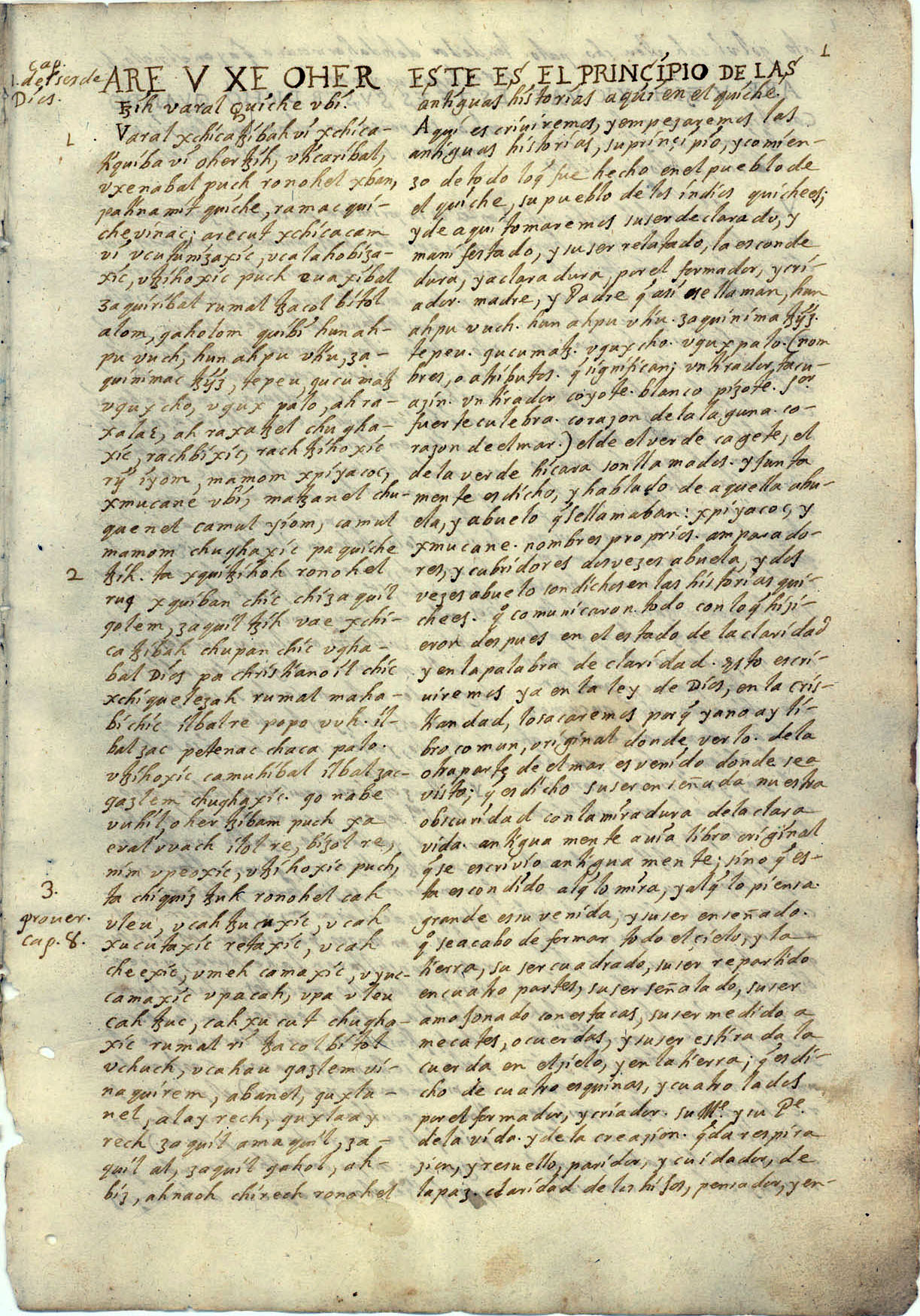
Photo: Francisco Ximénez, Public domain, via Wikimedia Commons
The Newberry Library in Chicago houses one of the world's most significant collections of rare manuscripts, including a precious copy of the Popol Vuh, the sacred creation narrative of the K'iche' Maya people. This 16th-century manuscript, written in the Latin alphabet by indigenous scribes, represents the most complete surviving Maya creation text and stands as one of the few written records that bridge pre-Columbian oral traditions with colonial documentation. The library itself, established in 1887, occupies a distinctive Romanesque Revival building on Chicago's Near North Side and contains over 1.5 million books and 5 million manuscripts. Visitors today can view this remarkable document that preserves creation stories, cosmological beliefs, and historical accounts that may date back centuries before European contact.
Timeline
K'iche' Maya oral traditions of creation stories and cosmology develop and are maintained through generations
K'iche' Maya scribes transcribe the Popol Vuh into Latin alphabet, preserving ancient oral traditions in written form
Newberry Library established in Chicago, eventually becoming repository for significant Mesoamerican manuscripts
Popol Vuh manuscript acquired by Newberry Library, making it accessible to scholars and researchers worldwide
What the Show Claims
- ›The Popol Vuh preserves literal accounts of extraterrestrial creators who physically manifested and spoke the world into existenceS04E01
- ›Ancient alien visitors selected sacred sites and specific peoples, with evidence preserved in Maya creation narrativesS04E01
- ›The sophisticated cosmological knowledge in the Popol Vuh suggests contact with advanced non-human intelligencesS04E01
Theorist Takes
“What they were saying was that a framework was created... that certain deities manifested themselves physically and made decisions as to what was going to happen. In the case of the Mayans, this was a choice as to where the Mayans were going to live, as well as the selection of certain sacred sites.”
From the Transcripts
“Housed here, in the Newberry Library, is the Mayan manuscript known as the Popol Vuh. Literally translated as 'the book of the people,' it is a collection of Maya oral histories passed on through the ages.”
What Archaeology Says
The Popol Vuh represents a unique archaeological treasure not in terms of physical excavation, but as a written artifact that preserves pre-Columbian Maya intellectual and spiritual traditions. The manuscript was created during the mid-16th century, likely between 1554 and 1558, by K'iche' Maya scribes who had learned to write their language using the Latin alphabet introduced by Spanish missionaries. This timing places its creation during a crucial period when indigenous communities sought to preserve their ancestral knowledge before it could be lost to colonial suppression.
Scholars including Dennis Tedlock, who produced the definitive English translation in 1985, have demonstrated that the text contains multiple layers of meaning and sophisticated astronomical knowledge that reflects centuries of Maya scientific observation. The narrative structure suggests it was compiled from various oral sources, possibly representing different lineages or communities within K'iche' society. Archaeological evidence from sites like Q'umarkaj (the K'iche' capital) supports many of the historical claims made in the later portions of the text, validating its role as both mythological and historical document.
The scientific consensus views the Popol Vuh as one of the most important surviving examples of indigenous American literature and religious thought. Researchers have identified clear parallels between its creation stories and those found in other Mesoamerican cultures, suggesting shared mythological traditions across the region. The text's sophisticated understanding of cycles, astronomy, and natural phenomena reflects the advanced intellectual achievements of Maya civilization.
What remains genuinely intriguing to scholars is the question of how ancient the oral traditions preserved in the manuscript actually are. Some elements may date back centuries or even millennia before the Spanish conquest, representing knowledge systems that developed over vast periods of time. The text's complex symbolism and layered meanings continue to yield new insights as scholars develop better understanding of K'iche' Maya language and culture.
Mysteries & Fun Facts
The name 'Popol Vuh' translates roughly to 'Council Book' or 'Book of the Community' in K'iche' Maya language
The manuscript preserves the famous story of the Hero Twins, Hunahpu and Xbalanque, who defeat the lords of the underworld through cleverness and skill
The text describes multiple failed attempts at creating humans, including beings made from mud and wood, before the gods successfully create people from maize
The Newberry Library's collection includes over 100,000 maps, making it one of the premier cartographic research centers in North America
Planning a Visit
The Newberry Library is generally open to the public for research purposes, though access to rare manuscripts like the Popol Vuh typically requires advance arrangement and research credentials. The library offers exhibitions and educational programs that may feature materials related to Mesoamerican cultures and historical manuscripts.
Chicago, Illinois (located within the city)
The library maintains consistent hours year-round, making any season suitable for visits. Weekdays typically offer quieter research conditions, while special exhibitions may draw larger crowds during opening periods.
Related Sites
Palenque
Palenque contains Maya inscriptions and artwork that complement the mythological narratives preserved in the Popol Vuh
Chichen Itza - Kukulkan Temple
Chichen Itza represents the architectural and astronomical achievements of Maya civilization that produced sophisticated creation stories like the Popol Vuh
Cahokia Mounds
Cahokia Mounds demonstrates the complex indigenous cultures of ancient North America that, like the Maya, preserved sophisticated knowledge systems through oral and material traditions