Tabby's Star (KIC 8462852)
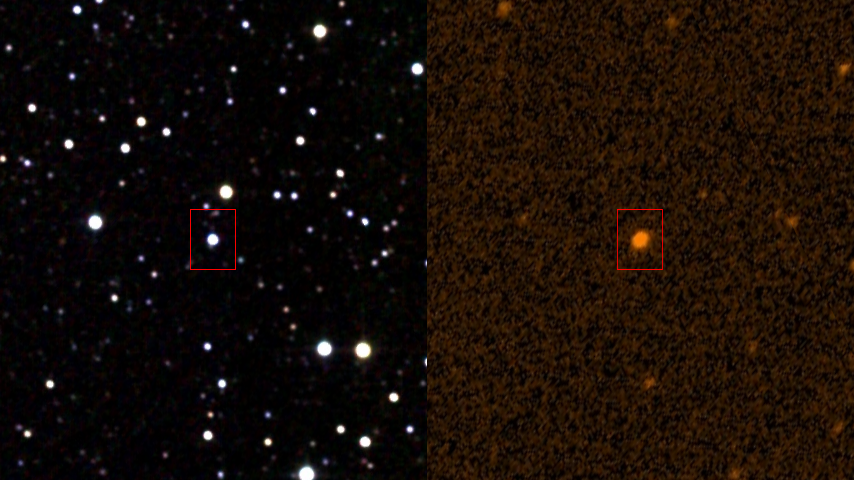
Photo: Infrared: IPAC/NASA Ultraviolet: STScI (NASA), Public domain, via Wikimedia Commons
Tabby's Star, officially designated KIC 8462852, is a main-sequence F-type star located approximately 1,470 light-years away in the constellation Cygnus. What makes this stellar object extraordinary are its irregular dimming patterns, with brightness reductions reaching up to 21% — far exceeding the typical 1% dimming expected from planetary transits. The star exhibits both short-term flickering and long-term dimming trends that have puzzled astronomers since 2015. Unlike physical archaeological sites, this cosmic mystery is observed through advanced telescopic data and represents one of the most intriguing stellar anomalies in modern astronomy. The star's unusual behavior has sparked intense scientific debate and captured public imagination as potentially the first evidence of an advanced extraterrestrial civilization. Some theorists have proposed that the star's dramatic dimming patterns could indicate a massive alien megastructure like a Dyson sphere—a hypothetical shell built around a star to capture its energy—suggesting an advanced civilization harvesting stellar power. However, astronomers studying the star have identified several natural phenomena that may explain the dimming, including clouds of dust and debris from cometary collisions, though no single explanation has yet fully accounted for all observed patterns. The scientific consensus remains that while Tabby's Star presents a genuine astronomical puzzle, additional data and observation are needed before any extraordinary conclusions can be drawn.
Timeline
NASA's Kepler Space Telescope continuously monitors KIC 8462852 as part of its exoplanet survey mission
Astronomer Tabetha Boyajian and citizen scientists analyzing Kepler data identify unprecedented irregular dimming patterns
Follow-up observations begin worldwide as the astronomical community investigates various hypotheses for the anomalous behavior
Ongoing monitoring campaigns continue using ground-based telescopes and space-based instruments to study the star's behavior
What the Show Claims
- ›The anomalous light dimming patterns of up to 21% are consistent with a massive extraterrestrial megastructure such as a Dyson sphereS12E01
- ›The irregular dimming suggests a Type II civilization capable of harnessing stellar energy on a galactic scaleS12E01
- ›Natural explanations including dust clouds and cometary swarms cannot fully account for the observed phenomenaS12E01
Theorist Takes
“This story is a total game-changer, because it suggests that a Type II civilization, a civilization that can harness the power of an entire star, actually does exist and we can see it with our telescopes.”
From the Transcripts
“members of the Kepler team revealed some incredible findings coming from the star KIC 8462852, also known as Tabby's Star... scientists who are publishing papers in which they propose that one of the explanations for what they are seeing is a massive extraterrestrial construct akin to something known as a Dyson sphere.”
What Archaeology Says
While Tabby's Star isn't an archaeological site in the traditional sense, the scientific investigation follows similar methodological approaches to uncovering ancient mysteries. The discovery began when citizen scientists working with astronomer Tabetha Boyajian analyzed data from NASA's Kepler Space Telescope, which had been continuously monitoring the star from 2009 to 2013. The initial findings revealed dimming events that were not only unusually deep but also highly irregular in timing and shape — unlike the predictable, symmetric dips caused by planets orbiting in front of their host stars.
Subsequent research efforts have involved astronomers worldwide, including teams led by researchers at Yale University, Louisiana State University, and other institutions. Various hypotheses have been proposed to explain the anomalous behavior, ranging from swarms of comets or asteroid fragments to unusual dust clouds or even instrumental artifacts. Some scientists have suggested that the star may be consuming planetary material or experiencing magnetic phenomena. The challenge for researchers is that none of these natural explanations fully account for all aspects of the observed dimming patterns.
The scientific consensus remains that while the star's behavior is genuinely anomalous and represents a significant astrophysical puzzle, extraordinary claims require extraordinary evidence. Most astronomers favor natural explanations over artificial ones, though they acknowledge that the mystery hasn't been definitively solved. What makes this case particularly intriguing is that continued observations have shown the star's long-term dimming trend may extend back over a century, based on analysis of historical photographic plates.
What remains genuinely unknown is the precise mechanism causing these dimming events. Despite years of intensive study using multiple telescopes and observational techniques, the phenomenon continues to challenge our understanding of stellar behavior. The ongoing mystery demonstrates how even in our age of advanced astronomical instruments, the universe can still surprise us with phenomena that don't fit neatly into established categories.
Mysteries & Fun Facts
The star was nicknamed 'Tabby's Star' after astronomer Tabetha Boyajian, who led the team that first identified its unusual behavior
Citizen scientists participating in the Planet Hunters project were instrumental in the initial discovery, demonstrating the power of crowdsourced astronomical research
The star has also been referred to as the 'WTF Star' by some astronomers, standing for 'Where's The Flux?' due to its mysterious dimming patterns
Analysis of historical photographic plates suggests the star may have been gradually dimming for over 100 years, adding another layer to the mystery
Planning a Visit
As an astronomical object, Tabby's Star cannot be visited physically, but amateur astronomers with modest telescopes may be able to observe it in the constellation Cygnus during appropriate seasons. The star appears as a faint point of light and requires some knowledge of star charts to locate. Professional observatories and planetariums occasionally offer public viewing sessions when discussing the ongoing mystery.
Not applicable - astronomical observation location dependent
The constellation Cygnus, where Tabby's Star is located, is best visible in the Northern Hemisphere during summer and early fall evenings. Dark, clear skies away from light pollution provide optimal viewing conditions.
Related Sites
Big Ear Radio Telescope, Ohio State University
Another site associated with the search for extraterrestrial intelligence and astronomical anomalies
White Sands Proving Ground
A location connected to advanced aerospace research and unexplained aerial phenomena
Cambridge University
An academic institution involved in cutting-edge astronomical research and SETI investigations