Heracleion (Thonis), Alexandria
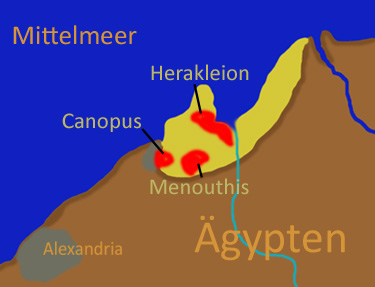
Photo: ChrisOsenbrück, Public domain, via Wikimedia Commons
Heracleion-Thonis lies submerged beneath approximately 10 meters of water in Abu Qir Bay, 6.5 kilometers northeast of Alexandria. The underwater ruins span an estimated area of several square kilometers, revealing massive temple foundations, colossal statues, and ancient harbor infrastructure. This remarkable archaeological site represents one of the most significant underwater discoveries of the 21st century, preserving an entire ancient Egyptian port city that served as the country's primary Mediterranean gateway for centuries before Alexandria's rise to prominence. Ancient Aliens has cited Heracleion-Thonis as evidence that mythologized accounts of lost cities warrant literal interpretation, pointing to the site's rediscovery by underwater archaeologist Franck Goddio in 2000 as vindication of ancient texts. However, mainstream archaeology attributes the city's submersion to well-documented geological processes—specifically liquefaction and subsidence of the Nile Delta—rather than unexplained disappearance, and dates the submergence to around the 8th century AD, centuries after the city's abandonment as a major port. The site's existence and rediscovery do demonstrate that some "lost" ancient locations were real, though the mechanisms of their disappearance align with established geological and hydrological models rather than extraordinary explanations.
Timeline
Heracleion-Thonis established as Egypt's main Mediterranean port
Alexandria founded by Alexander the Great, gradually eclipsing Heracleion
City believed to have finally sunk completely due to liquefaction and subsidence
Rediscovered by Franck Goddio and the European Institute for Underwater Archaeology
What the Show Claims
- ›The 2000 discovery of submerged Heracleion ruins proves that ancient textual accounts of lost civilizations should be taken as factual evidence rather than legendS12E06
Theorist Takes
“For a long time. Heracleion in Egypt was in many stories, but had not been found until the year 2000.”
From the Transcripts
“A group of divers working off the Egyptian coast near Alexandria discovered the submerged ruins of statues and even entire temple complexes. One instance of the discovery of something that we thought was legendary was the discovery of Heracleion, Thonis, near Alexandria.”
What Archaeology Says
The rediscovery of Heracleion-Thonis in 2000 by French underwater archaeologist Franck Goddio represents one of modern archaeology's most spectacular achievements. Using advanced sonar mapping and magnetometer surveys, Goddio's team has systematically excavated the site since 2000, revealing a remarkably preserved ancient city complete with temples, harbors, and residential districts. The discoveries include colossal granite statues of pharaohs and gods, massive temple blocks weighing several tons, and hundreds of smaller artifacts that illuminate daily life in this cosmopolitan port.
The archaeological evidence confirms ancient Greek and Egyptian sources that described Heracleion (known to Egyptians as Thonis) as a major religious and commercial center. Excavations have uncovered the remains of the grand temple of Amun-Gereb, where pharaohs came to receive legitimacy from the gods, as well as evidence of the city's role in collecting taxes from Greek merchants. Gold coins, jewelry, ritual objects, and ship remains paint a picture of a wealthy, multicultural city that served as Egypt's gateway to the Mediterranean world for nearly four centuries.
Mainstream archaeology attributes the city's submersion to natural geological processes including liquefaction of the clay soil beneath the city, gradual subsidence, and rising sea levels. The Nile Delta region is geologically unstable, and seismic activity likely accelerated the city's descent into Abu Qir Bay. This explanation is supported by geological surveys showing the area's susceptibility to ground liquefaction and evidence of similar subsidence affecting other ancient coastal settlements in the region.
While the cause of Heracleion's submersion is well understood, many aspects of daily life and religious practices in this cosmopolitan port remain to be discovered. Less than 5% of the site has been excavated, meaning that decades of underwater archaeology lie ahead. The preservation conditions are exceptional, offering unique insights into ancient Egyptian maritime culture and international trade relationships that terrestrial sites cannot provide.
Mysteries & Fun Facts
The name 'Heracleion' comes from Hercules, whom the Greeks believed had visited the city
Colossal granite statues discovered at the site include a 5.4-meter tall figure believed to represent a Ptolemaic queen
The city's harbor contained over 60 ancient shipwrecks spanning different historical periods
Lead and bronze weights found at the site reveal the sophisticated trade measurement systems used by ancient merchants
Planning a Visit
Heracleion-Thonis is accessible only through specialized underwater diving expeditions, as the ruins lie 10 meters beneath Abu Qir Bay. Several diving operators in Alexandria offer guided tours for certified divers, though access depends on weather conditions and Egyptian archaeological permits. Most visitors experience the site through the artifacts displayed at the Grand Egyptian Museum and Alexandria National Museum.
Alexandria, approximately 32 kilometers southwest
The optimal diving season runs from April through October when Mediterranean waters are calmer and visibility is generally better. Summer months offer the warmest water temperatures but may have more crowded diving conditions.
Related Sites
Antikythera (mechanism discovery site)
Another underwater archaeological discovery that revealed sophisticated ancient technology
Abu Simbel
Major ancient Egyptian religious and political center with colossal statuary
Luxor Temple
Ancient Egyptian temple complex demonstrating the architectural grandeur of pharaonic civilization