Lake Guatavita
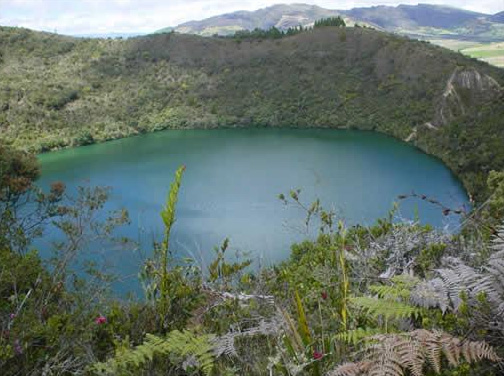
Photo: Masanalv, CC BY 3.0, via Wikimedia Commons
Lake Guatavita is a circular sacred lake nestled in the Colombian Andes, 57 kilometers northeast of Bogotá at an elevation of approximately 3,100 meters. The lake covers 19.8 hectares (49 acres) and was formed by the dissolution of underground salt deposits, creating a natural sinkhole rather than a volcanic crater as once theorized. This pristine highland lake served as the ceremonial heart of the Muisca civilization and inspired the legendary El Dorado. Today, visitors can observe the lake from viewing platforms that offer panoramic views of this remarkably preserved sacred site. The surrounding landscape features the characteristic páramo ecosystem of the high Andes, with nearby hot springs in Sesquilé adding to the area's mystical atmosphere. Ancient Aliens theorists have questioned whether the deity to whom the Muisca made their elaborate gold offerings might have been an extraterrestrial visitor rather than a spiritual entity, pointing to the lake's role as a source of ritual treasure. Archaeological evidence and historical records, however, indicate that Lake Guatavita was the sacred ceremonial site of the Muisca chiefdom, where their ruler—the Zipa—performed ritualistic gold offerings to appease their gods and ensure prosperity, a practice that fueled the legendary tales of El Dorado. The 1912 excavation of the lake bed, which yielded thousands of golden artifacts, provides tangible evidence of these high-status ritual practices central to Muisca spiritual and political life.
Timeline
Muisca civilization establishes Lake Guatavita as their most sacred ceremonial site for gold offerings
Spanish conquistador Gonzalo Jiménez de Quesada becomes the first European to reach Lake Guatavita
Spanish attempts to drain the lake begin, recovering some gold artifacts but damaging the site
British engineer Hartley Knowles conducts major excavation, recovering approximately $20,000 worth of golden artifacts
Colombian government declares Lake Guatavita a protected archaeological site
What the Show Claims
- ›Theorists suggest the 'god' dwelling at the bottom of Lake Guatavita was an extraterrestrial entity that received the Muisca gold offeringsS03E04
- ›The precision and sophistication of Muisca goldworking techniques may indicate advanced knowledge beyond their supposed technological capabilitiesS03E04
Theorist Takes
“A number of researchers have suggested that ancient aliens have come to Earth primarily to mine gold.”
From the Transcripts
“Lake Guanavita, Colombia. Believed to be the site of an ancient meteor crater, this circular-shaped mountain lake is at the center of one of mankind's greatest searches... the search for El Dorado, the Lost City of Gold.”
What Archaeology Says
Archaeological investigations at Lake Guatavita have revealed one of the most sophisticated pre-Columbian ceremonial traditions in South America. The Muisca people conducted elaborate rituals where their ruler, known as the Zipa, would cover himself in gold dust and make offerings of precious metals to their water deity. These ceremonies gave birth to the El Dorado legend that would drive Spanish conquistadors across the continent.
The most significant modern excavation occurred in 1912 when British engineer Hartley Knowles attempted to drain the lake using advanced pumping equipment. His efforts recovered numerous gold artifacts, including figurines, ornaments, and ceremonial objects that demonstrated the extraordinary skill of Muisca metalworkers. The recovered pieces, worth approximately $20,000 at the time, provided crucial insights into Muisca religious practices and their sophisticated understanding of gold alloys and craftsmanship techniques.
Scientific analysis of the artifacts and the lake itself has established that the Muisca possessed advanced metallurgical knowledge, creating tumbaga alloys and employing techniques like lost-wax casting with remarkable precision. The lake's formation through salt deposit dissolution rather than volcanic activity has been confirmed through geological studies, explaining the unique mineral composition that may have contributed to the site's sacred significance.
What remains intriguing to researchers is the exact nature of the Muisca cosmology that made this particular lake so sacred among dozens of similar high-altitude lakes in the region. The astronomical alignments of certain ceremonial elements and the sophisticated mathematical relationships in the golden artifacts suggest a level of scientific understanding that continues to be studied by archaeologists and anthropologists working to decode the full complexity of Muisca civilization.
Mysteries & Fun Facts
The name 'Sesquilé' means 'hot water' in the extinct Chibcha language, referring to the nearby thermal springs that still flow today
Lake Guatavita inspired the El Dorado legend, which originally referred to a person ('the golden one') rather than a place
The lake maintains a nearly perfect circular shape with a diameter of approximately 500 meters
Spanish colonizers attempted multiple lake drainage projects over centuries, but the 1912 excavation remains the most successful archaeological effort
Planning a Visit
Lake Guatavita is accessible to tourists through organized tours that depart from the nearby town of Sesquilé, with guided visits typically lasting 2-3 hours. Visitors can explore the lake from designated viewing platforms and learn about Muisca history at the on-site interpretation center.
Bogotá, approximately 57 kilometers southwest
The dry season from December to March offers the clearest views and most comfortable hiking conditions. Morning visits are recommended for optimal lighting and fewer crowds.
Related Sites
Sacsayhuaman
Another sophisticated pre-Columbian site featuring advanced stonework and ceremonial significance in South America
Chavín de Huántar
Ancient Peruvian ceremonial center known for its advanced metallurgy and religious practices similar to Muisca traditions
Tulum
Coastal Mayan site that demonstrates the widespread sophistication of pre-Columbian civilizations across the Americas
Featured In1 episodes
Historical data sourced from Wikipedia