USS Wasp Incident Site, 75 miles off Puerto Rico
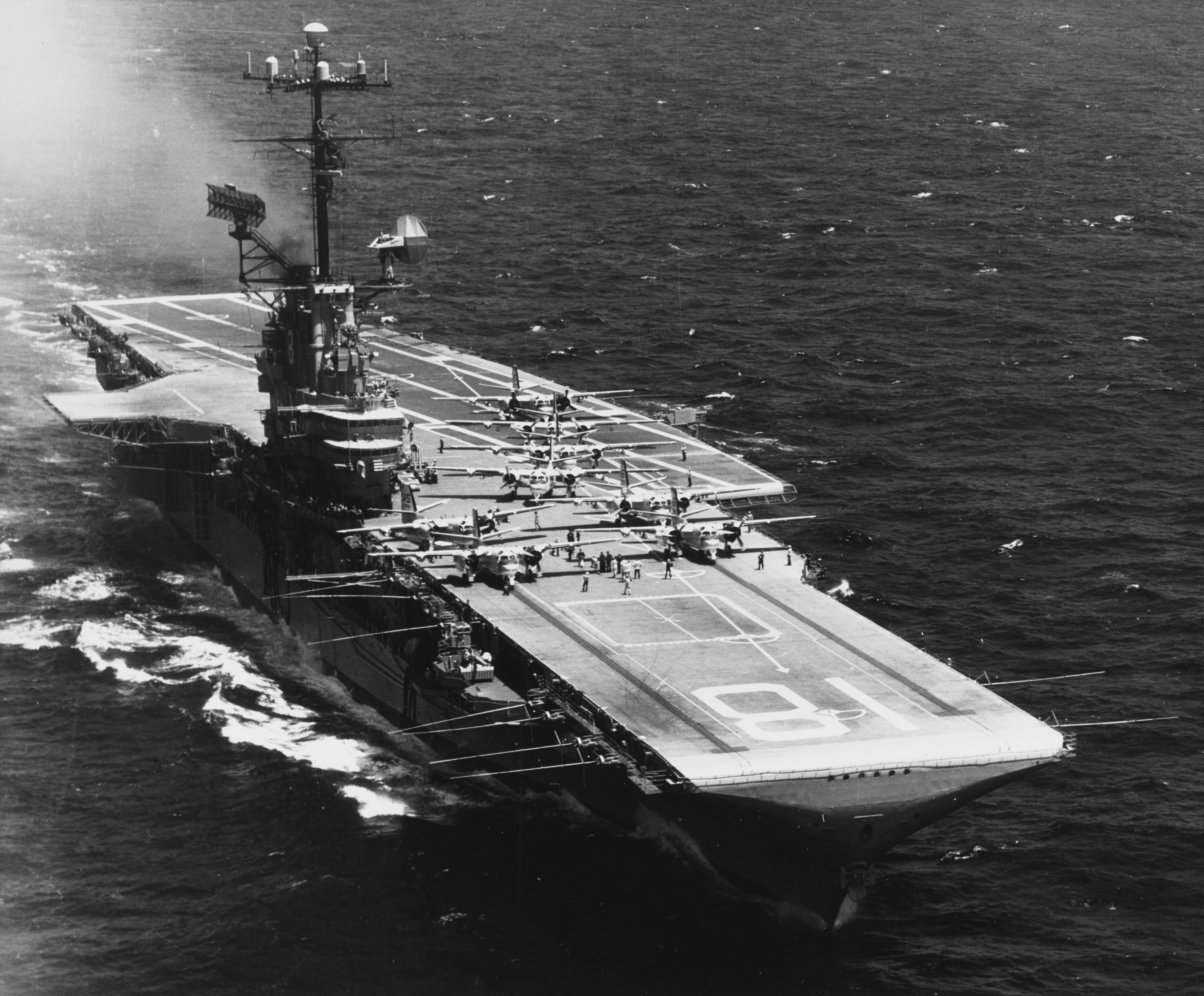
Photo: U.S. Navy, Public domain, via Wikimedia Commons
The USS Wasp Incident Site marks the approximate location where, in March 1963, a U.S. Navy carrier battle group reportedly encountered an unidentified submersible object roughly 75 miles off Puerto Rico's coast. The coordinates represent open ocean waters in the Puerto Rico Trench region, one of the deepest parts of the Atlantic Ocean with depths exceeding 28,000 feet. Today, this area remains international waters frequently traversed by both military and commercial vessels. The incident occurred during the height of the Cold War when Navy anti-submarine warfare exercises were routine throughout the Caribbean. The specific location has become a focal point for researchers investigating unexplained underwater phenomena, though no permanent markers or structures exist at the site itself. Ancient astronaut theorists suggest the sonar contact tracked during the USS Wasp's anti-submarine exercises—reportedly moving at speeds exceeding 150 knots and descending beyond known submarine capabilities—may have represented extraterrestrial technology operating in Earth's oceans. However, naval historians and oceanographers note that Cold War-era sonar technology was prone to false contacts from natural phenomena, equipment artifacts, and unidentified marine life, and no declassified Navy records have confirmed the specific performance characteristics theorists cite. The incident remains unexplained in official accounts, though mainstream researchers attribute similar contacts from that era to sensor limitations rather than non-human origins.
Timeline
USS Wasp carrier group conducts anti-submarine exercises and reportedly tracks anomalous underwater contact for four consecutive days
Initial Navy reports describe contact moving at speeds exceeding 150 knots and diving to depths of approximately 27,000 feet
Ancient Aliens television series brings renewed attention to the incident as potential evidence of underwater UFO activity
What the Show Claims
- ›A 1963 US Navy sonar contact tracked an unidentified submersible object moving at over 150 knots and descending to 27,000 feet, far beyond any known human technologyS06E09
- ›The object's capabilities exceeded those of any known submarine technology from that era or even todayS06E09
- ›The four-day tracking period suggests the object was under intelligent control rather than a natural phenomenonS06E09
Theorist Takes
“There is nothing in any naval inventory anywhere in the world that can approach anything remotely that speed. Not then, not now.”
From the Transcripts
“March 1963. 75 miles off the coast of Puerto Rico. While training in anti-submarine maneuvers, the United States Navy's fleet... led by the USS Wasp aircraft carrier... detects an unknown sonar target moving in the nearby waters.”
What Archaeology Says
Unlike traditional archaeological sites, the USS Wasp Incident location presents researchers with the challenge of investigating events in one of Earth's most inaccessible environments. The Puerto Rico Trench, where the encounter allegedly occurred, reaches depths that challenge even modern deep-sea exploration technology. No physical evidence from the 1963 incident has ever been recovered or verified through independent investigation.
Naval historians and military researchers have attempted to piece together the official records from the exercise, though much documentation from the era remains classified or has been lost to standard military archival procedures. The technical specifications claimed for the unidentified object—speeds exceeding 150 knots underwater and dive capabilities to 27,000 feet—would represent propulsion and pressure-resistance technologies that remain beyond current human engineering capabilities six decades later.
Skeptical researchers point out that sonar technology in 1963 was significantly less sophisticated than modern systems, potentially leading to misinterpretation of natural phenomena, equipment malfunctions, or even deliberate misinformation during Cold War military exercises. The lack of corroborating evidence from other vessels in the carrier group, or from subsequent military exercises in the region, raises questions about the incident's veracity.
What remains genuinely puzzling to investigators is the apparent absence of any conventional explanation for the specific sonar readings described in the reports. While natural phenomena like whale songs, underwater landslides, or thermal layers can create unusual sonar signatures, none adequately account for the sustained tracking of a discrete, high-speed, deep-diving object over multiple days.
Mysteries & Fun Facts
The Puerto Rico Trench near the incident site contains the deepest point in the Atlantic Ocean at over 28,000 feet below sea level
In 1963, the fastest known submarines could achieve speeds of approximately 25 knots underwater, making the reported 150+ knot speed truly extraordinary
The USS Wasp CV-18 was an Essex-class aircraft carrier that served with distinction in World War II before the 1963 incident
Modern nuclear submarines still cannot safely dive beyond approximately 3,000 feet, making the reported 27,000-foot depth remarkable
Planning a Visit
The incident site itself is located in open ocean approximately 75 miles off Puerto Rico's coast, making it inaccessible to typical tourists. Visitors interested in the story can explore related exhibits at maritime museums in San Juan or visit naval historical sites throughout Puerto Rico.
San Juan, Puerto Rico, approximately 75 miles to the southeast
Since the site is in open ocean, there are no specific visiting conditions, though the Caribbean region generally offers the best weather for maritime activities between December and April.
Related Sites
Tunguska explosion site
Another location where unexplained phenomena occurred involving technology seemingly beyond human capabilities
37th Parallel (Global UFO Superhighway)
A geographic region associated with frequent UFO sightings and unexplained military encounters
Alaska Triangle
An area known for mysterious disappearances and anomalous readings involving military aircraft and vessels