Nubian Desert (asteroid impact site, Sudan)
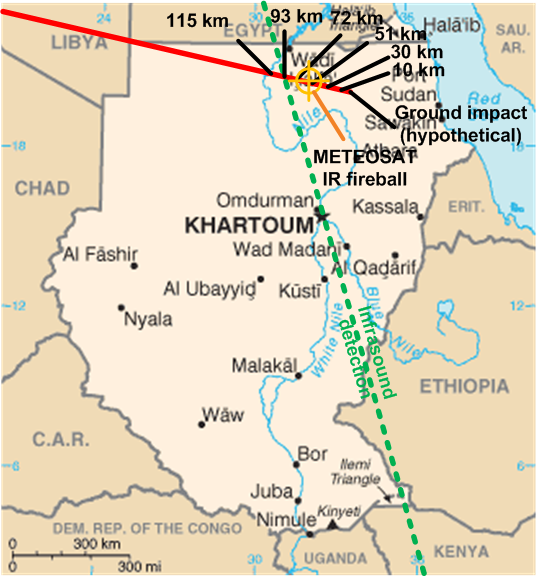
Photo: George William Herbert (graphic overlay) / US Government (original map), Public domain, via Wikimedia Commons
The Nubian Desert asteroid impact site in Sudan marks where approximately 600 meteorite fragments from asteroid 2008 TC3 scattered across the desert floor on October 7, 2008. The impact zone spans roughly 30 kilometers along the desert, with fragments designated as Almahata Sitta meteorites containing rare diamond inclusions and ureilite material. This remote stretch of Nubian Desert, located between the Nile and the Red Sea, represents one of the few cases where scientists tracked an asteroid from space to ground impact. The meteorites provide extraordinary evidence of a destroyed proto-planet that once existed in our early solar system, making this barren landscape a treasure trove for planetary science.
Timeline
Formation and destruction of proto-planet that would become source of 2008 TC3 asteroid
Asteroid 2008 TC3 discovered in space on October 6, impacts Earth atmosphere on October 7
Recovery expeditions collect approximately 600 meteorite fragments across Nubian Desert
What the Show Claims
- ›The diamond-bearing meteorite fragments provide physical evidence supporting Zecharia Sitchin's theory of a destroyed 12th planet that once existed beyond MarsS13E15
- ›The destruction of this proto-planet may have displaced its inhabitants, forcing them to relocate first to Mars and eventually to EarthS13E15
- ›The meteorites represent tangible proof of a lost world that ancient astronaut theorists believe was referenced in Sumerian textsS13E15
Theorist Takes
“Between Mars and Jupiter today, we have the asteroid belt, and the asteroid belt, in my opinion, was once a planet which exploded. Which exploded because there was a war. There was a war in space, a war in heaven.”
From the Transcripts
“October 7, 2008. An 80-ton asteroid enters the Earth's atmosphere and explodes 23 miles above the Nubian Desert in Sudan. That day, an estimated 600 meteorites literally showered the landscape. But when examined, the meteorites were found to contain something incredible: diamonds.”
What Archaeology Says
The 2008 TC3 impact represents a landmark event in planetary science, as it marked the first time astronomers successfully tracked an asteroid from space through atmospheric entry to ground impact. Within hours of the predicted impact, international research teams began organizing recovery expeditions to locate the scattered fragments across the vast Nubian Desert.
Over multiple expeditions between 2008 and 2009, researchers collected hundreds of meteorite samples, officially catalogued as Almahata Sitta meteorites. Laboratory analysis revealed the fragments contained nanodiamonds and were composed primarily of ureilite, a rare type of meteorite material that forms under specific high-pressure conditions. These characteristics strongly suggest the meteorites originated from a differentiated proto-planet—a small planetary body that had developed distinct layers like Earth's core and mantle.
The scientific consensus confirms that the meteorites provide evidence of a destroyed proto-planet that existed during the early formation of our solar system, approximately 4.5 billion years ago. Planetary scientists believe this proto-planet was shattered during the chaotic bombardment period when larger bodies collided and merged to form the planets we know today. The diamond inclusions formed under extreme pressure conditions that could only exist within a substantial planetary body.
What remains genuinely intriguing is how fragments from this ancient destroyed world survived billions of years in space before reaching Earth. The meteorites represent some of the oldest material in our solar system, offering a rare window into the violent processes that shaped planetary formation, though mainstream science finds no connection between these geological processes and ancient human origins.
Mysteries & Fun Facts
Asteroid 2008 TC3 was only the second asteroid in history to be discovered before impact, detected just 19 hours before entering Earth's atmosphere
The meteorites contain nanodiamonds smaller than human hair, formed under pressures that required a planetary body at least as large as Ceres
Some fragments were found to contain graphite inclusions alongside the diamonds, indicating the proto-planet had a complex internal structure
The total mass of recovered meteorite fragments represents only a tiny fraction of the original 80-ton asteroid that entered Earth's atmosphere
Planning a Visit
The Nubian Desert impact site is extremely remote and challenging to access, requiring specialized desert vehicles and experienced guides familiar with the harsh terrain. Most meteorite fragments have been collected by research teams, so visitors are unlikely to find specimens, and the impact zone spans a large area without obvious landmarks.
Khartoum, approximately 400 kilometers northeast
Winter months from November to February offer the most tolerable desert conditions with cooler temperatures. Summer temperatures can be extreme and potentially dangerous for unprepared visitors.
Related Sites
Tunguska explosion site
Another famous impact site where extraterrestrial objects dramatically affected Earth's surface
Allen Hills, Antarctica (ALH 84001 meteorite find site)
Location where controversial meteorite evidence of possible ancient Martian life was discovered
Wolfe Creek Crater (Kandimalal)
Massive crater formed by ancient meteorite impact, demonstrating the long history of cosmic bombardment