Mount Tambora
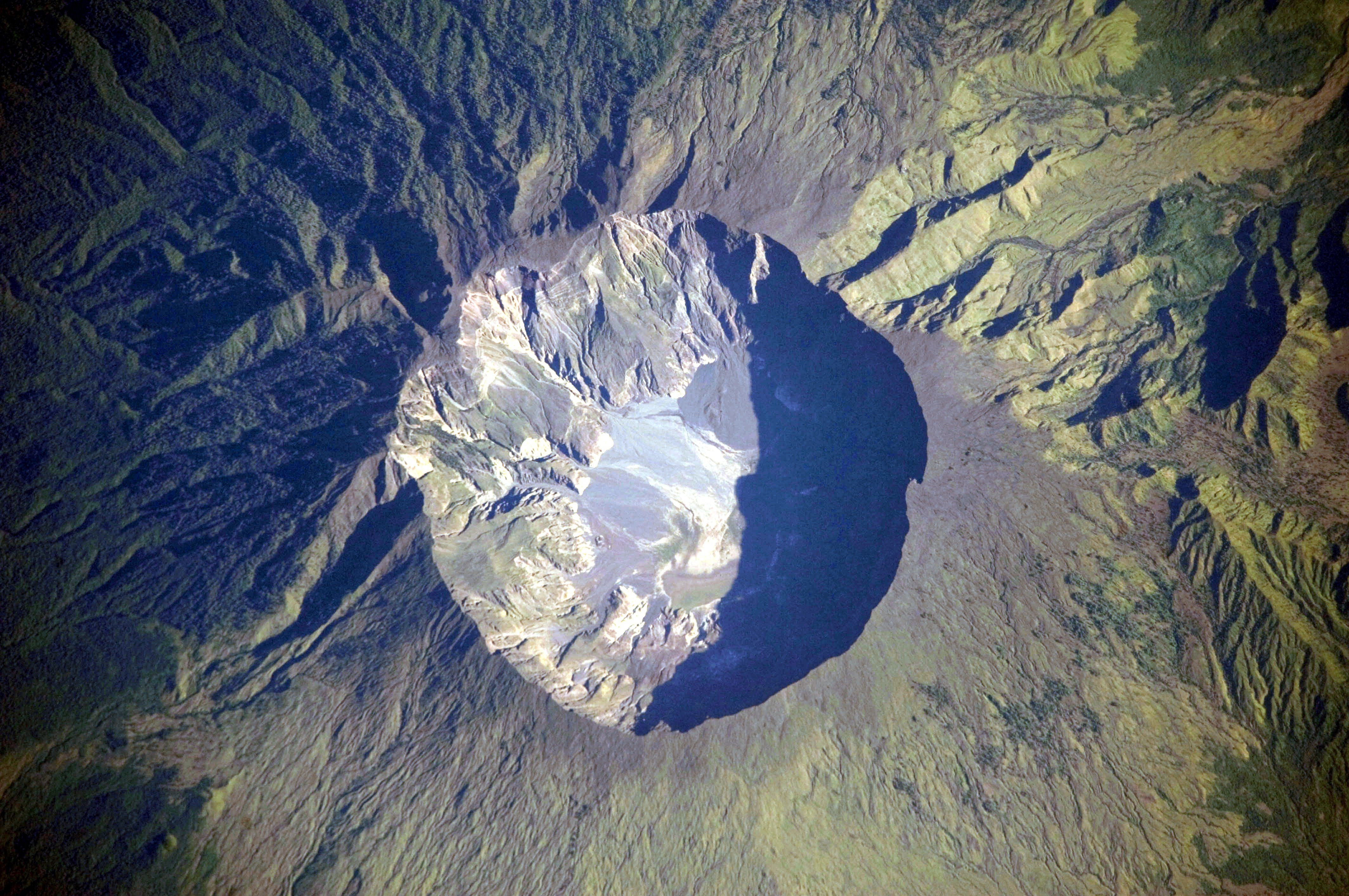
Photo: This image was taken by the NASA Expedition 20 crew., Public domain, via Wikimedia Commons
Mount Tambora is an active stratovolcano located on Sumbawa Island in Indonesia's West Nusa Tenggara province, rising from the Lesser Sunda Islands chain. The mountain is most famous for producing the largest volcanic eruption in recorded history in April 1815, which ejected up to 150 cubic kilometers of volcanic material and reached a VEI-7 rating on the Volcanic Explosivity Index. Today, visitors can see the massive caldera formed by this catastrophic eruption, which measures approximately 6-7 kilometers across and up to 1,100 meters deep. The volcano remains active and is closely monitored, with its location at the intersection of subduction zones making it a textbook example of explosive volcanism. The surrounding landscape still bears the scars of the 1815 event, though lush tropical vegetation has reclaimed much of the devastated area. Some theorists have proposed that local cultural interpretations of the 1815 eruption—attributing it to divine or otherworldly forces—might suggest an extraterrestrial connection to volcanic activity, though volcanologists attribute the eruption entirely to the interaction of tectonic plates at the subduction zone beneath Sumbawa. The catastrophic scale of the 1815 event and its global climate impacts were well within the known parameters of terrestrial volcanic behavior, with detailed geological evidence pointing to magma chamber dynamics and crustal stress rather than anomalous external intervention. The cultural and religious responses to the disaster reflect how societies throughout history have interpreted natural phenomena through their existing worldviews, rather than necessarily pointing to off-world origins.
Timeline
Minor volcanic activity begins, with small eruptions and earthquakes preceding the major event
Catastrophic eruption occurs in April, killing approximately 71,000 people and ejecting massive amounts of material into the atmosphere
Global climate effects manifest as the 'Year Without a Summer,' causing widespread crop failures and famine across the Northern Hemisphere
What the Show Claims
- ›Local religious traditions attributing the 1815 eruption to the gods may indicate extraterrestrial involvement, with theorists suggesting aliens might use volcanoes as bases or weaponsS04E04
From the Transcripts
“Here, in April 1815, the Mount Tambora volcano exploded in a cataclysm of fire, smoke and ash. The amount of material discharged into the atmosphere... estimated to have been 120 cubic tons, makes the event the largest volcanic eruption in recorded history.”
What Archaeology Says
Mount Tambora's archaeological significance lies not in ancient structures, but in its role as a natural time capsule of one of history's most devastating volcanic events. The 1815 eruption buried entire villages and kingdoms on Sumbawa Island under meters of ash and pyroclastic flow deposits, preserving a snapshot of early 19th-century Indonesian life. Archaeological investigations in the region have uncovered evidence of the former Kingdom of Tambora, which was completely obliterated by the eruption, including artifacts that provide insights into the sophisticated cultures that once thrived in the area.
Volcanologists and archaeologists have worked together to understand both the geological mechanics of the eruption and its human impact. Research has revealed that the explosion was heard up to 2,000 kilometers away, and the ash fall extended across Southeast Asia. The eruption column reached an estimated height of 43 kilometers into the atmosphere, injecting sulfur compounds that created the global cooling effect responsible for the 1816 climate anomalies.
Scientific consensus attributes the massive eruption to the buildup of highly pressurized magma in a shallow chamber beneath the volcano, a process typical of stratovolcanoes in subduction zones. The chemistry of the ejected material and the scale of the caldera formation are well understood through modern volcanological methods. However, predicting when such super-eruptions might occur again remains one of the greatest challenges in volcanic hazard assessment.
What remains genuinely mysterious is the precise triggering mechanism for such catastrophic events and whether there were any warning signs that pre-industrial societies might have recognized. Local oral traditions and folklore from the region continue to be studied for potential insights into past volcanic activity, though separating historical memory from mythological interpretation presents ongoing challenges for researchers.
Mysteries & Fun Facts
The 1815 eruption was so powerful that volcanic ash circled the globe multiple times, creating spectacular sunsets that inspired artists including J.M.W. Turner
The Year Without a Summer in 1816 was so cold that Mary Shelley spent her vacation indoors writing Frankenstein
An estimated 150 cubic kilometers of rock, ash, and pumice were ejected - enough material to bury the entire state of Rhode Island under 10 feet of debris
The sound of the explosion traveled over 2,000 kilometers and was mistaken for cannon fire by British officials in Java
Planning a Visit
Mount Tambora is accessible to visitors, though reaching the volcano requires a combination of flights to Sumbawa Island followed by ground transportation and guided trekking. The climb to the crater rim is challenging and typically takes 2-3 days, requiring good physical fitness and proper equipment. Visitors should arrange trips through licensed local guides and check current volcanic activity status before planning their visit.
Mataram, Lombok (approximately 150 kilometers southeast)
The dry season from May to September offers the best conditions for trekking, with clearer skies and less rain. However, weather can be unpredictable at altitude, so visitors should be prepared for various conditions regardless of season.
Related Sites
Tunguska explosion site
Another site where a massive natural disaster event has been linked to potential extraterrestrial explanations by theorists
Burckle Crater, Indian Ocean
An impact crater in the Indian Ocean that some theorists connect to ancient catastrophic events affecting human civilization
Wolfe Creek Crater (Kandimalal)
A meteor impact crater that demonstrates how natural cosmic events can create dramatic geological formations on Earth
Featured In1 episodes
Historical data sourced from Wikipedia