Bavaria
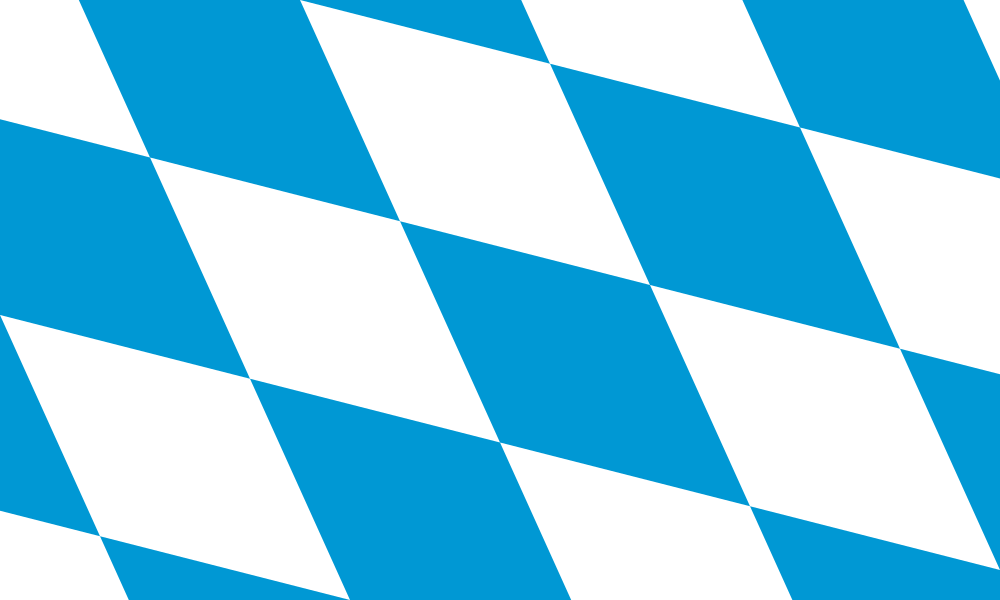
Photo: diese Datei: Jwnabd, Public domain, via Wikimedia Commons
Bavaria is Germany's largest federal state, covering 70,550 square kilometers in the country's southeast. This historically rich region borders Austria and the Czech Republic, with Munich as its capital and cultural heart. Bavaria became the unlikely focus of ancient alien theorists due to a crystal skull discovery in 2011 at a former Nazi property, connecting the state to claims about occult artifacts and supernatural weapons. The region's complex history spans from Celtic settlements through Roman occupation to its role as a kingdom within the Holy Roman Empire, making it a crossroads of European civilization and, according to some, extraterrestrial intrigue.
Timeline
Celtic tribes settle in the region during the Iron Age
Roman Empire incorporates the territory into provinces of Raetia and Noricum
Duchy of Bavaria established in Francia following Roman collapse
Bavaria becomes a kingdom under Napoleon's reorganization of German territories
Modern Free State of Bavaria established as part of West Germany
Crystal skull discovered at former Nazi SS officer's property, sparking ancient alien theories
What the Show Claims
- ›A 20-pound crystal skull discovered in 2011 at a former Nazi SS officer's home was likely owned by Heinrich Himmler to harness supernatural powers for the Third ReichS06E02
- ›Crystal skulls function as powerful weapons whose energy can be directed for destructive purposesS06E02
Theorist Takes
“I, for one, think that probably Heinrich Himmler, uh, had procured a crystal skull. The Nazis were really obsessed with procuring ancient knowledge, and part of that ancient knowledge was with the crystal skull.”
From the Transcripts
“Bavaria, Germany. March 2011. A 20-pound crystal skull is discovered at the former home of a high-ranking Nazi ss officer. Some researchers believe the skull was once owned by Heinrich Himmler.”
What Archaeology Says
Bavaria's archaeological record reveals continuous human habitation spanning over two millennia. Celtic settlements from the Iron Age have been excavated throughout the region, showing sophisticated metalworking and trade networks. Roman archaeological sites demonstrate the territory's integration into imperial provinces, with well-preserved remains of roads, fortifications, and settlements that connected Bavaria to the broader Mediterranean world.
The 2011 crystal skull discovery occurred not through formal archaeological excavation but during the clearing of a former Nazi property. While the skull's provenance remains disputed, historians confirm Heinrich Himmler's documented obsession with occult artifacts and his systematic looting of cultural treasures across occupied Europe. The SS-Ahnenerbe, Himmler's research organization, conducted pseudo-scientific expeditions seeking mystical objects to support Nazi ideology.
Modern archaeological consensus views crystal skulls as 19th and 20th-century creations rather than ancient artifacts. Scientific analysis using electron microscopy has revealed tool marks consistent with modern rotary equipment on most examined specimens. However, the Nazi connection adds a genuinely historical dimension to Bavaria's crystal skull story, as Himmler did collect what he believed were powerful occult objects.
What remains unknown is the specific provenance of the Bavarian skull and whether it was among Himmler's documented collection. The lack of clear archaeological context makes scientific dating difficult, leaving questions about its creation and intended purpose within the Nazi occult framework.
Mysteries & Fun Facts
Bavaria is the largest German state, covering 70,550 square kilometers with 13.08 million inhabitants
The region was ruled by Romans who incorporated it into the provinces of Raetia and Noricum in the first century AD
Bavaria became a kingdom in 1806 and retained this status until the end of World War I
The Bavarian language is spoken by around 12 million people, making it the largest German dialect group
Planning a Visit
Bavaria is easily accessible to visitors, with Munich serving as the primary gateway through its international airport and excellent rail connections. While the specific location of the crystal skull discovery is not a public tourist site, visitors can explore Bavaria's rich archaeological heritage through numerous museums and historical sites throughout the region.
Munich, the capital and largest city of Bavaria
Late spring through early fall offers the most pleasant weather for exploring Bavaria's outdoor archaeological sites and museums. Summer brings festival season, including Oktoberfest, but also larger crowds.
Related Sites
Externsteine
Another German site associated with Nazi occult interests and ancient mysteries
Germany / Western Europe (Foo Fighters theater)
Connected through Nazi Germany's documented interest in unexplained aerial phenomena during WWII
Wieliczka Salt Mine
European site where Nazis conducted archaeological expeditions seeking mystical artifacts
Featured In1 episodes
Historical data sourced from Wikipedia