Sumatra, Indonesia (2004 tsunami epicenter)
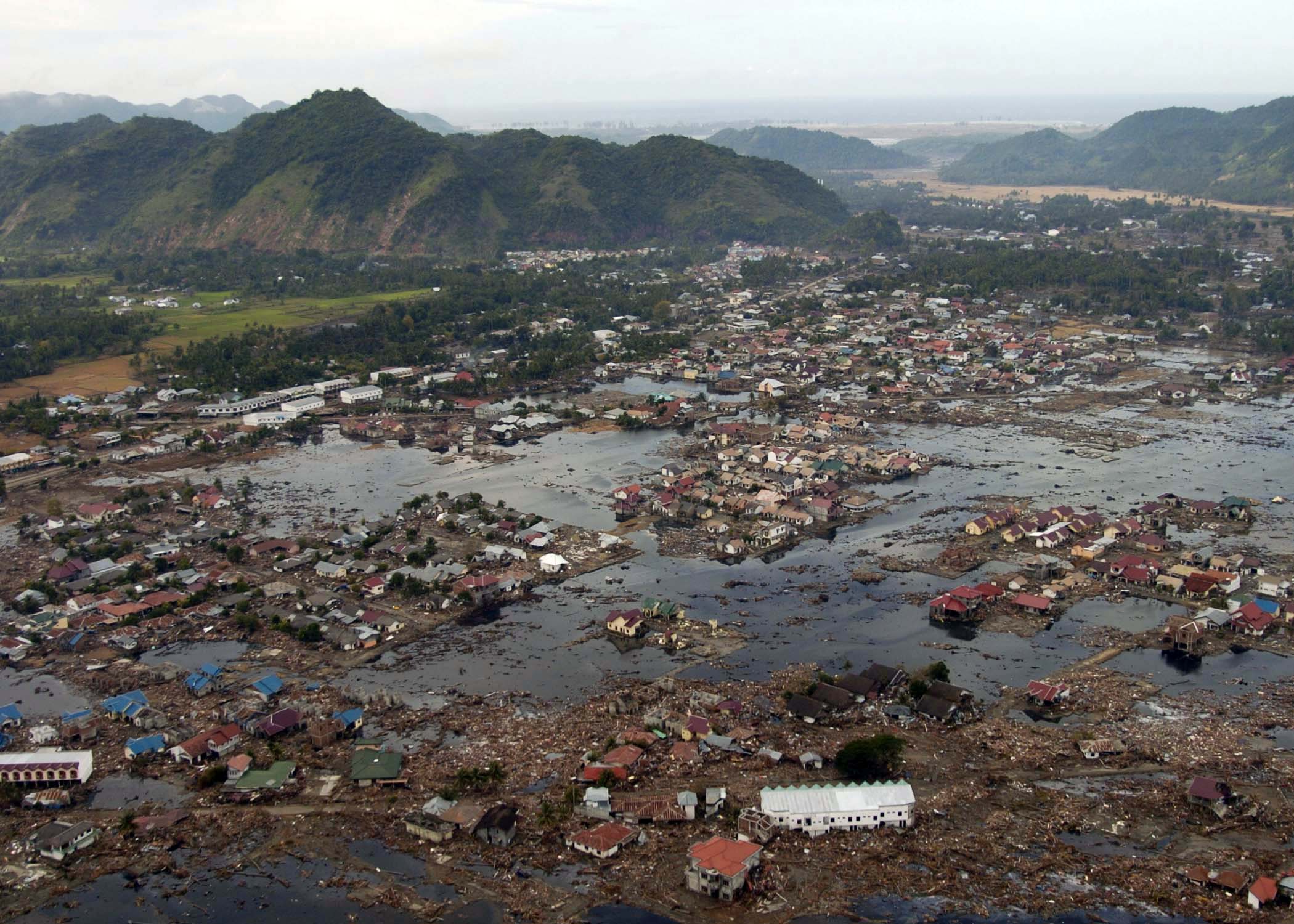
Photo: U.S. Navy photo by Photographer's Mate 2nd Class Philip A. McDaniel, Public domain, via Wikimedia Commons
The 2004 Indian Ocean tsunami epicenter lies off the northern coast of Sumatra, Indonesia, where the Indo-Australian and Burma tectonic plates meet in one of Earth's most seismically active zones. On December 26, 2004, this underwater region generated a devastating 9.1-magnitude earthquake that ruptured along approximately 1,600 kilometers of fault line, making it the third-largest earthquake ever recorded on a seismograph. The resulting tsunami waves reached heights of up to 30 meters in some coastal areas and traveled across the entire Indian Ocean basin at speeds approaching 800 kilometers per hour. Today, the epicenter itself remains underwater and inaccessible to visitors, but memorial sites and rebuilt communities along Sumatra's western coastline serve as sobering reminders of the disaster's impact. Some theorists have pointed to the 2004 tsunami as evidence supporting psychic Baba Vanga's purported precognitive abilities and access to hidden knowledge of future events. However, seismologists attribute the disaster to well-understood tectonic processes: the rupture of the Sunda megathrust fault, where the Indo-Australian Plate subducts beneath the Eurasian Plate—a geological mechanism that has generated major earthquakes in this region throughout recorded history.
Timeline
Formation of the Indo-Australian and Burma tectonic plate boundary that would later generate the 2004 earthquake
December 26: 9.1-magnitude undersea earthquake triggers devastating tsunami across the Indian Ocean
International tsunami warning systems established following the disaster
What the Show Claims
- ›The 2004 Indian Ocean tsunami was a fulfilled prophecy of Bulgarian mystic Baba Vanga, supporting claims that she accessed the Akashic record's repository of future eventsS12E10
From the Transcripts
“Sumatra, Indonesia. December 26, 2004. A 9.1 magnitude earthquake off the coast of the island creates a devastating tsunami, completely engulfing over 3,000 miles of land and claiming the lives of over 230,000 people.”
What Archaeology Says
While the 2004 tsunami epicenter is not an archaeological site in the traditional sense, underwater surveys and geological studies have revealed important insights about the disaster's mechanics and the seafloor's structure. Marine geologists using sonar mapping and deep-sea submersibles have documented the massive seafloor displacement that occurred during the earthquake, with some areas of the ocean bottom rising several meters while others dropped significantly.
Researchers from institutions worldwide, including the United States Geological Survey and various Japanese oceanographic institutes, have conducted extensive studies of the fault rupture zone. Their findings show that the earthquake released energy equivalent to approximately 23,000 atomic bombs, making it one of the most powerful seismic events in modern history. Core samples from the seafloor have provided evidence of similar massive earthquakes occurring in this region roughly every 200-500 years.
The scientific consensus attributes the disaster entirely to natural tectonic processes, with no evidence supporting supernatural or extraterrestrial intervention. The earthquake occurred when immense pressure built up over centuries between the colliding plates finally released catastrophically. However, some aspects of the event remain subjects of ongoing research, particularly regarding the precise mechanisms that determined which coastal areas experienced the most severe impact.
What remains genuinely unknown includes the exact timing of future major earthquakes in this region, despite improved monitoring systems. Scientists continue studying tsunami deposits in coastal sediments to better understand the historical pattern of such events, though predicting the precise timing of the next major tsunami remains beyond current scientific capability.
Mysteries & Fun Facts
The earthquake was so powerful it caused the entire planet to vibrate and shortened the length of a day by 2.68 microseconds
Tsunami waves from the event were detected as far away as Antarctica, traveling completely around the globe
The earthquake moved the North Pole by approximately 2.5 centimeters due to the massive redistribution of Earth's mass
Some coastal areas of Sumatra were permanently raised by up to 20 meters, while others sank below sea level
Planning a Visit
The underwater epicenter itself cannot be visited, but memorial sites and museums along Sumatra's affected coastlines are generally accessible to visitors. The Tsunami Museum in Banda Aceh provides comprehensive exhibits about the disaster and its aftermath. Travelers should check current local conditions and tourism guidance, as infrastructure in some affected areas continues recovering.
Banda Aceh, approximately 160 kilometers southeast of the epicenter
The dry season from May to September offers the most favorable weather conditions for visiting memorial sites along Sumatra's coast. During this period, seas are generally calmer and rainfall is minimal, making coastal travel more comfortable.
Related Sites
Tunguska explosion site
Both locations are associated with catastrophic natural events that some theorists connect to prophecetic or supernatural knowledge
Dogon Country
The Dogon people are claimed by some to possess advanced knowledge of cosmic events, similar to claims about Baba Vanga's prophetic abilities
Mount Denali
Represents another location where natural geological forces create phenomena that some interpret through non-scientific frameworks