Bay of Bengal
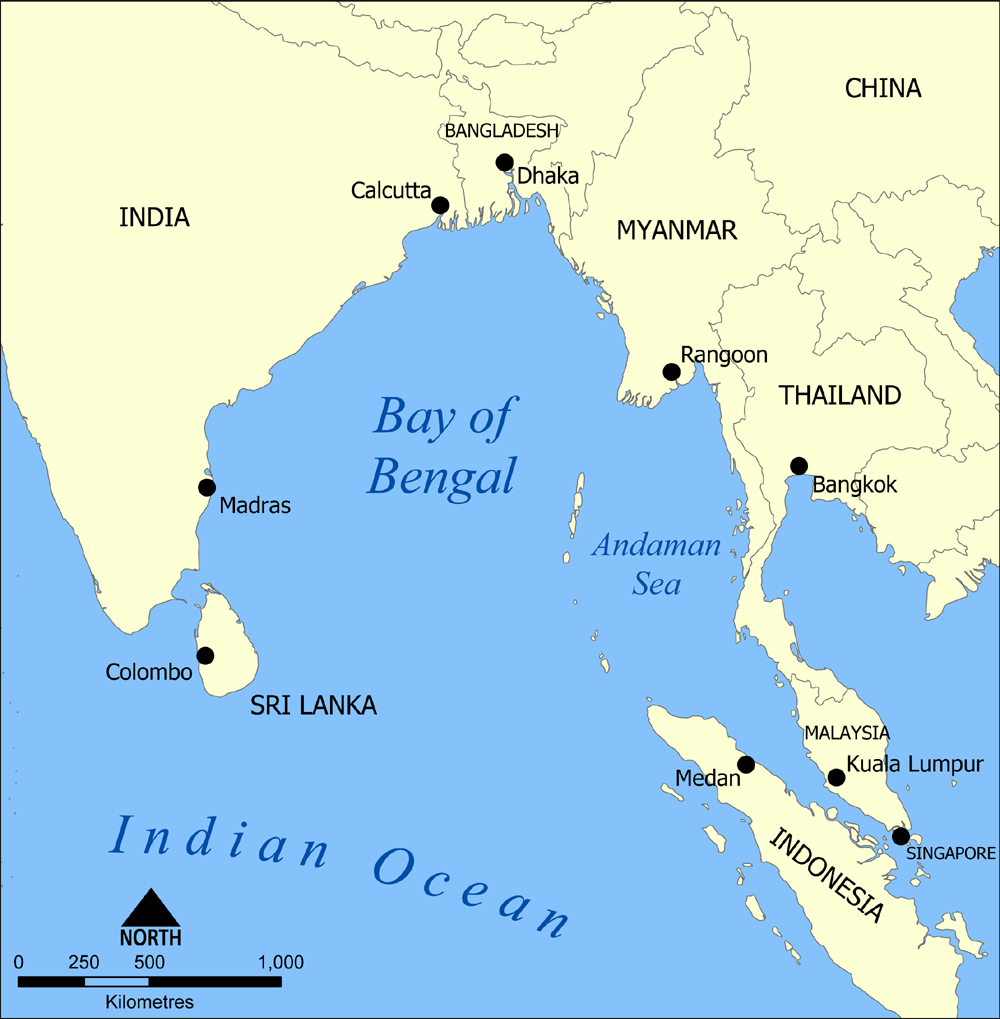
Photo: No machine-readable author provided. NormanEinstein assumed (based on copyright claims)., CC BY-SA 3.0, via Wikimedia Commons
The Bay of Bengal forms the northeastern part of the Indian Ocean, spanning an enormous area of 2,600,000 square kilometers (1,000,000 square miles) between the Indian subcontinent and Southeast Asia. This vast body of water is bordered by India to the west, Bangladesh to the north, Myanmar to the northeast, and the Andaman and Nicobar Islands to the east. Major river systems including the Ganges, Brahmaputra, and Irrawaddy flow into the bay, creating complex coastal ecosystems like the Sundarbans mangrove forest. The bay's waters have been crucial shipping lanes for millennia, connecting ancient civilizations and modern nations across South and Southeast Asia. Ancient Aliens theorists have pointed to reports of mysterious luminescent phenomena witnessed by fishermen in the Bay of Bengal as potential evidence of interdimensional or extraterrestrial activity, suggesting these anomalies fit a broader pattern of unexplained aerial lights globally. However, such luminescent occurrences in the bay have been documented for centuries across maritime records and local folklore, where they are traditionally attributed to spiritual phenomena or natural bioluminescence. Scientists note that the bay's unique environmental conditions—including specific algae species, atmospheric conditions, and reflected light from fishing vessels—can produce striking visual effects that may account for many documented sightings.
Timeline
Early maritime civilizations begin navigating Bay of Bengal waters for trade
European colonial powers establish major shipping routes through the bay
Modern systematic documentation of unexplained luminescent phenomena begins by maritime authorities
What the Show Claims
- ›Mysterious lights seen by fishermen in the Bay of Bengal are part of a global pattern of anomalous light phenomena potentially linked to interdimensional or extraterrestrial activityS14E11
- ›Local fishermen interpret the unexplained lights as spirits of deceased fishermenS14E11
From the Transcripts
“We have these lights, too, that appear in the Bay of Bengal, and fishermen believe that they are the lights of dead fishermen.”
What Archaeology Says
While the Bay of Bengal itself is not an archaeological site in the traditional sense, the waters and coastal regions contain significant maritime archaeological evidence of ancient civilizations. Underwater surveys have revealed ancient ports, shipwrecks, and submerged settlements along the coastlines, particularly near river deltas where major trading centers once flourished. The bay served as a crucial maritime highway for ancient trade networks connecting India with Southeast Asia, facilitating the spread of Buddhism, Hinduism, and cultural exchange.
The unexplained luminescent phenomena reported in these waters present a different kind of mystery entirely. Maritime authorities and oceanographers have documented these light displays for decades, with reports consistently describing bright, moving lights that appear above or just below the water's surface. The lights typically appear as white or bluish orbs that move in patterns that don't correspond to known natural phenomena like bioluminescence or St. Elmo's fire.
Scientific investigation of these phenomena remains limited due to the vastness of the bay and the sporadic nature of the sightings. Some researchers have proposed explanations involving unusual electromagnetic conditions created by the interaction of multiple major river systems with ocean currents, while others suggest undocumented forms of marine bioluminescence. However, the consistent reports from experienced mariners across different seasons and locations suggest these lights represent a genuine unexplained phenomenon.
What remains genuinely puzzling is the organized, seemingly intelligent movement patterns described in many eyewitness accounts. Unlike random natural light phenomena, these displays often involve multiple lights moving in formation or responding to the presence of vessels. The cultural significance of these lights to local fishing communities, who have incorporated them into their folklore for generations, adds another layer to this enduring maritime mystery.
Mysteries & Fun Facts
The Bay of Bengal receives freshwater from some of the world's largest river systems, making it less saline than most ocean areas
The bay contains the world's largest mangrove forest, the Sundarbans, shared between India and Bangladesh
Some of the world's longest natural beaches, including Cox's Bazar in Bangladesh, line the bay's coastline
The bay's unique geography creates ideal conditions for tropical cyclones, which form regularly during monsoon seasons
Planning a Visit
The Bay of Bengal can be experienced from numerous coastal locations across India, Bangladesh, Myanmar, and Sri Lanka, with major ports like Chennai, Kolkata, and Chittagong offering harbor views. Boat tours and fishing expeditions are available from most coastal cities, though witnessing the unexplained light phenomena requires considerable luck and patience.
Multiple major cities border the bay, including Kolkata, Chennai, Dhaka, and Yangon.
The optimal time for bay visits is during the dry season from November to March when seas are calmer and visibility is better. Most mysterious light sightings are reported during clear nights with minimal moon illumination.
Related Sites
Dogon Country
The Dogon people of Mali have ancient traditions describing mysterious lights and aerial phenomena, similar to the Bay of Bengal's unexplained luminous displays
Tunguska explosion site
The Tunguska event represents another unexplained phenomenon involving mysterious lights and energy displays witnessed over a large geographical area
GIMBAL UAP Incident Site (Atlantic Coast of Florida)
The GIMBAL incident site involves modern unexplained aerial phenomena over water, paralleling the mysterious lights reported in the Bay of Bengal
Featured In1 episodes
Historical data sourced from Wikipedia