Mars (subglacial lake, south polar region)
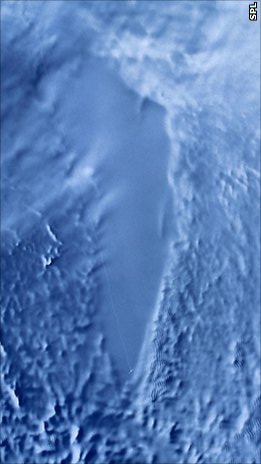
Photo: Goddard Space Flight Center, Public domain, via Wikimedia Commons
This subglacial lake beneath Mars' southern polar ice cap represents one of the most significant discoveries in astrobiology, located approximately 1.5 kilometers beneath the layered polar deposits at coordinates 81°S, 193°E. The radar-detected water body spans roughly 20 kilometers in width, making it comparable in size to subglacial lakes found beneath Antarctica's ice sheets. The lake exists in a region where surface temperatures plunge to -68°C, yet liquid water persists due to pressure from the overlying ice and likely dissolved salts that lower the freezing point. This discovery by the European Space Agency's Mars Express orbiter has fundamentally altered our understanding of Mars' current habitability potential.
Timeline
ESA launches Mars Express orbiter equipped with MARSIS radar instrument
Mars Express conducts systematic radar mapping of Martian polar regions
ESA announces discovery of subglacial lake beneath Mars' south polar ice cap
Follow-up studies confirm liquid water signatures and debate composition
What the Show Claims
- ›The subglacial lake provides evidence that Mars currently supports environments suitable for lifeS13E15
- ›Discovery confirms ancient astronaut theories that Mars was once a blue ocean world hosting advanced civilizationsS13E15
- ›Liquid water beneath polar ice represents the most significant evidence yet for ongoing habitability on MarsS13E15
From the Transcripts
“On July 25, 2018, the European Space Agency's Mars Express spacecraft reported the discovery of a subglacial lake located a mile or so beneath the planet's otherwise arid surface.”
What Archaeology Says
The discovery emerged from over a decade of radar observations by the Mars Advanced Radar for Subsurface and Ionosphere Sounding (MARSIS) instrument aboard ESA's Mars Express orbiter. Between 2012 and 2015, the radar detected unusually bright subsurface reflections in a 200-kilometer-wide region beneath the Planum Australe ice cap, with the strongest signals concentrated in a roughly 20-kilometer area.
Lead researcher Roberto Orosei and his international team analyzed 29 radar profiles, finding reflection patterns consistent with liquid water rather than ice or rock. The radar signatures showed characteristics similar to subglacial lakes discovered beneath Earth's Antarctic ice sheets, where microbial life thrives in extreme conditions. The water likely remains liquid due to pressure from approximately 1.5 kilometers of overlying ice and dissolved perchlorates that act as antifreeze.
Subsequent studies have both supported and challenged these findings, with some researchers proposing alternative explanations including clay minerals or saline ice that could produce similar radar signatures. The scientific consensus acknowledges this as the strongest evidence yet for current liquid water on Mars, though confirmation through additional missions remains necessary.
What remains genuinely unknown is the lake's exact composition, depth, age, and most critically, whether it could harbor microbial life. The extreme salinity required to keep water liquid at such temperatures would challenge even the most hardy extremophile organisms known on Earth, yet the discovery has revolutionized astrobiology and planetary science discussions about Mars' habitability potential.
Mysteries & Fun Facts
The subglacial lake was detected using radar technology similar to instruments used to map lakes beneath Antarctica's ice
Water in the lake likely has a salinity level three times higher than Earth's oceans to remain liquid at -10°C
The discovery required analyzing radar data collected over three years to distinguish water signatures from ice
Mars Express has been orbiting Mars for over 20 years, making it one of the longest-operating interplanetary missions
Planning a Visit
Physical visitation to this Martian site remains impossible with current technology, though the discovery can be explored through ESA's online Mars Express mission archives and interactive maps. Space agencies worldwide are developing future missions that may directly sample this subsurface environment.
No terrestrial cities apply; the nearest human presence would be Earth-based mission control centers approximately 225 million kilometers away.
This site exists in perpetual Martian winter conditions with no seasonal variation in accessibility for future robotic missions.
Related Sites
Allen Hills, Antarctica (ALH 84001 meteorite find site)
Site where the famous Martian meteorite was discovered, linking Earth and Mars through ancient astronaut theories
Atacama Desert
Earth's most Mars-like environment used for astrobiology research and ancient life detection
White Sands Proving Ground
Location of early rocket testing that would eventually enable Mars exploration missions