Peenemunde Research Center, Germany
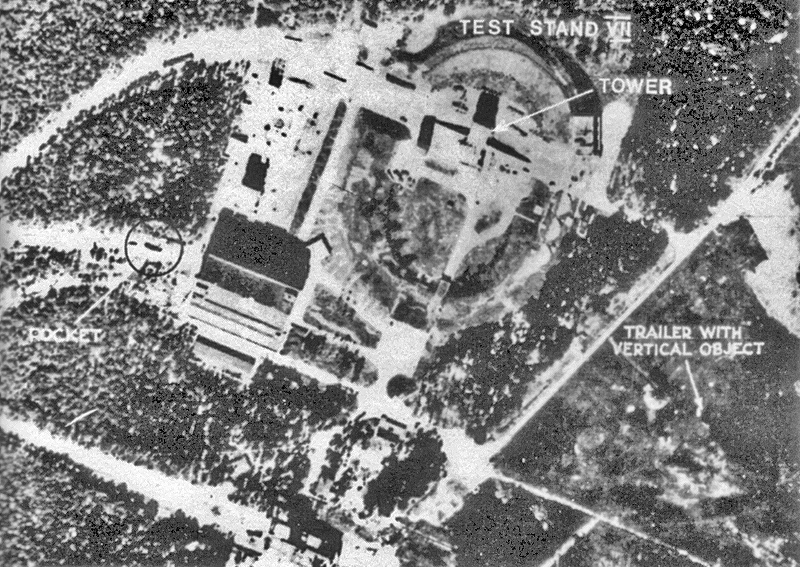
Photo: British Sortie N/853[2] by Flight Lieutenant R. A. Lenton and Sergeant R. S. Haney[3] took this photograph of Peenemünde, which shows 'a thick vertical column about 40 feet high' southeast of the 'buttresses': Flight Lieutenant Andre' J. A. Kenny's Industrial Section[4] enlarges the photos and initially fails to identify the rocket. Over a year later on August 4, 1944, Dr. R. V. Jones obtained a private set of the June 12, 1943 Peenemünde photos from the Medmenham commander, Group Captain P. G. Stewart, the 'thick vertical columns' were measured again and confirmed as vertical rockets, and Jones identified the rocket image to Duncan Sandys.[4][5][6], Public domain, via Wikimedia Commons
The Peenemunde Army Research Center sits on the remote Baltic coast of Usedom Island in northeastern Germany, where remnants of launch pads, concrete bunkers, and testing facilities still dot the coastal landscape. This sprawling complex, covering several square kilometers, served as Nazi Germany's most advanced rocket development facility during World War II. Today, visitors can explore the preserved ruins of the V-2 rocket production facilities, including the massive concrete foundations of the test stands where the world's first operational ballistic missiles were fired. The site now houses a historical museum within the former power plant building, displaying original V-2 components and documenting the complex history of early spaceflight technology developed here. Some theorists have proposed that Wernher von Braun's rapid advancement of rocket technology at Peenemunde—achieving capabilities far beyond what contemporaries thought possible—suggests access to unconventional knowledge sources, potentially linked to esoteric influences within Nazi leadership circles. Mainstream historians and engineers, however, attribute the V-2's development to Von Braun's demonstrated technical expertise, Nazi Germany's substantial industrial resources and funding priorities, the contributions of a large team of scientists and engineers, and the exploitation of forced labor from concentration camps—factors that, while morally dark, adequately explain the program's accelerated progress without requiring alternative explanations.
Timeline
German Army establishes rocket research facility on Usedom Island
First successful V-2 rocket test launch achieves suborbital flight
Peak V-2 production using forced labor from concentration camps
Facility evacuated and partially destroyed as Allied forces advance
Peenemunde Historical Technical Museum opens to the public
What the Show Claims
- ›Von Braun's extraordinary rocket achievements at Peenemunde, far surpassing contemporary technology, imply access to exotic or possibly extraterrestrially-derived knowledgeS04E05
- ›Von Braun's SS secret-society background and belief in Aryan celestial origins connected him to otherworldly technological sourcesS04E05
- ›The rapid advancement from basic rockets to sophisticated V-2 ballistic missiles suggests non-human technological assistanceS04E05
Theorist Takes
“Von Braun learned about the myths of the superiority of the Aryan race and their rightful place in the stars and where they had come from. So it makes complete sense that Von Braun would become fascinated with space.”
From the Transcripts
“During World War II Von Braun worked as the technical director at Germany's Peenemunde Research Center, where he built rockets not for space travel but as weapons of war.”
What Archaeology Says
Archaeological investigations at Peenemunde have focused on preserving and documenting the extensive concrete infrastructure left from the wartime rocket program. Excavations have revealed the foundations of multiple test stands, assembly buildings, and the intricate rail network used to transport rockets to launch positions. The site contains well-preserved examples of Nazi-era military architecture, including reinforced bunkers and specialized facilities designed for rocket fuel storage and handling.
Historians and engineers have extensively studied the technical documentation and physical remains to understand the rapid development of ballistic missile technology at Peenemunde. The preserved V-2 components and launch equipment demonstrate the sophisticated engineering capabilities achieved by Wernher von Braun's team, built upon earlier rocket experiments and substantial state investment in the program. Research has documented how the facility utilized forced labor from nearby concentration camps, with prisoners working under horrific conditions to construct both the rockets and the infrastructure.
The scientific consensus attributes the technological achievements at Peenemunde to von Braun's exceptional engineering talent, combined with extensive German investment in rocket research dating back to the 1920s, and the systematic exploitation of captured scientists and forced laborers. The facility's innovations built upon established principles of rocket propulsion and represented an acceleration of existing technological development rather than revolutionary breakthroughs. However, some aspects of the rapid progress from experimental rockets to operational ballistic missiles continue to generate debate among historians studying wartime technological development.
Mysteries & Fun Facts
The first rocket to reach space was launched from Peenemunde in 1944, crossing the Kármán line at 100 kilometers altitude
Wernher von Braun later became the chief architect of the Apollo program that put humans on the moon
The facility produced over 3,000 V-2 rockets during the war, with more people dying in their production than from their use as weapons
Many of Peenemunde's scientists were secretly transported to the United States after the war in Operation Paperclip
Planning a Visit
The Peenemunde Historical Technical Museum is generally accessible to visitors, housed in the former power plant building with outdoor access to various concrete ruins and launch pad remnants. Guided tours are available that cover both the technical achievements and the darker historical aspects of forced labor used in rocket production. The site offers educational exhibits displaying original V-2 components, technical drawings, and historical documentation from the wartime period.
Greifswald, approximately 50 kilometers southwest
Late spring through early autumn provides the best weather for exploring the outdoor ruins and coastal location. Summer months can be crowded with German and international tourists interested in aerospace history.
Related Sites
White Sands Proving Ground
White Sands became the primary testing site for captured V-2 rockets and former Peenemunde scientists after World War II
Roswell
The Roswell incident occurred near rocket testing facilities where former Nazi scientists continued their work
Tunguska explosion site
The Tunguska event represents another mysterious technological phenomenon that some theorists link to advanced propulsion experiments