Barringer Crater (Meteor Crater)
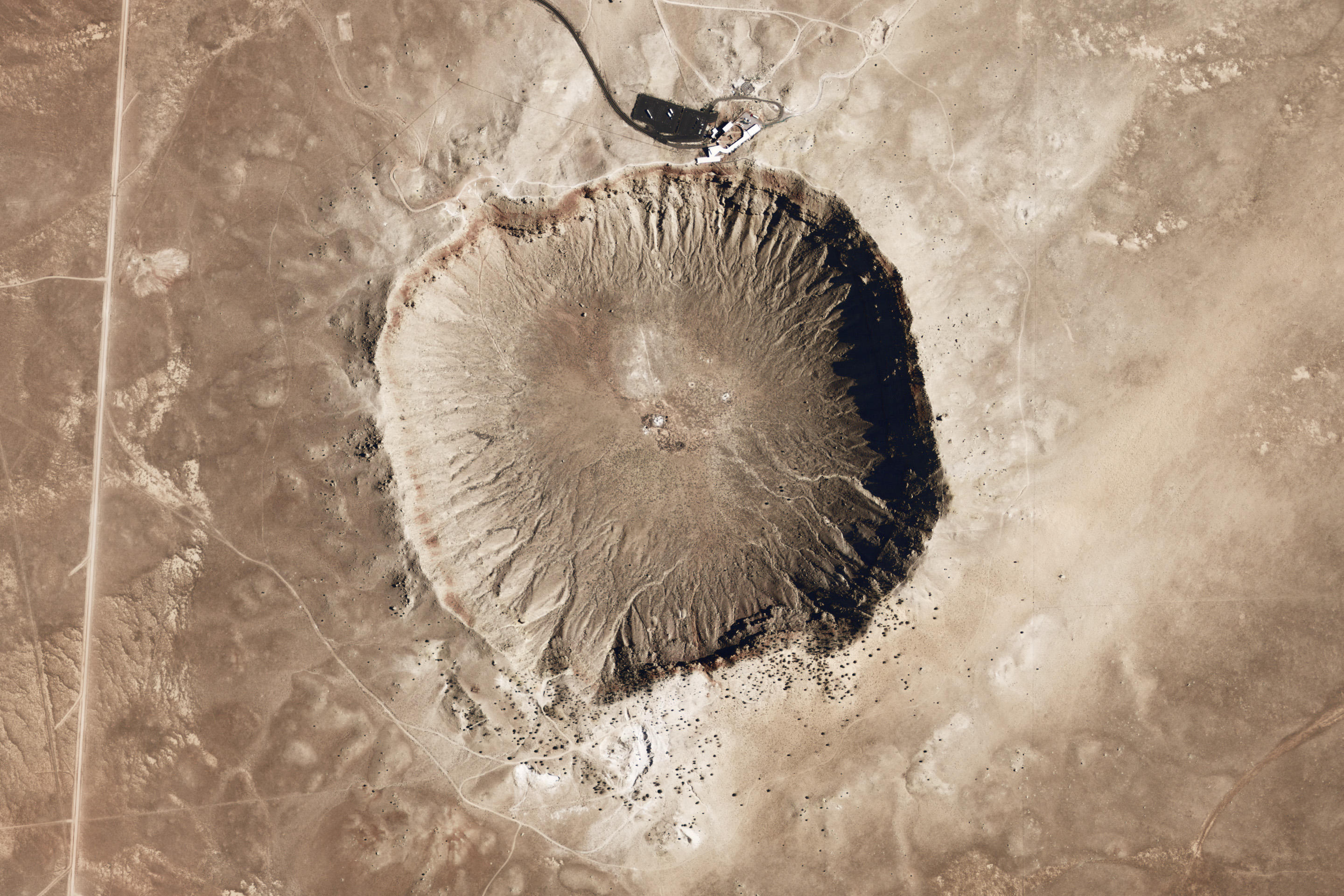
Photo: National Map Seamless Server, Public domain, via Wikimedia Commons
The Barringer Crater, also known as Meteor Crater, stands as one of Earth's best-preserved meteorite impact craters in the high desert of northern Arizona. This remarkable circular depression measures approximately 1,200 meters across and plunges 170 meters deep, with raised rim walls that tower 45 meters above the surrounding plain. Created roughly 50,000 years ago when an iron-nickel meteorite estimated at 50 meters in diameter struck the Earth at tremendous velocity, the crater represents a rare window into the violent forces that have shaped our planet. Today, visitors can walk along the rim trail and peer into this ancient scar, witnessing firsthand the raw power of celestial impacts that continue to fascinate scientists and ancient astronaut theorists alike.
Timeline
Iron-nickel meteorite impact creates the crater
First scientific investigation by Grove Karl Gilbert
Daniel Barringer begins mining operations, convinced the crater contains a massive iron meteorite
NASA astronauts train at the crater for lunar missions
Site designated as a National Natural Landmark
What the Show Claims
- ›Meteorite impacts could serve as delivery systems for extraterrestrial materials or organisms, essentially terraforming environments through cosmic bombardmentS13E12
- ›The preserved nature of Barringer Crater demonstrates how such impacts might have brought alien technology or biological material to Earth in ancient timesS13E12
- ›Ancient astronaut theorists point to impact craters as potential landing sites or markers left by visiting extraterrestrial civilizationsS13E12
From the Transcripts
“Le crat?re Barringer fait 1 200 m de diam?tre et environ 170 m de profondeur.”
What Archaeology Says
While the Barringer Crater predates human habitation in the region, archaeological investigations have revealed fascinating insights into both the impact event and subsequent human interaction with the site. Scientific drilling and excavation efforts throughout the 20th century, led by researchers including Daniel Barringer and later Eugene Shoemaker, uncovered shocked quartz, meteorite fragments, and other evidence confirming the cosmic origin of this remarkable formation.
The crater's exceptional preservation in Arizona's arid climate has made it an invaluable laboratory for understanding impact mechanics and planetary geology. Unlike many ancient impact sites that have been eroded or obscured over millions of years, Barringer Crater retains its original bowl shape and raised rim structure. Scientists estimate that the original meteorite weighed approximately 300,000 tons and was traveling at roughly 12 kilometers per second when it struck.
Modern research continues to unlock secrets about the impact event, with studies of microscopic diamonds and other high-pressure minerals formed during the collision. The site has served as an analog for understanding impact craters throughout the solar system, including those on the Moon and Mars. What remains genuinely intriguing to researchers is the precise trajectory and composition of the original meteorite, as most of the impactor was vaporized upon impact, leaving behind only scattered fragments and the dramatic scar in the landscape.
The crater's role in NASA's Apollo training program adds another layer of scientific significance, as astronauts practiced lunar geology techniques in this terrestrial impact site before venturing to study similar features on the Moon.
Mysteries & Fun Facts
The crater is so well-preserved that NASA astronauts trained here for lunar missions, practicing techniques they would later use to study impact craters on the Moon
Daniel Barringer spent 27 years and a fortune trying to mine what he believed was a massive buried meteorite, not realizing it had largely vaporized upon impact
The impact energy released was equivalent to approximately 150 times the atomic bomb dropped on Hiroshima
Tiny diamonds found in the crater were formed by the extreme pressure and temperature of the meteorite impact
Planning a Visit
The Barringer Crater is accessible to visitors year-round through a privately-operated visitor center and museum located on the rim. Guided rim trail walks offer spectacular views into the crater, while the interactive museum provides detailed explanations of impact science and meteorite research.
Flagstaff, Arizona, approximately 60 kilometers to the west.
Spring and fall offer the most comfortable weather conditions, with mild temperatures ideal for rim trail hiking. Summer visits are possible but can be extremely hot, while winter occasionally brings snow to the high desert location.
Related Sites
Tunguska explosion site
Another location where celestial impacts have sparked theories about extraterrestrial visitation and cosmic intervention in Earth's history
Allen Hills, Antarctica (ALH 84001 meteorite find site)
Site where controversial meteorite evidence of ancient Martian life was discovered, connecting meteorites to the possibility of life beyond Earth
Wolfe Creek Crater (Kandimalal)
Australia's famous meteorite crater that, like Barringer, demonstrates the power of cosmic impacts and their potential role in ancient astronaut theories