Marquesas Islands
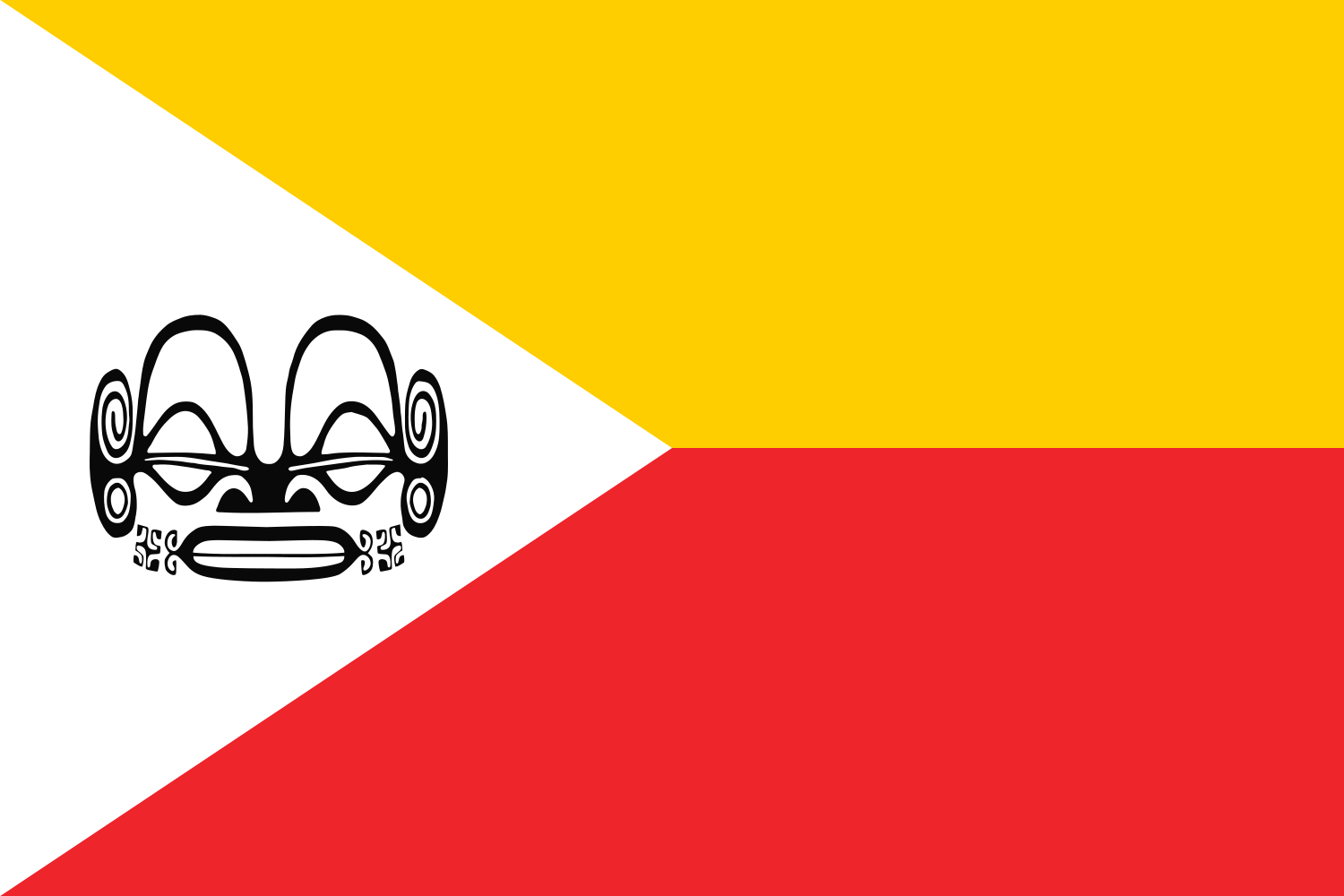
Photo: Background: Association MOTU HAKA Tiki's head: Association PATUTIKI Vectorization: Sémhur, Public domain, via Wikimedia Commons
The Marquesas Islands are a group of volcanic islands in French Polynesia, rising dramatically from the Pacific Ocean with their highest peak, Mount Oave on Ua Pou island, reaching 1,230 meters (4,035 feet) above sea level. This remote archipelago consists of fourteen islands, six of which are inhabited, scattered across approximately 1,274 square kilometers of land. Archaeological evidence suggests these islands were settled around the 10th century AD by Polynesian voyagers, making them one of the earliest stepping stones in humanity's remarkable expansion across the Pacific. The islands are renowned for their distinctive tiki sculptures and petroglyphs, which display the characteristic goggle-eyed figures that have captured the attention of ancient astronaut theorists. Today, visitors encounter a landscape of steep volcanic ridges, lush valleys, and ancient ceremonial sites that speak to a sophisticated Polynesian culture.
Timeline
Initial Polynesian settlement of the Marquesas Islands by voyagers from West Polynesia
Spanish navigator Álvaro de Mendaña becomes first European to visit, naming the islands after the Marquis of Cañete
Census records population at 9,346 inhabitants across the inhabited islands
What the Show Claims
- ›The Marquesas Islands are the ancestral homeland indicated by the seven seaward-facing moai at Ahu Akivi on Easter IslandS13E10S14E12
- ›The goggle-eyed tiki figures found throughout the Marquesas depict actual extraterrestrial visitors who also appeared on Easter IslandS13E10S14E12
- ›The islands served as a launching point for ancient astronauts traveling between different Pacific island civilizationsS14E12
Theorist Takes
“I think it's really fascinating that, in the Marquesas, there's a story of seven brothers that were exiled by their father in order to go to Easter Island.”
From the Transcripts
“Following it on a northwesterly route, the first landmass in its path is the Marquesas Islands, roughly 2,300 miles from Easter Island.”
What Archaeology Says
Archaeological research has revealed that the Marquesas Islands were settled by Polynesian voyagers around the 10th century AD, representing one of the earliest phases of eastward Pacific expansion. Excavations across the islands have uncovered sophisticated stone platforms called tohua, elaborate petroglyphs, and the famous tiki sculptures that display the distinctive goggle-eyed appearance. These archaeological findings demonstrate a remarkably uniform culture that developed and maintained consistency across the archipelago for over a millennium.
The islands' archaeological record shows clear evidence of their role as a major dispersal point for further Polynesian expansion. Researchers have traced cultural and genetic connections between the Marquesas and later settlements in Hawaii, Easter Island, and other Pacific destinations. The similarity between Marquesan tiki figures and Easter Island's moai has been noted by archaeologists, though mainstream research attributes these parallels to shared Polynesian cultural traditions rather than extraterrestrial influence.
What remains genuinely intriguing is the remarkable navigational achievement represented by the initial settlement of these remote islands. The Polynesian voyagers who first reached the Marquesas accomplished one of humanity's greatest maritime feats, crossing thousands of miles of open ocean using traditional sailing techniques and celestial navigation. While the methods of this extraordinary expansion are well-documented ethnographically, the precise timing and routes of early Pacific settlement continue to be refined through ongoing archaeological and genetic research.
Mysteries & Fun Facts
The Marquesas maintain two distinct dialects of the Marquesan language: Te Henua 'Enana in the north and Te Fenua 'Enata in the south, both meaning 'the land of men'
Mount Oave on Ua Pou island is the highest point in the archipelago at 1,230 meters above sea level
The islands have maintained what researchers describe as a 'remarkably uniform culture, biology and language' for over a thousand years
The population of the entire Marquesas archipelago was recorded at just 9,346 inhabitants in the 2017 census
Planning a Visit
The Marquesas Islands are accessible primarily through flights to Nuku Hiva from Tahiti, with inter-island transport available by small aircraft and cargo ships. Visitors can explore ancient archaeological sites including tiki sculptures, petroglyphs, and ceremonial platforms, though some sites require hiking through challenging volcanic terrain. The capital town of Taioha'e on Nuku Hiva serves as the main base for exploring the archipelago.
Papeete, Tahiti, approximately 1,400 kilometers southwest
The dry season from May to October offers the most pleasant weather conditions with lower humidity and reduced rainfall. This period also provides better conditions for hiking to remote archaeological sites and clearer skies for photography of the dramatic volcanic landscapes.
Related Sites
Ahu Tongariki
Easter Island's Ahu Tongariki represents the destination of Polynesian voyagers who likely originated from the Marquesas, sharing cultural and sculptural traditions
Pohnpei (Sokehs Rock)
Pohnpei's ancient stone structures demonstrate the sophisticated building capabilities of Pacific island civilizations that may have shared common Polynesian roots
Stone Spheres of Costa Rica
Costa Rica's stone spheres represent another Pacific Rim mystery involving precisely carved stone objects, suggesting possible ancient transpacific connections
Featured In2 episodes
Historical data sourced from Wikipedia