Peenemünde Army Research Center, Germany
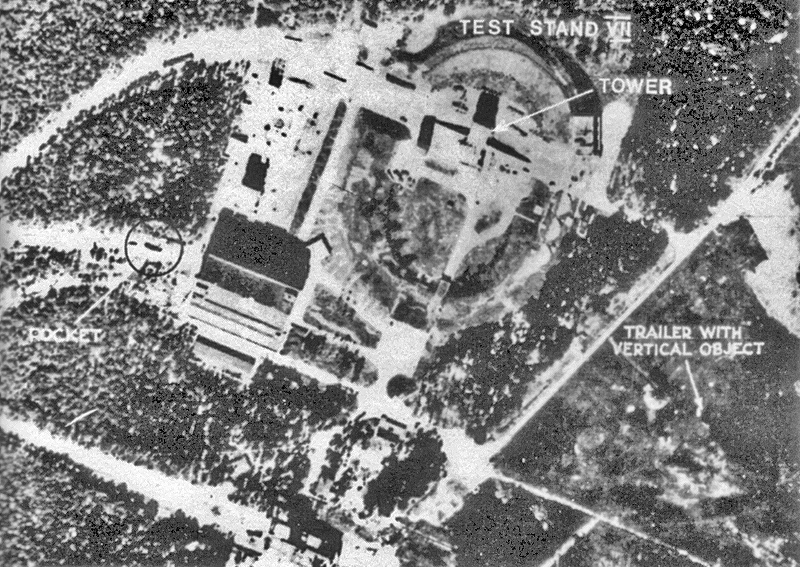
Photo: British Sortie N/853[2] by Flight Lieutenant R. A. Lenton and Sergeant R. S. Haney[3] took this photograph of Peenemünde, which shows 'a thick vertical column about 40 feet high' southeast of the 'buttresses': Flight Lieutenant Andre' J. A. Kenny's Industrial Section[4] enlarges the photos and initially fails to identify the rocket. Over a year later on August 4, 1944, Dr. R. V. Jones obtained a private set of the June 12, 1943 Peenemünde photos from the Medmenham commander, Group Captain P. G. Stewart, the 'thick vertical columns' were measured again and confirmed as vertical rockets, and Jones identified the rocket image to Duncan Sandys.[4][5][6], Public domain, via Wikimedia Commons
The Peenemünde Army Research Center, established in 1937 on the remote Baltic island of Usedom, served as Nazi Germany's most secretive rocket development facility. The complex covered approximately 25 square kilometers of coastal terrain, housing wind tunnels, test stands, assembly halls, and residential areas for thousands of scientists and technicians. Today, visitors can explore the preserved Historical Technical Museum within the former power plant building, which stands as a stark reminder of humanity's first steps toward space exploration. The site's isolated location on Germany's northeastern coast made it ideal for clandestine weapons testing, while its proximity to the sea allowed for launches over water. Ancient astronaut theorists suggest that heavily annotated copies of Russian cosmist Konstantin Tsiolkovsky's writings discovered at Peenemünde point to an extraterrestrial lineage of knowledge influencing von Braun's rocket development. Mainstream historians and archivists document von Braun's genuine intellectual engagement with Tsiolkovsky's pioneering theoretical work on space travel, which was openly published and widely studied by rocket scientists across multiple nations during the early 20th century. The V-2 program's rapid advancement is well-documented through conventional engineering progress, materials testing, and the talent von Braun assembled—making Peenemünde's historical records a window into how human innovation built the foundation for the space age.
Timeline
German Army establishes the Peenemünde Army Research Center under the direction of Walter Dornberger
First successful V-2 rocket test launch achieves suborbital flight, marking the birth of the space age
Allied intelligence discovers the facility, leading to Operation Crossbow bombing raids
Soviet forces capture the facility and recover remaining rocket technology and documentation
Peenemünde Historical Technical Museum opens to preserve the site's complex legacy
What the Show Claims
- ›The discovery of Tsiolkovsky's writings heavily annotated by Wernher von Braun at Peenemünde reveals a chain of cosmist, extraterrestrially-inspired knowledge passed down through rocket scientists to bring humanity back to the starsS11E05
Theorist Takes
“Wernher von Braun was heavily influenced by Tsiolkovsky. Tsiolkovsky himself had this concept of human beings being birthed in the stars. And if you really think about it, could it be that these scientists coming out of Russia had some kind of advanced knowledge?”
From the Transcripts
“His work in rocketry was so important that the Soviets scoured his former headquarters at Peenemunde Army Research Center in search of any information he may have left behind. What they discovered were the writings of Konstantin Tsiolkovsky and found that almost every page was embellished by von Braun's comments and notes.”
What Archaeology Says
Unlike traditional archaeological sites, Peenemünde presents a unique case of industrial archaeology focused on preserving and understanding mid-20th century technological development. Extensive documentation efforts by museums and historians have recovered blueprints, test data, and personal accounts that reveal the systematic progression from theoretical rocketry to practical space-capable vehicles. The facility's layout, with its massive concrete test stands and underground bunkers, demonstrates the scale of ambition behind the world's first operational ballistic missile program.
Key research has focused on understanding the intellectual networks that connected early rocket pioneers like Konstantin Tsiolkovsky, Hermann Oberth, and Robert Goddard to the Peenemünde team. Scholars have documented how theoretical works on spaceflight, some dating back decades, directly influenced the engineering decisions made at the facility. The preservation of Wernher von Braun's personal library and technical notes provides insight into the knowledge transfer that occurred between generations of rocket scientists.
The scientific consensus recognizes Peenemünde as the birthplace of practical astronautics, where theoretical concepts first became operational hardware capable of reaching space. The V-2 rocket developed here became the direct ancestor of both the rockets that launched the first satellites and those that carried humans to the Moon. However, questions remain about the full extent of theoretical influences on the program, particularly regarding the philosophical motivations of key figures who saw rocketry as humanity's path to the stars.
What remains genuinely intriguing is the extent to which early cosmist and space exploration philosophies influenced the practical decisions made at Peenemünde. While the immediate military applications are well-documented, the underlying vision of space exploration that drove many of the scientists continues to be a subject of historical investigation and debate among researchers studying the intellectual origins of the space age.
Mysteries & Fun Facts
The first rocket to officially reach space was a V-2 launched from this facility in 1944, achieving an altitude of over 100 kilometers
Allied bombing raids in 1943 killed approximately 735 people at the site but failed to significantly halt rocket production
Many of Peenemünde's scientists, including von Braun, later became key figures in NASA's Apollo Moon program
The facility's wind tunnels could simulate conditions for aircraft traveling at speeds up to Mach 4.4
Planning a Visit
The Peenemünde Historical Technical Museum is generally accessible to visitors year-round, offering guided tours of the preserved facilities and extensive exhibits on rocket development history. The museum occupies the former power plant building and features original V-2 rocket components, technical documentation, and interactive displays. Visitors should check current operating hours and tour availability through local tourism websites, as schedules may vary seasonally.
Berlin, approximately 250 kilometers southeast
Late spring through early autumn offers the most pleasant weather conditions for exploring both the museum and the outdoor historical sites scattered across the former facility. Summer months provide the longest daylight hours for experiencing the full scope of this sprawling historical complex.
Related Sites
White Sands Proving Ground
White Sands became the primary American testing ground for captured V-2 rockets and the technology developed by former Peenemünde scientists
Tunguska explosion site
The Tunguska event represents another moment when humanity encountered advanced propulsion phenomena that challenged conventional understanding
Royal Society, London
The Royal Society served as an early institution where theoretical space exploration concepts were first seriously discussed by scientists