Mount Erebus, Ross Island, Antarctica
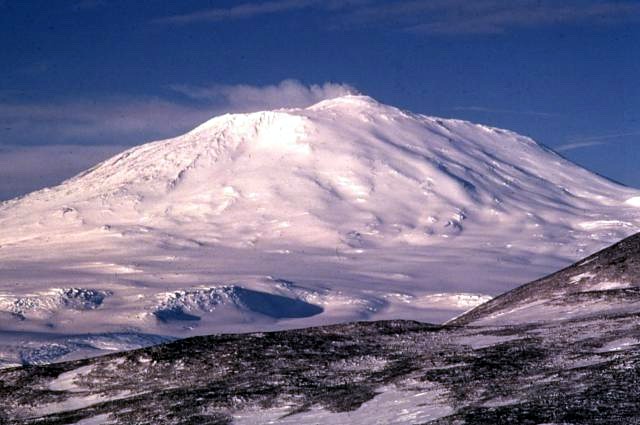
Photo: Richard Waitt, U.S. Geological Survey, Public domain, via Wikimedia Commons
Mount Erebus stands as Antarctica's most accessible active volcano and the world's southernmost volcanic peak, rising 3,794 meters above Ross Island in McMurdo Sound. The volcano features a persistent lava lake within its summit crater, one of only a handful of such formations worldwide. Scientists have confirmed extensive cave systems beneath the surrounding glacial ice, created by the volcano's geothermal activity and reaching temperatures up to 22°C (72°F). These thermally heated caverns represent some of the most hospitable environments on the continent, supporting unique microbial ecosystems in an otherwise frozen landscape. Ancient astronaut theorists have proposed that these geothermally heated caverns could function as concealed extraterrestrial bases, citing the caves' Earth-like conditions as evidence of their suitability for sustaining life. However, scientists attribute the caves' formation and warmth entirely to Mount Erebus's volcanic geology—a well-understood geological process where magma beneath the surface melts surrounding ice, creating these thermal refuges for microbial life rather than serving any otherworldly purpose. The cave systems remain scientifically significant primarily for what they reveal about extremophile ecosystems and the volcano's ongoing geothermal activity.
Timeline
Mount Erebus discovered and named by Captain James Clark Ross during British Antarctic expedition
First successful ascent achieved by members of Ernest Shackleton's Nimrod Expedition
Establishment of permanent monitoring stations to study volcanic activity and atmospheric conditions
Australian National University scientists confirm extensive geothermally heated cave systems beneath glacial ice
What the Show Claims
- ›Vast thermally heated ice caverns near Mount Erebus could serve as ready-made hidden bases for extraterrestrials, with temperatures warm enough to sustain lifeS14E01
Theorist Takes
“Here we have a huge, apparently, underground world beneath Antarctica. And this could be used by extraterrestrials as these ready-made bases that are underground and are hidden.”
From the Transcripts
“Mount Erebus. Ross Island, Antarctica. 2017. Researchers from the Australian National University discover the existence of vast ice caverns directly adjacent to this active volcano.”
What Archaeology Says
While Mount Erebus itself predates human presence in Antarctica, the volcanic system has become a focus of intense scientific study due to its unique geological characteristics. The Australian National University's 2017 research revealed cave networks extending beneath the Ross Ice Shelf, formed by volcanic heat and steam vents. These discoveries have transformed understanding of potential habitable zones in extreme polar environments.
Researchers have documented that the geothermal cave systems maintain temperatures significantly above freezing, creating microenvironments that could theoretically support life forms. The volcanic activity continuously shapes these underground chambers, with some caverns believed to be large enough to house substantial spaces. DNA sampling within these caves has revealed diverse microbial communities thriving in the warm, humid conditions.
The scientific consensus views these formations as natural results of ongoing volcanic processes interacting with the ice sheet. However, the caves' consistent temperatures and protected environments have sparked discussions about their potential as natural shelters or research facilities. What remains genuinely unknown is the full extent of these cave systems and whether similar formations exist beneath other Antarctic volcanic sites.
The unique combination of accessibility, volcanic activity, and ice-cave formation makes Mount Erebus a natural laboratory for studying extremophile organisms and testing theories about life in harsh environments. Ongoing monitoring continues to reveal new aspects of this remarkable geological system.
Mysteries & Fun Facts
Mount Erebus contains one of only five permanent lava lakes on Earth, continuously active for over 100 years
The volcano's summit crater reaches temperatures of over 1000°C while surrounded by ice and snow year-round
Unique volcanic glass bombs called 'Erebus crystals' are ejected from the lava lake and can be found scattered on surrounding glaciers
The mountain serves as a natural atmospheric laboratory, with researchers studying how volcanic emissions interact with the polar atmosphere
Planning a Visit
Access to Mount Erebus is extremely limited and requires specialized Antarctic expedition arrangements through approved tour operators or research programs. Most visitors reach the area via flights to McMurdo Station, followed by helicopter transport to the volcano base. Climbing permits and extensive cold-weather gear are mandatory for any approach to the summit area.
Christchurch, New Zealand, approximately 3,800 kilometers away, serves as the primary departure point for Antarctic expeditions.
The Antarctic summer season from November to February offers the only viable window for visits, with nearly continuous daylight and relatively milder temperatures. Weather conditions remain extreme and can change rapidly, requiring flexible scheduling.
Related Sites
Allen Hills, Antarctica (ALH 84001 meteorite find site)
Another Antarctic location featured on Ancient Aliens where extraterrestrial theories intersect with extreme geological formations
Tunguska explosion site
Remote impact site that ancient astronaut theorists connect to unexplained phenomena in isolated regions
Wolfe Creek Crater (Kandimalal)
Massive crater formation in an isolated location that has attracted similar theories about hidden or unusual geological features