Adam's Bridge (Rama's Bridge), Palk Strait
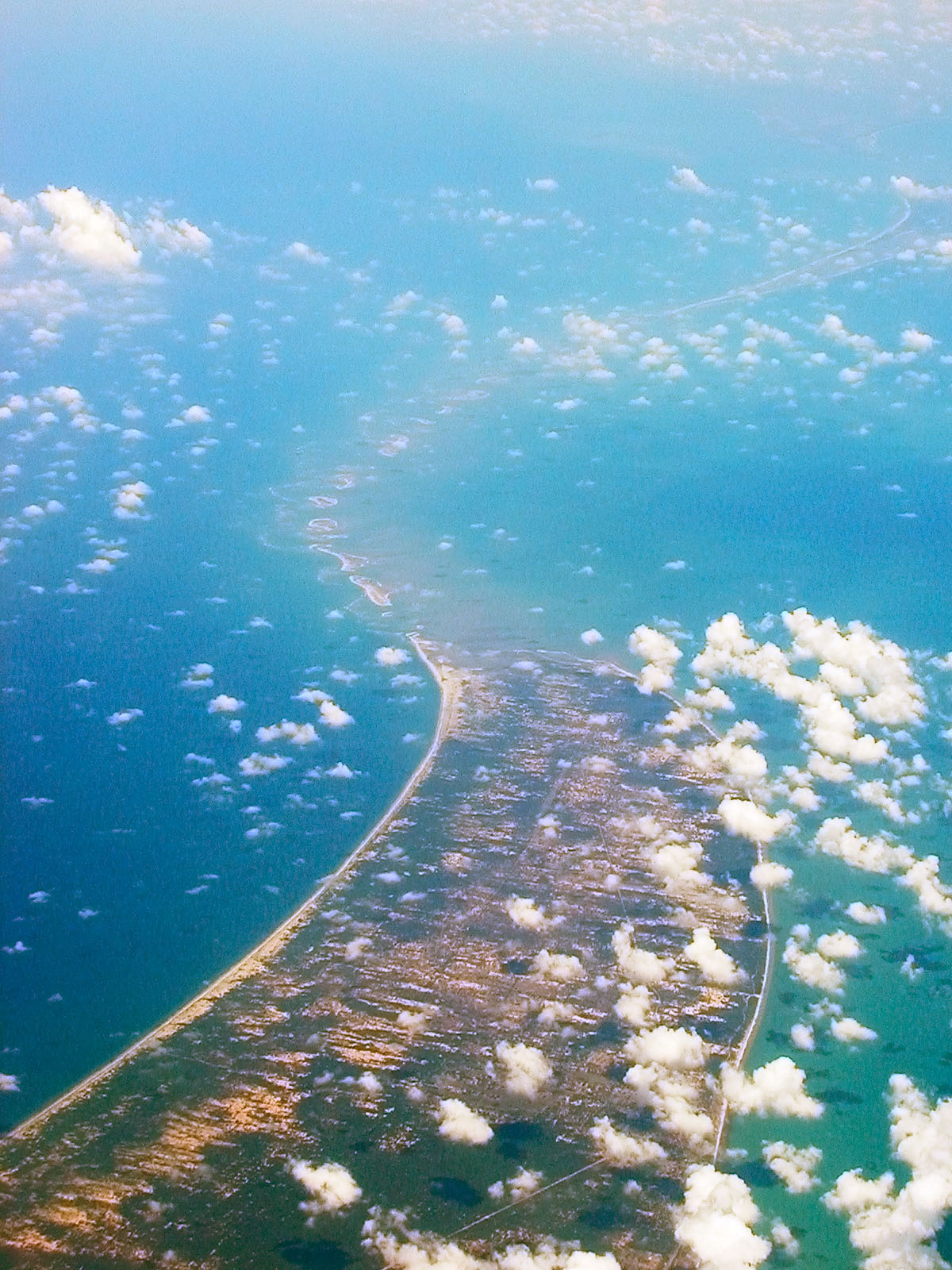
Photo: This Image was created by User:PlaneMad. If you are using the image under the creative commons share alike license please credit the photo CC-by-sa PlaneMad/Wikimedia and include a link to this page. No explicit permission is needed from me, but id appreciate an email if my work has been of help to you. If you dont want to release your work under a creative commons license, please mail me at arun.planemad@gmail.com or catch me at my Website to negotiate a custom license as per your needs., CC BY-SA 2.5, via Wikimedia Commons
Adam's Bridge, known in Hindu tradition as Rama Setu, stretches approximately 30 miles (50 kilometers) across the shallow waters of Palk Strait between Pamban Island in India and Mannar Island in Sri Lanka. This remarkable chain of limestone shoals, coral reefs, and sandstone formations creates an almost continuous pathway across the narrow strait, with water depths rarely exceeding 3 feet in many sections. The bridge-like formation has captured imaginations for millennia, featuring prominently in the ancient Sanskrit epic Ramayana as a supernatural causeway built by an army of monkeys to help Lord Rama rescue Sita from Lanka. Today, visitors can observe portions of the formation from both the Indian and Sri Lankan sides, where the shallow waters reveal the underlying rocky structure that has sparked both geological study and mythological wonder. Some theorists have proposed that the bridge's remarkable regularity and extent suggest artificial construction using advanced technology, possibly of extraterrestrial origin, pointing to satellite imagery of the 30-mile formation as evidence of intentional engineering rather than natural processes. However, geological surveys and carbon dating studies indicate the structure is consistent with natural limestone shoal formation, with the underlying bedrock being significantly older than any potential human construction period. The debate between natural geological processes and the Ramayana's account of divine construction continues to intrigue researchers and enthusiasts alike.
Timeline
Composition of the Ramayana epic describing a bridge built by Rama's army to reach Lanka
Ibn Battuta and other medieval travelers document the shallow crossing between India and Sri Lanka
NASA satellite imagery brings global attention to the linear formation visible from space
Indian government halts shipping canal project following protests citing religious and environmental concerns
What the Show Claims
- ›Satellite imagery reveals a 30-mile-long chain of rocks connecting India to Sri Lanka, matching the Ramayana's description of Rama's supernatural bridgeS16E07
- ›The formation was constructed using levitating stones and advanced technology of extraterrestrial originS16E07
- ›The precise alignment and construction suggests capabilities beyond ancient human engineeringS16E07
Theorist Takes
“Rama's bridge to Sri Lanka is real. And you have to ask yourself, was it built artificially, uh, by levitating stones and putting them there? That's what the Ramayana tells us.”
From the Transcripts
“modern satellite imagery has revealed a 30-mile-long barrier of rocks and sand that, in fact, connects the southern tip of India to Sri Lanka.”
What Archaeology Says
Geological surveys conducted by the Archaeological Survey of India and Sri Lankan authorities have extensively studied the formation's composition and origins. Core samples reveal that Adam's Bridge consists primarily of limestone, coral fragments, and sandstone deposits typical of natural shoal formations in tropical marine environments. The underlying bedrock geology dates back millions of years, while surface materials have been carbon dated to periods spanning several millennia.
Marine geologists generally classify the formation as a natural tombolo—a type of sandbar that connects an island to the mainland or another island. The consistent northeast monsoon patterns, longshore drift currents, and sediment deposits from both the Indian and Sri Lankan coastlines provide a scientifically plausible explanation for the bridge-like appearance. Research teams have documented similar natural formations in other parts of the world where specific oceanographic conditions prevail.
Despite scientific consensus on its natural origins, the formation's remarkable linearity and the shallow depths that would have made ancient crossing feasible continue to intrigue researchers. Some studies suggest that sea levels in the region may have been lower in ancient times, potentially making the crossing even more accessible. The correlation between the geological reality and the detailed descriptions in ancient texts remains a subject of ongoing scholarly discussion.
What remains genuinely intriguing is the precision with which ancient texts describe a formation that matches the actual geographical features observable today. Whether this represents accurate historical memory, coincidental geography, or something else entirely continues to fuel both scientific inquiry and popular fascination with this unique natural landmark.
Mysteries & Fun Facts
The formation is sometimes called "Adam's Bridge" in Islamic and Christian traditions, referring to the biblical Adam's crossing from Sri Lanka to India
NASA's satellite imagery from 2002 sparked renewed global interest in the formation, showing its linear structure clearly from space
Water depths across much of the formation remain shallow enough that people could theoretically wade across during low tide in many sections
The 2004 Indian Ocean tsunami temporarily exposed more of the underlying rock structure as water levels receded
Planning a Visit
The formation can be viewed from Dhanushkodi at the southern tip of Pamban Island in Tamil Nadu, India, and from various points along the northern coast of Mannar Island in Sri Lanka. Boat tours from both sides offer closer views of the shoals, though visitors should verify current accessibility due to varying water levels and international border considerations.
Rameswaram, India (approximately 12 miles) and Mannar, Sri Lanka (approximately 15 miles)
The dry season from December to March offers the clearest views and calmest seas for boat excursions. During low tide periods, more of the underlying rock formations become visible above water.
Related Sites
Sigiriya
Another remarkable ancient site in Sri Lanka that demonstrates sophisticated engineering capabilities
Harappa
Represents the advanced Indus Valley civilization that flourished in the same broader South Asian region
Kailasa Temple
Carved temple complex in India that showcases the remarkable stone-working abilities attributed to ancient builders